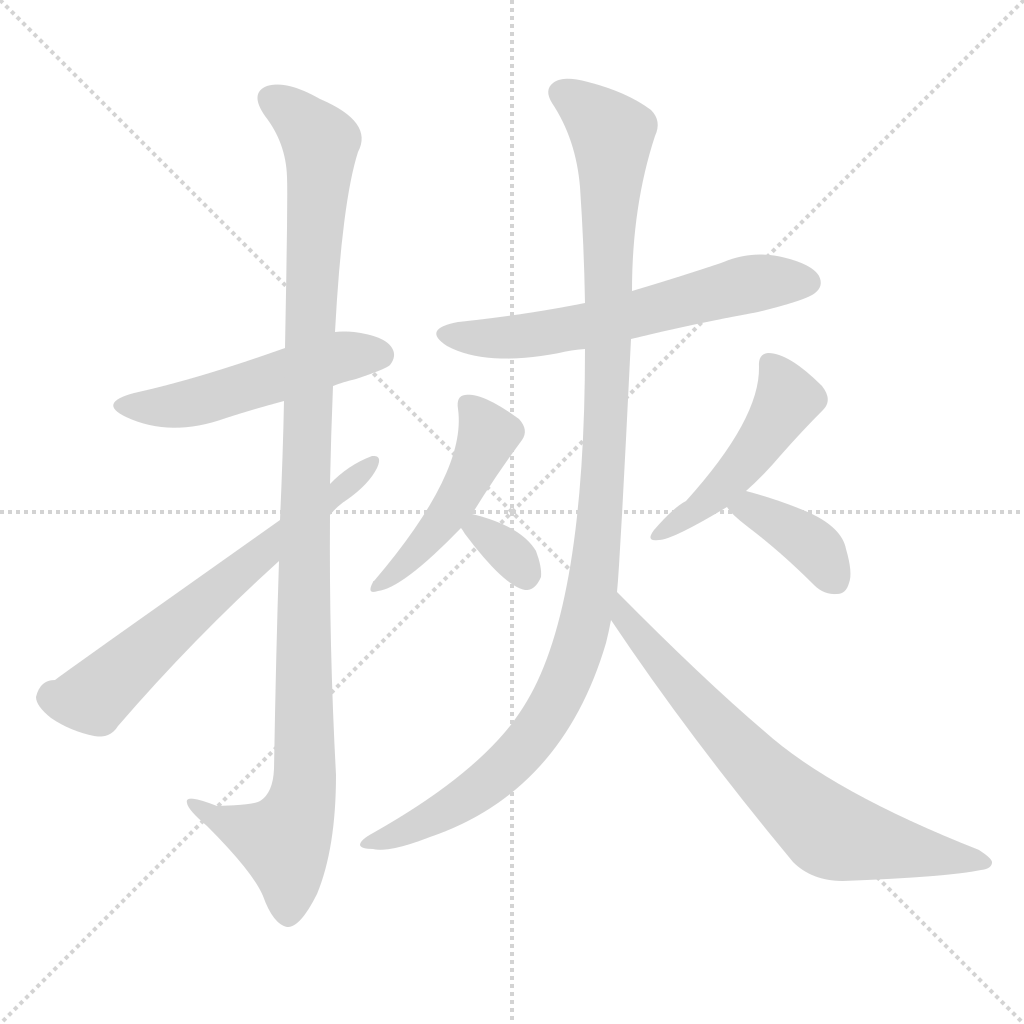
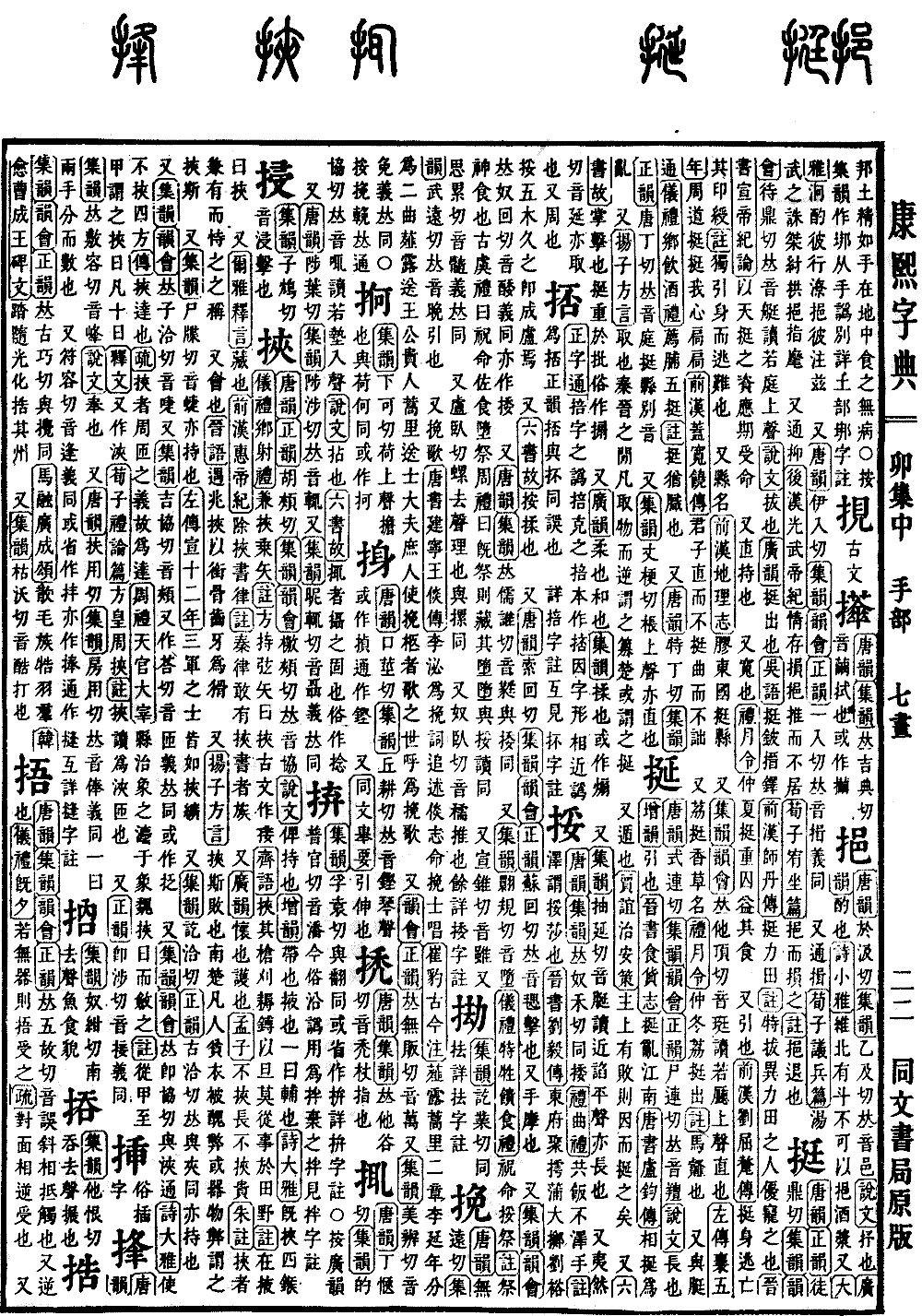
Mao Collection, Middle Volume
Radical: Hand (shǒu)
Kangxi Strokes: 11
Page 432, Entry 16
Tang Yun (Tang Dynasty rhyme dictionary) and Zheng Yun (Orthodox rhyme dictionary) provide the pronunciation xie (rising tone). Jiyun (Compilation of rhymes) and Yunhui (Collection of rhymes) provide the pronunciation xie (rising tone). The sound is xie (rising tone).
Shuowen Jiezi (Explaining graphs and analyzing characters): To hold.
Zeng Yun (Expanded rhyme dictionary): To carry, to hold under the arm. Another meaning is to assist.
Book of Odes (Shijing), Greater Odes: Already holding four arrows.
Book of Etiquette and Ceremonial (Yili), Rural Archery Rites: Holding multiple arrows simultaneously.
Annotation: Holding the bowstring and arrow is called xie. The archaic form is written as jie.
Discourses of the States (Guoyu), Discourses of Qi: Carrying their spears, sickles, and hoes, working in the fields from morning until evening.
Annotation: To hold under the arm is called xie.
Erya (Approaching refinements), Explanation of Words: To store.
History of the Former Han (Hanshu), Annals of Emperor Hui: Abolished the law against holding books.
Annotation: Under the Qin laws, those who dared to hold books were punished by clan extermination.
Guangyun (Broad rhyme dictionary): To cherish, to protect.
Mencius: Do not rely on seniority, do not rely on high status.
Zhu Xi's Annotation: The term xie refers to both possessing something and relying upon it.
To meet or gather.
Discourses of the States (Guoyu), Discourses of Jin: Encountering the oracle, holding the bone in the mouth, the teeth becoming a source of disorder.
Yang Xiong's Dialects (Fangyan): Xie-si means to be ruined. In southern Chu, when commoners are poor, their clothing or utensils are worn out, they call it xie-si.
Jiyun: Pronounced die (falling tone). Also means to hold.
Zuo Tradition (Zuozhuan), Twelfth Year of Duke Xuan: The soldiers of the three armies were all as if holding silk wadding.
Jiyun and Zheng Yun: Pronounced jia (entering tone), same as the character for clamp. Also means to hold.
Jiyun and Yunhui: Pronounced die (entering tone).
Jiyun: Pronounced jia (entering tone).
Also pronounced za (entering tone). The meaning is the same. Sometimes written as the character for hold.
Jiyun and Yunhui: Pronounced jie (entering tone). Interchangeable with the character for encompass.
Book of Odes (Shijing), Greater Odes: To not encompass the four directions.
Commentary: Xie means to reach.
Sub-commentary: Xie carries the meaning of surrounding or completing a circuit, therefore it means to reach.
Rites of Zhou (Zhouli), Offices of Heaven, Grand Administrator: Display the laws regarding governance at the Xiangwei gate, collect them after ten days.
Annotation: From one jia day to the next jia day is called xie-ri, totaling ten days.
Explanation of Texts: Also written as the character for encompass.
Xunzi, Discussion of Rites: To traverse and encompass.
Annotation: Xie is read as encompass. It means a full circle.
Zheng Yun: Pronounced jie (entering tone). The meaning is the same.