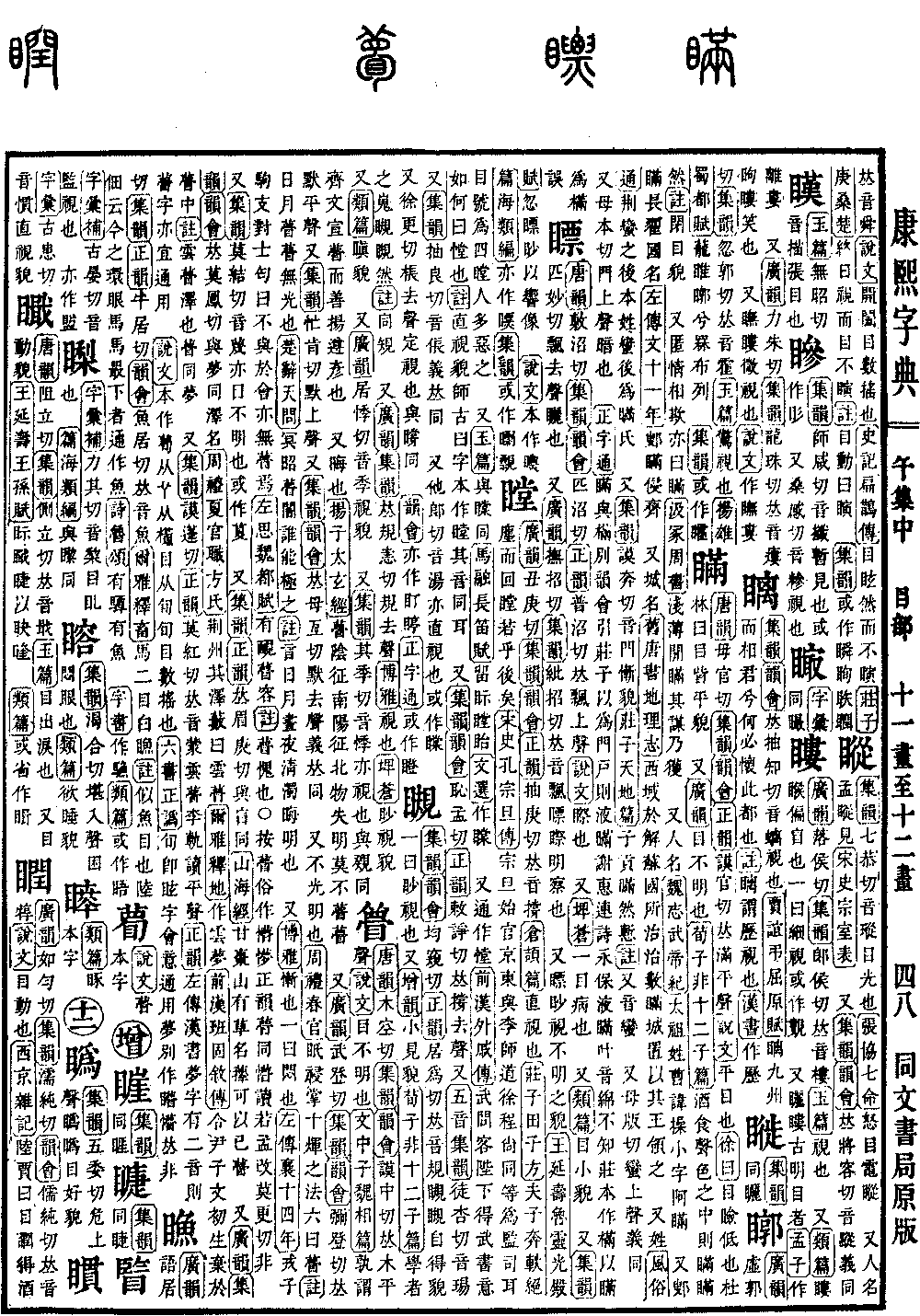
Wu Collection, Middle Volume
Radical: Eye (mù)
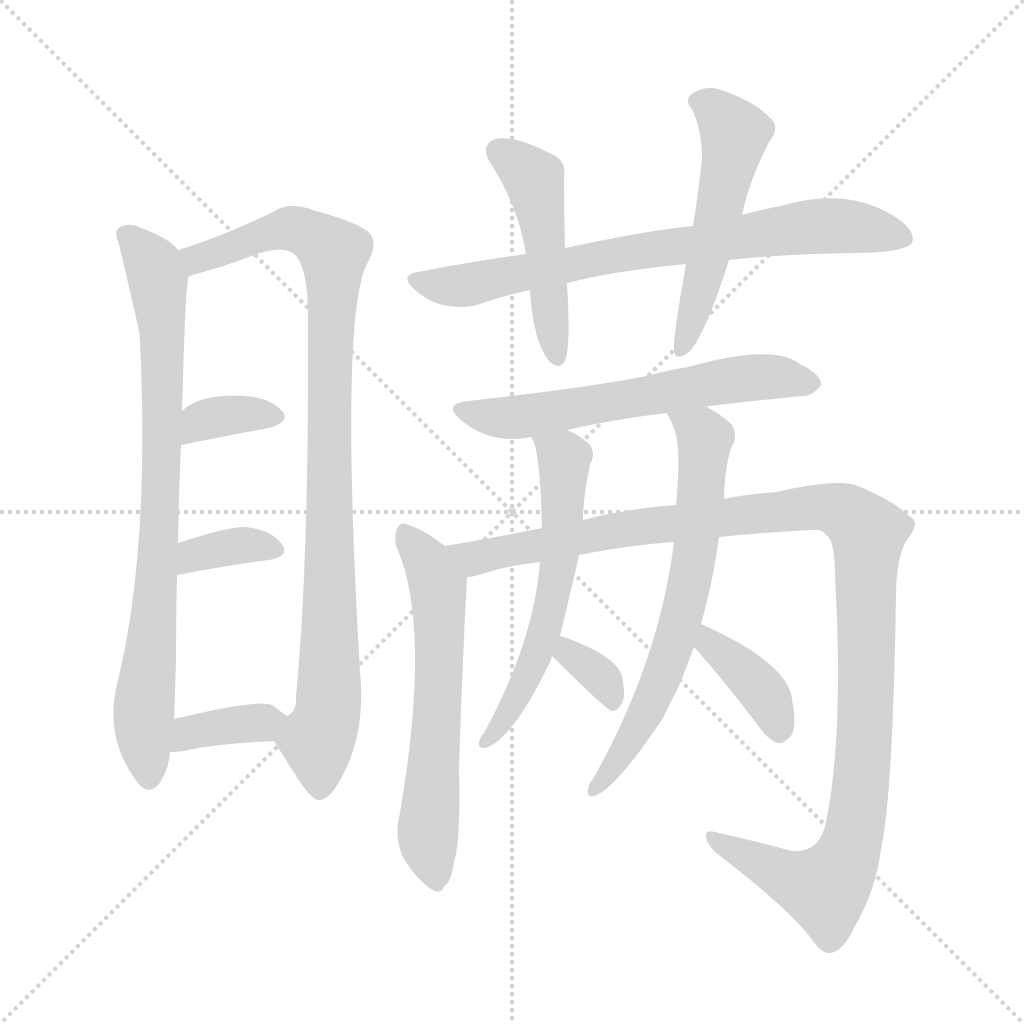
瞞
Kangxi Strokes: 16
Page 816, Entry 04
Tangyun: Pronounced man (level tone)
Jiyun, Yunhui, Zhengyun: Pronounced man (level tone)
Shuowen Jiezi (Shuowen): To level the eyes. Xu says: Eyelids drooping. Du Lin says: The appearance of the corners of the eyes being level.
Also, Guangyun: Eyes seeing unclearly.
Xunzi, Non-Twelve Masters Chapter: Being in the midst of wine, food, sound, and color, appearing dazed and lethargic. Commentary: The appearance of eyes closed.
Also: Hiding the truth to deceive others is also called man.
Jizhu Zhoushu (Zhoushu): Shallow and prone to deception, his schemes are able to succeed.
Also: A person's name. Records of the Three Kingdoms (Sanguozhi), Annals of Emperor Wu: The Grand Ancestor was surnamed Cao, named Cao, with the childhood name Aman.
Also: Souman, the name of the Changdi state. Zuo Tradition (Zuozhuan), 11th Year of Duke Wen: The Souman people invaded the State of Qi.
Also: A city name. Old Book of Tang (Jiu Tangshu), Treatise on Geography: In the Western Regions, where the Yujiesu State governs, they governed Shouman City and established official posts to allow their king to rule.
Also: A surname. Comprehensive Record of Customs (Fengsutong): Descendants of the Jingman tribe, originally surnamed Man, later changed to the Man clan.
Also: Jiyun: Pronounced men. The appearance of being ashamed. Zhuangzi, Heaven and Earth Chapter: Zigong appeared ashamed. Commentary: Also pronounced man.
Also: Pronounced man (rising tone). The meaning is the same.
Also: Pronounced men (rising tone). Meaning dim or dark.
Zhengzitong: Man and men are different. The Yunhui cites the Zhuangzi, believing that liquid oozes from a door, and Xie Huilian's poem states: Forever preserve the liquid men. It is read as mian for rhyming, but it is incorrect to believe the original Zhuangzi text used man, as it actually used men; using man for men is a mistake.