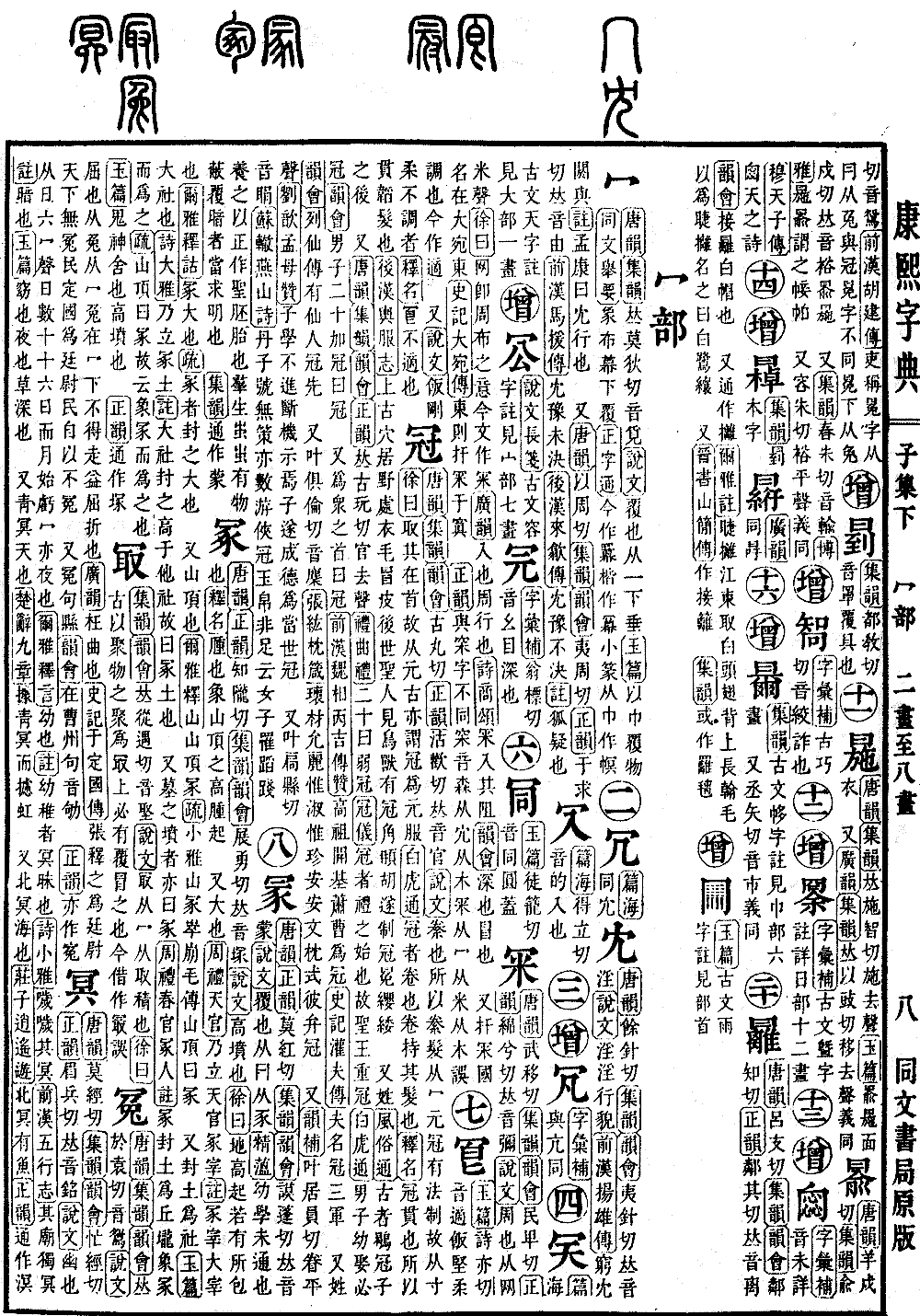
Zi Collection, Page Position: Lower
Radical: Cover (mì)
Character: zhǒng; Kangxi strokes: 13; Page: 130, entry 25
Pronunciation: zhǒng. According to the Tang Yun (Tangyun) and Zheng Yun (Zhengyun), pronounced as zhī lǒng qiè. According to the Ji Yun (Jiyun) and Yun Hui (Yunhui), pronounced as zhǎn yǒng qiè.
According to the Shuowen Jiezi (Shuowen), it means a high tomb. Xu says: The ground rises high, like something wrapped inside. According to the Shiming (Shiming), it means "swollen." It resembles the appearance of a high, rising mountaintop. It also signifies "large." In the Rites of Zhou (Zhouli), Book of Heaven Officials: "Then the Heaven Official, the Lord Administrator (zhǒngzǎi), was established." The commentary states: "The Lord Administrator (zhǒngzǎi) is the Grand Administrator." In the Erya (Erya), Explanation of Words: "Zhong means large." The commentary explains: "Zhong refers to a large-scale earthen mound." It also refers to a mountaintop. In the Erya, Explanation of Mountains: "A mountaintop is called zhǒng." The commentary states: "The Lesser Odes (Xiaoya) contains the line 'mountaintops crumbling down.' Mao's Commentary explains that a mountaintop is called zhǒng." It also refers to an altar (shè) built with piled earth. The Yupian (Yupian) states: "It refers to the Grand Altar." In the Greater Odes (Daya) of the Book of Odes (Shijing): "Then the zhǒngtǔ (grand altar mound) was established." The commentary notes: "The earthen mound of the Grand Altar is higher than other altar mounds, hence it is called zhǒngtǔ." Furthermore, a tomb with a high earthen mound is also called zhǒng. The commentary on the Officer of Tombs (zhǒngrén) in the Rites of Zhou, Spring Officials, states: "A zhǒng is an earthen mound piled up to form a hillock, constructed in imitation of a zhǒng (mountaintop)." The commentary explains: "A mountaintop is called zhǒng, therefore it is said to be built in imitation of a zhǒng." The Yupian states: "It is the dwelling of spirits and gods, referring to a large tomb." According to the Zheng Yun (Zhengyun), it is interchangeable with a variant form pronounced zhǒng.