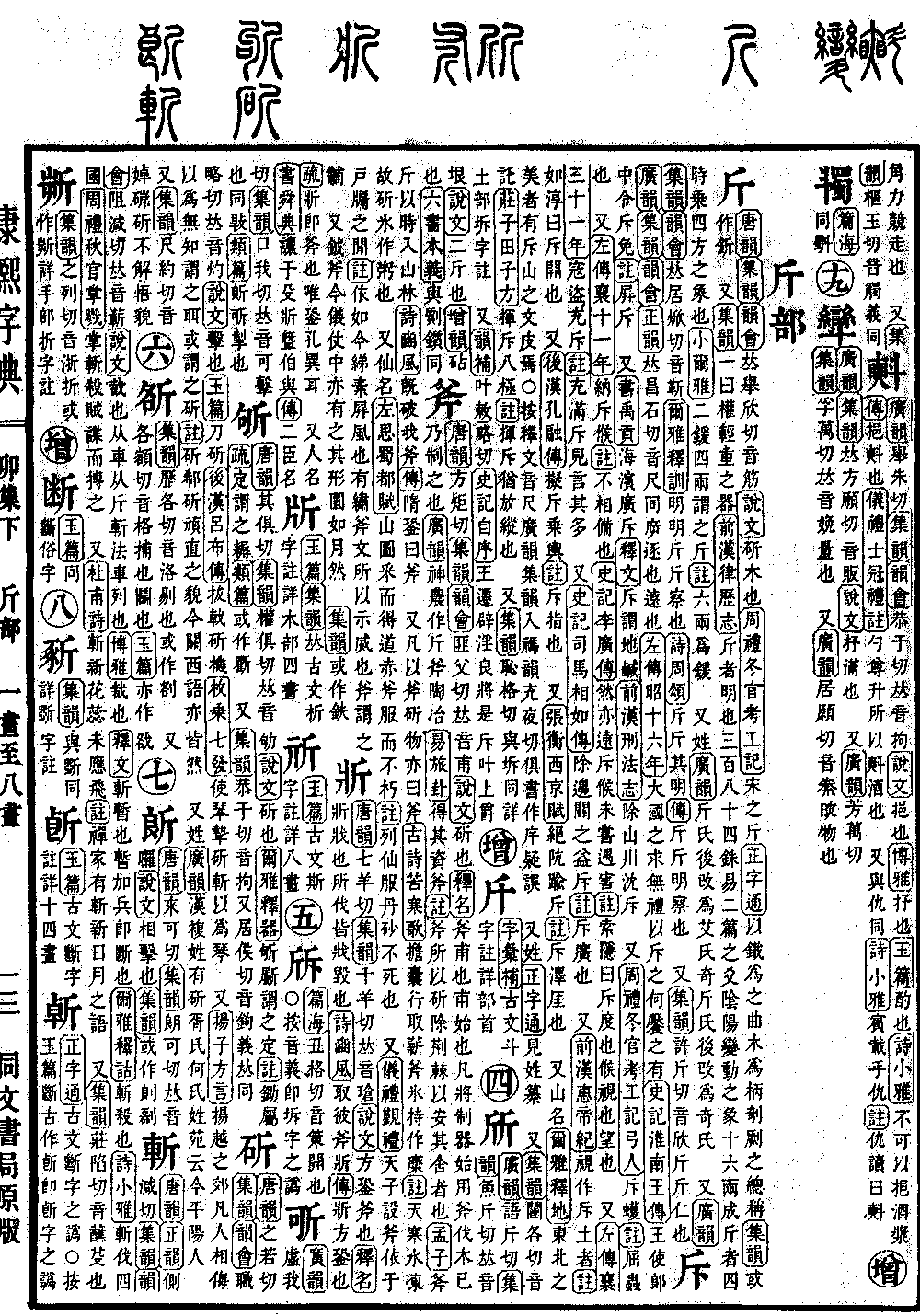
Mao Collection, Lower Volume
Radical: Axe (jīn)
Kangxi stroke count: 8
Page 479, Entry 08
Pronounced fǔ. Pronounced fǔ. Pronounced fǔ.
Shuowen Jiezi explains it as a tool for chopping.
Shiming states: The axe (fǔ) signifies beginning (fǔ). Whenever tools are crafted, one must first use an axe to fell trees before construction can begin.
Guangyun records: The Divine Husbandman (Shennong) invented the adze and the axe, and began the practices of pottery and smelting.
Book of Changes (Yijing), Travel Hexagram (Lügua) mentions: Obtaining wealth and an axe. The commentary explains: The axe is used to clear away brambles in order to securely construct a dwelling.
Mencius states: Tools such as axes must be taken into the forests for timber at the appropriate seasons.
Book of Odes (Shijing), Odes of Bin (Binfeng) writes: My axe is already broken. The commentary explains: A type of axe with an oval-shaped eye is called a fǔ. Furthermore, any act of chopping with an axe can be referred to as fǔ.
Ancient Poem, Song of Bitter Cold (Kuhange) describes: Carrying a sack to gather firewood, chopping ice to cook porridge. The commentary explains: Because the weather is cold and the water is frozen, one chops ice to cook porridge.
It is also the name of an immortal. Zuo Si, Rhapsody on the Capital of Shu (Shudu Fu) writes: One seeks the Tao by gathering herbs according to mountain maps, while Chifu attains longevity through the consumption of elixirs. The commentary explains: Biographies of Immortals (Liexian Zhuan) records that consuming cinnabar leads to immortality.
Additionally, Book of Etiquette and Ceremonial (Yili), Audience Ritual (Qinli) records: The Son of Heaven placed a fǔyī between the doors and windows. The commentary explains: An yī is similar to a modern plain screen. It is embroidered with patterns of axes to manifest majesty. The axe is also known as fǔ.
There is also the yuefu (ceremonial axe), which appears in modern honor guards; its shape is as round as a full moon.
Jiyun records: Sometimes also written in a variant form (fū).