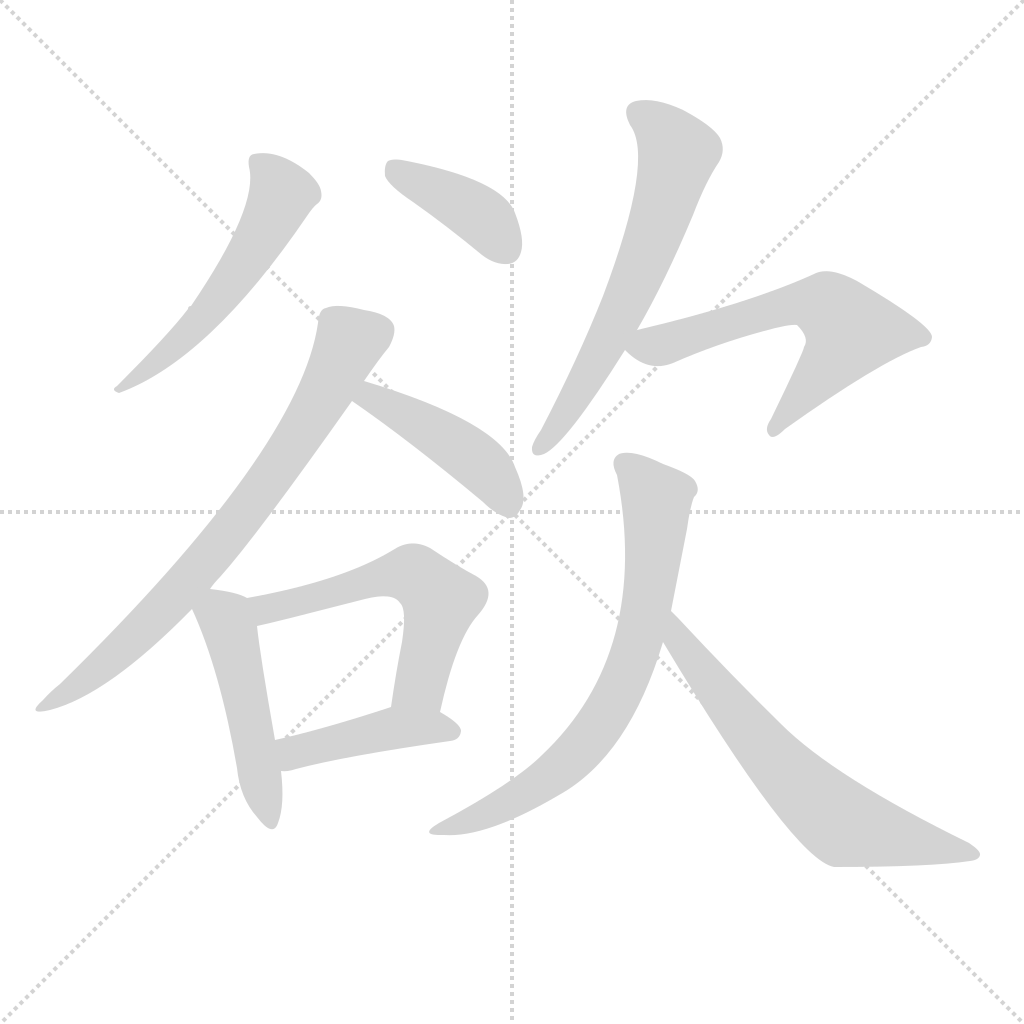
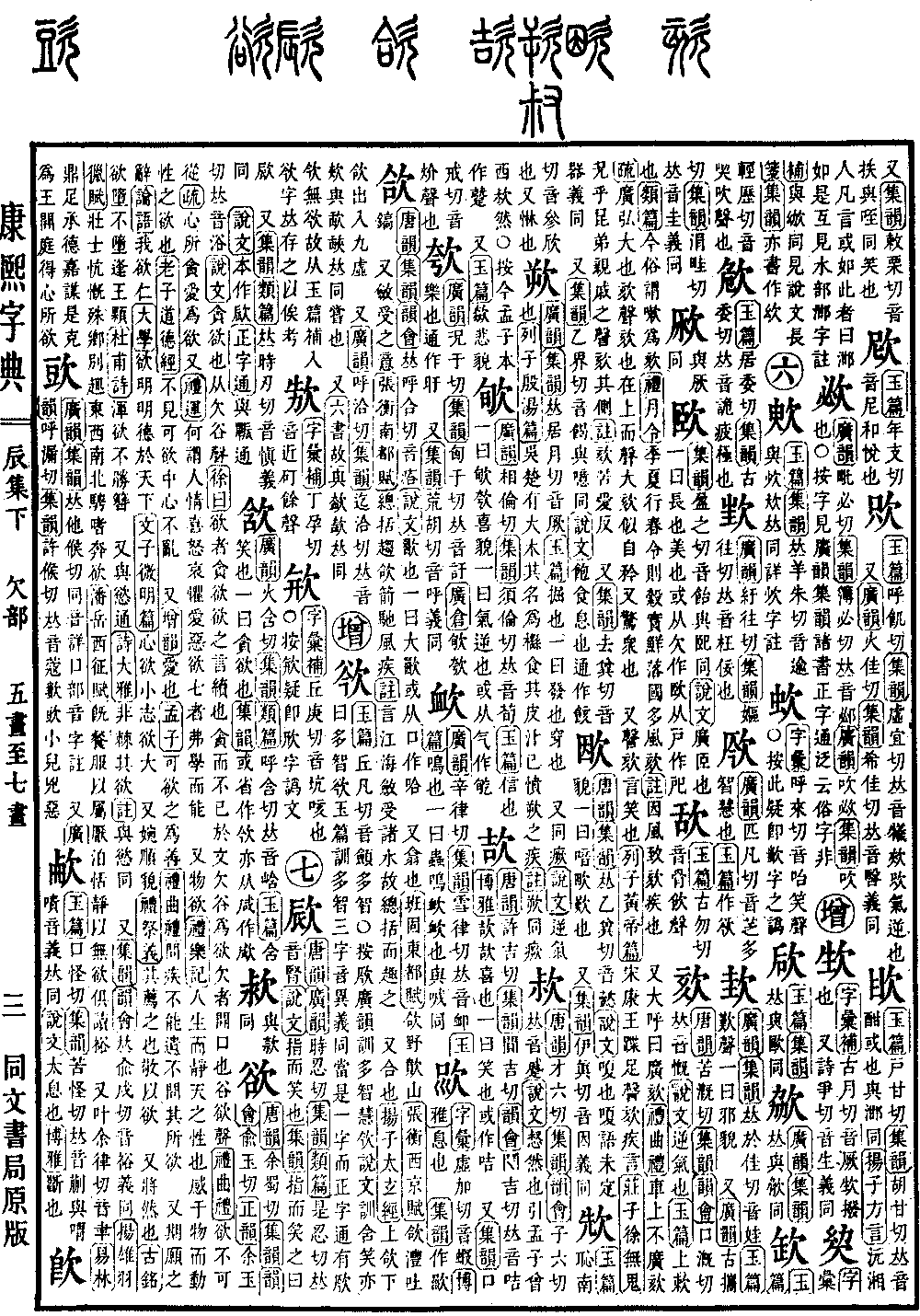
Chen Collection, Lower Volume
Radical: Lack (qiàn)
Kangxi Strokes: 11
Page 567, Entry 36
Pronounced yu (fourth tone).
Explaining Writing (Shuowen): Covetous desire. Formed from the radical lack and the phonetic element valley (gu).
Xu says: Desire is covetousness. The word desire means to continue; to be covetous without end. In terms of the written character, the combination of lack and valley denotes desire. Lack means an open mouth; valley is the sound.
Book of Rites (Liji), Songs of Propriety: Desire must not be followed.
Commentary: What the heart covets is called desire.
Also, Record of Rituals (Liyun): What are the human sentiments? Joy, anger, sorrow, fear, love, hatred, and desire—these seven are possessed without the need for learning.
Also, material desire.
Book of Rites (Liji), Record of Music (Yueji): To be born and remain calm is the nature bestowed by heaven. To be moved by things and set in motion is the desire of one's nature.
Laozi, Classic of the Way and Virtue (Daodejing): By not seeing things that are desirable, the heart is not confused.
Also, Extended Rhymes (Zengyun): Love.
Mencius (Mengzi): That which is desirable is called good.
Book of Rites (Liji), Songs of Propriety: When inquiring about an illness, one cannot neglect to provide, nor fail to ask about what is desired.
Also, a term for longing or wishing.
Analects (Lunyu): I desire humaneness.
Great Learning (Daxue): Desiring to make the brilliant virtue shine throughout the world.
Wenzi, Subtle Clarity Chapter (Weiming pian): The heart should desire to be small, while the will should desire to be great.
Also, a compliant and smooth appearance.
Book of Rites (Liji), Meaning of Sacrifices (Jiyi): When presenting the offering, do so with reverence and compliance.
Also, something about to happen.
Ancient Inscriptions (Guming): About to fall, yet not falling, meeting Wang Ke.
Du Fu’s Poetry: Almost unable to bear the weight of the hairpin.
Also, interchangeable with the variant form (yu).
Book of Odes (Shijing), Greater Odes (Daya): Not urgent in its desire.
Note: Equivalent to the variant form (yu).
Also, pronounced yu (fourth tone). Meaning is the same.
Yang Xiong, Rhapsody on the Feather Hunt (Yulie fu): The brave men are spirited, in distant lands and separate paths. East, west, south, and north, galloping in pursuit of wild desires.
Pan Yue, Rhapsody on the Western Expedition (Xizheng fu): Already having dined and become satisfied, tranquil and quiet without desire. Both are read as yu (fourth tone).
Also, rhyming with the pronunciation yu (fourth tone).
Forest of Changes (Yilin): The tripod feet support virtue, excellent strategies are achieved. Opening the court for the king, obtaining what the heart desires.
Corrections:
Laozi, Classic of the Way and Virtue (Daodejing): By not seeing things that are desirable, the heart is not confused. Adjusted based on the original texts of Heshanggong and Wang Bi; the character middle was changed to make.
Book of Odes (Shijing), Greater Odes (Daya): Not urgent in its desire. Adjusted based on the original text; non was changed to not.
Yang Xiong, Rhapsody on the Feather Hunt (Yulie fu): The brave men are spirited, in distant lands and separate paths. Adjusted based on the original text; the character qu was changed to qu.