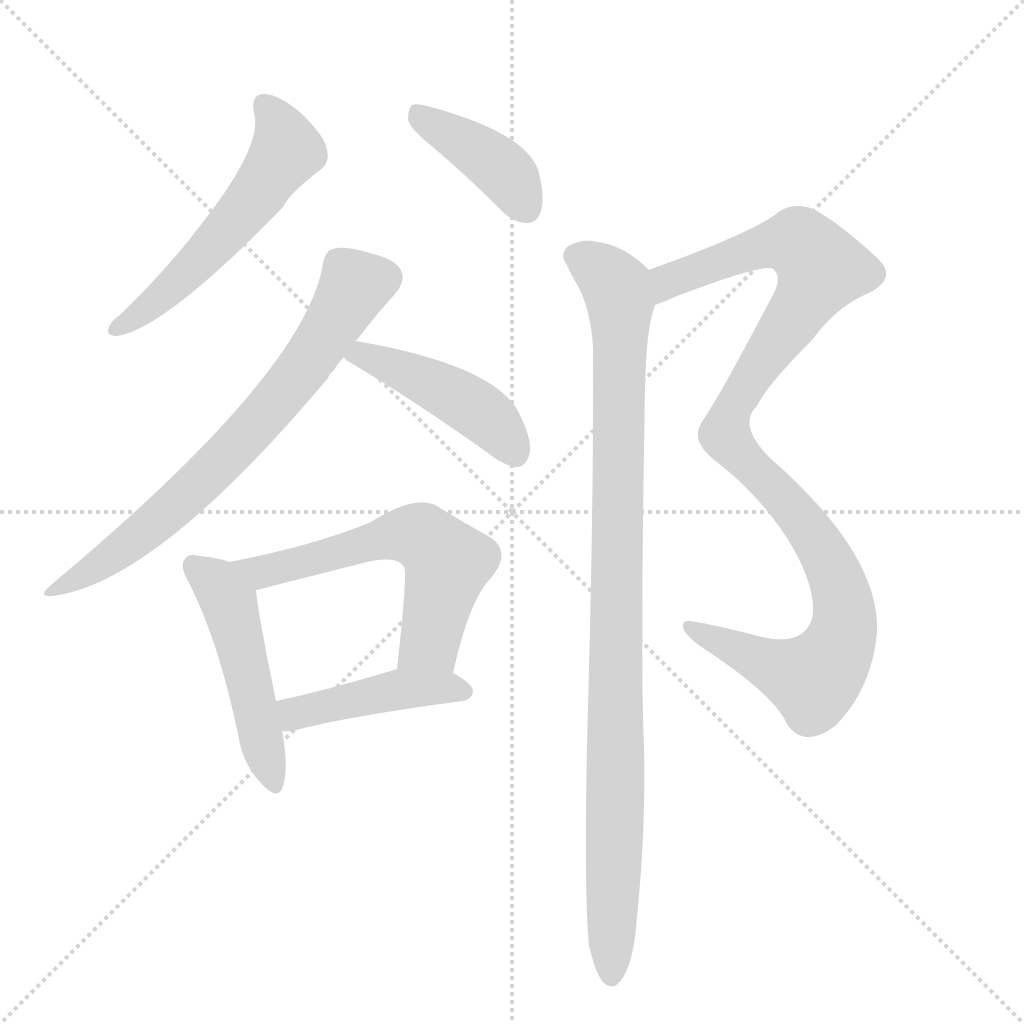
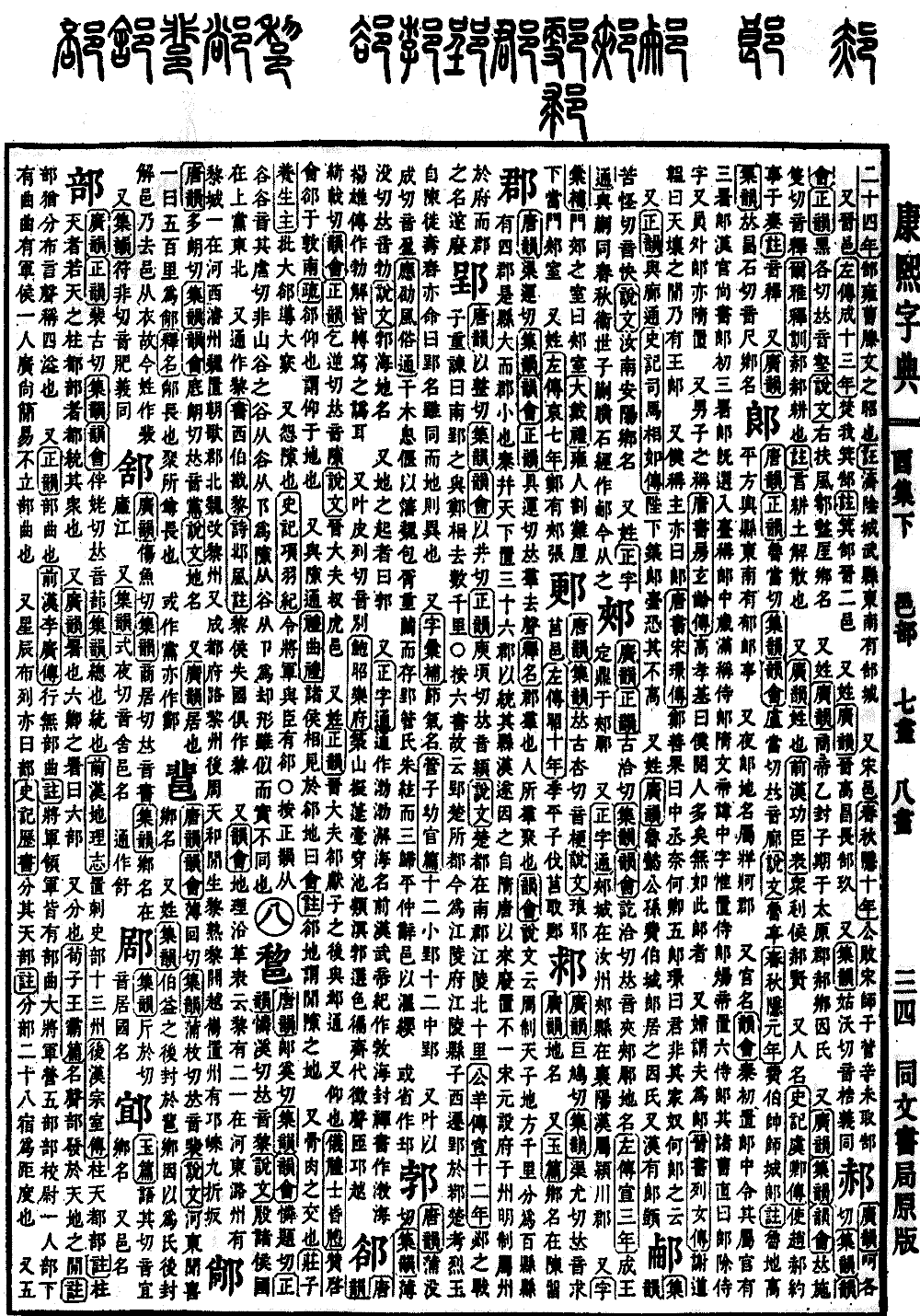
You Collection, Lower Volume, Radical: City (yì)
Stroke Count: 14
Page 1272, Entry 10
Pronounced xi (entering tone) according to Tang Yun, and qì (entering tone) according to Yun Hui and Zheng Yun.
A fief of Shu Hu, a Grand Master of Jin. Also a surname. Descendants of Xi Xianzi, a Grand Master of Jin, interchangeable with the character 郄 (qie).
Also refers to lifting up. In the "Book of Rites (Liji), Chapter on the Ceremony of a Scholar's Marriage (Shì Hūn Lǐ)", it describes the ritual assistant opening the food box and placing the lid face up to the south of the dun. The commentary states that "xi" means to place face up, referring to placing it face up on the ground.
Also interchangeable with the character 隙 (xì). In the "Book of Rites (Liji), Chapter on General Rules of Conduct (Qū Lǐ)", when feudal lords meet in a "xi" place, it is called a "hui" (meeting). The commentary explains that "xi place" refers to the area between two states.
Also refers to the gaps between bones. In "Zhuangzi (Zhuangzi), Chapter on the Essentials of Nurturing Life (Yǎng Shēng Zhǔ)", it says to split open the gaps between large bones and guide into large cavities.
Also refers to enmity or resentment. In "Records of the Grand Historian (Shiji), Annals of Xiang Yu (Xiàng Yǔ Běnjì)", it states that this caused enmity between the general and me.
Note: According to Zheng Yun, the character is derived from 谷 (gǔ) and pronounced qí nüè (falling tone), not the 谷 (gǔ) meaning valley. The character 隙 (xì) is formed from 谷 (gǔ) and 阝 (yì), while the character 却 (què) is formed from 谷 (gǔ) and 卩 (jié). Although the forms are similar, they are actually different.