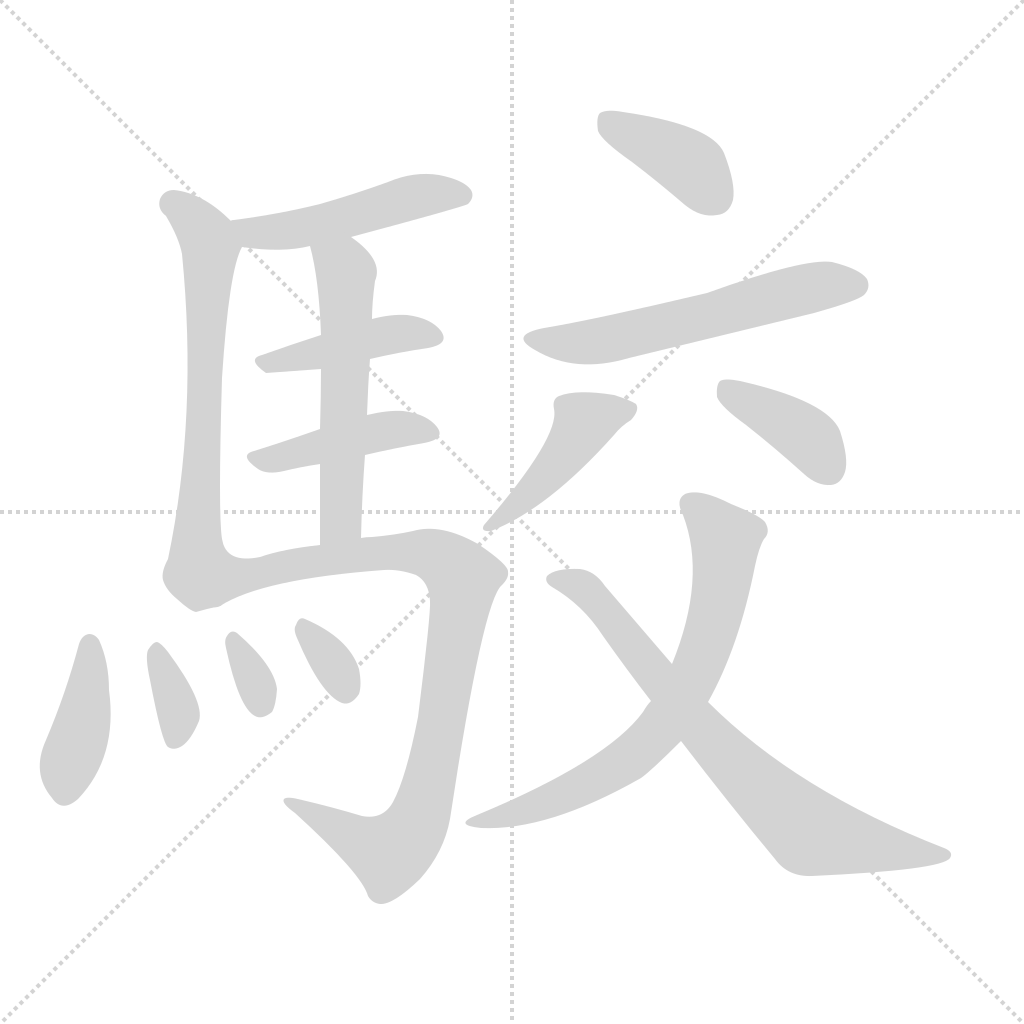
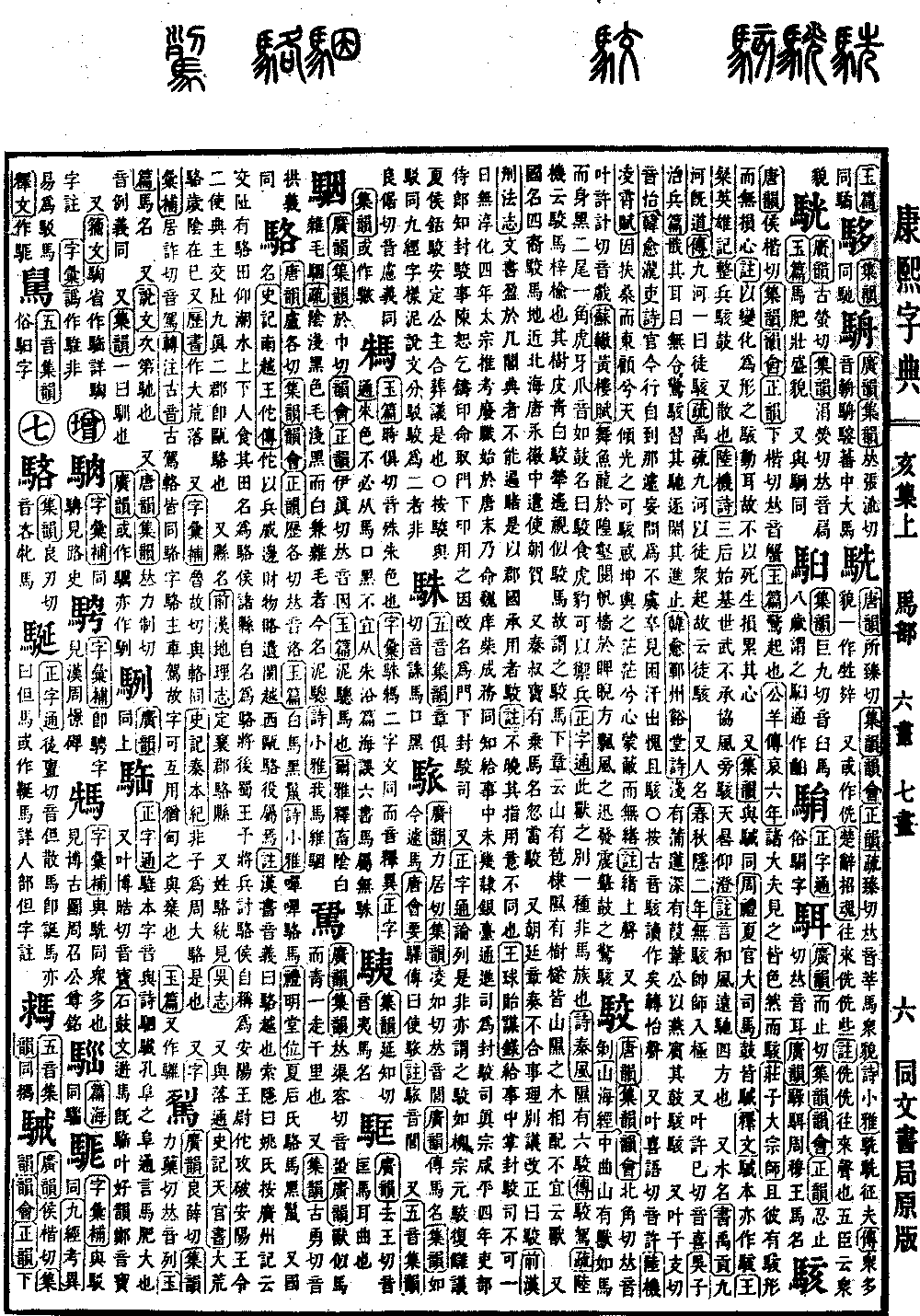
Hai Collection, Upper Volume
Radical: Horse (mǎ)
Kangxi stroke count: 16
Page 1438, Entry 09
Tangyun (Tang Dynasty Rhyming Dictionary), Jiyun (Collected Rhymes), Yunhui (Collection of Rhymes): Pronounced bo.
Classic of Mountains and Seas (Shanhaijing): On Mount Zhongqu there is a beast that resembles a horse but has a black body, two tails, and one horn. It possesses the teeth and claws of a tiger, and its cry sounds like the beating of a drum. It is named bo and can eat tigers and leopards; it can also protect against weapons.
Zhengzitong (Correction of Character Dictionary): This is a unique type of animal and does not belong to the horse family.
Book of Odes (Shijing), Qin Feng: In the low-lying wetlands, there are six bo trees. Commentary: The bo tree resembles a horse. Sub-commentary: Lu Ji says the bo horse is the catalpa elm. Its bark is mottled with green and white, resembling a bo horse when viewed from a distance, hence it is called the bo horse. The following chapter states: On the mountains are dense pear trees, and in the low-lying wetlands are mountain pear trees; these are all trees that correspond to the mountains and wetlands, and should not refer to a wild beast.
Also the name of a country. The distant Bo Ma country is located near the Northern Sea. During the Yongzhong period of the Tang Dynasty, envoys were sent to offer congratulations. Additionally, Qin Shubao had a mount named Huleibo.
When a memorial to the throne is unreasonable, discussing and correcting it is called bo.
History of the Former Han (Qian Hanshu), Treatise on Criminal Law: Documents piled up on desks and shelves, and the officials in charge could not read them all; therefore, when the various commanderies and states followed them, there were instances of confusion and inconsistency. Commentary: Not understanding the main point, each person's understanding differed.
Wangqiu Yimulu: The department of the Gentleman Attendant at the Gate (geishizhong) in charge of sealing and returning memorials (fengbo) could not remain vacant for even a single day. In the fourth year of the Chunhua era, Emperor Taizong examined and investigated the matter, finding that the neglect of this office began at the end of the Tang Dynasty. He then ordered Wei Xiang and Chai Chengwu to jointly hold the office of Gentleman Attendant at the Gate. Soon after, it was subordinated to the Silver Terrace Transmission Office (yintai tongjinsi) and became the Office of Sealing and Returning Memorials (fengbosi). In the fourth year of the Xianping era under Emperor Zhenzong, the Vice Minister of the Ministry of Personnel took charge of these affairs. Chen Shu requested that a seal be cast and ordered the seal of the Secretariat-Chancellery (menxiasheng) to be used, thus it was renamed the Secretariat-Chancellery Office of Sealing and Returning Memorials.
Furthermore, Zhengzitong states that discussing and judging right and wrong is also called bo. For example, Liu Zongyuan’s Refutation of the Discussion on Revenge (Bo fuchou yi) and Xiahou Xian’s Refutation of the Discussion on Princess Anding’s Joint Burial (Bo Anding gongzhu hezang yi) are of this type.
Note: Bo and bo are the same character. The Nine Classics Character Patterns (Jiujing Ziyang) is overly pedantic regarding the Explanation of Script and Elucidation of Characters (Shuowen Jiezi) by treating them as two separate characters, which is incorrect.
Textual research: Book of Odes (Shijing), Qin Feng: In the low-lying wetlands, there are six bo trees. Commentary: The bo is like a horse. Note: The phrase like a horse is a transcription error for resembles a horse. According to the original text, it should be corrected to resembles a horse.