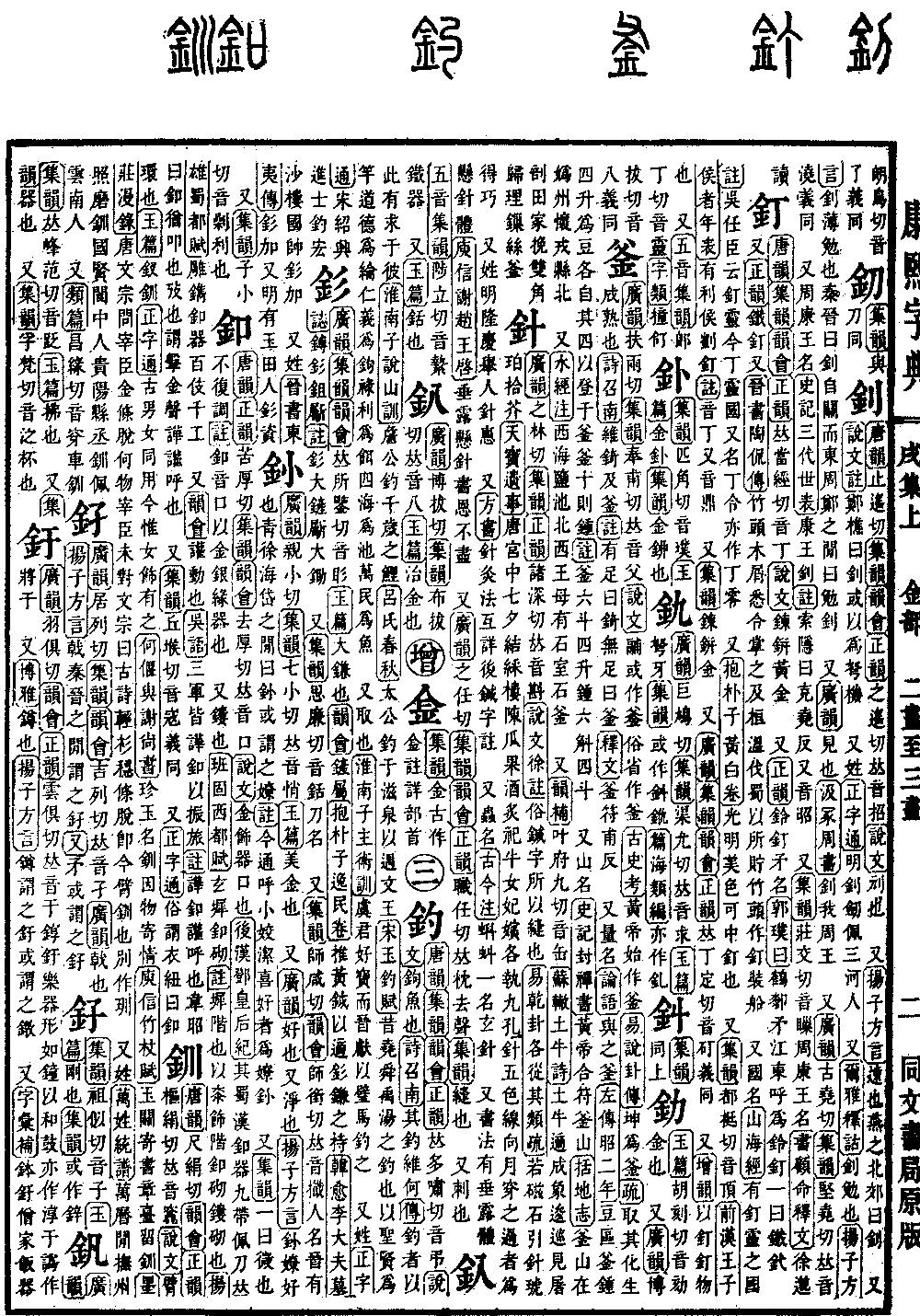
Xu Collection, Upper Volume
Radical: Metal (jīn)
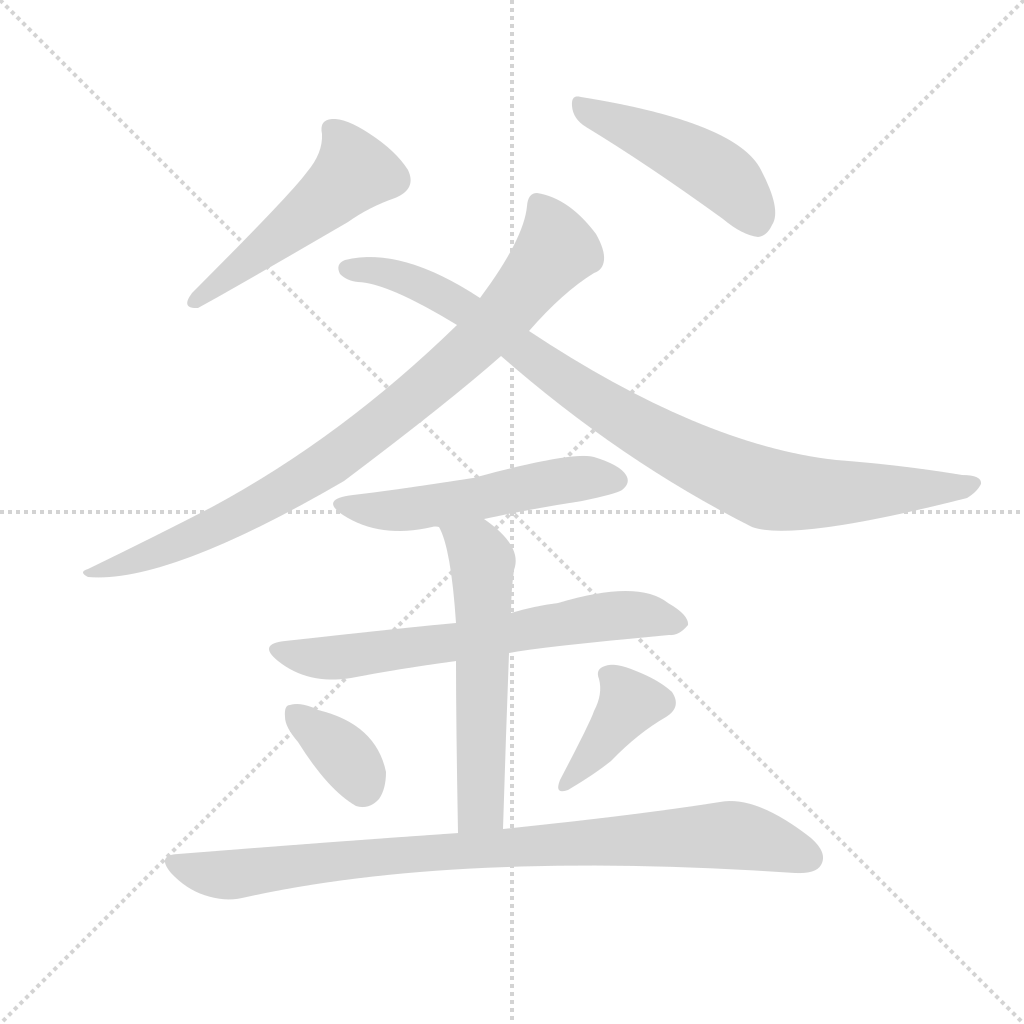
Fu
Kangxi Strokes: 10
Page 1296, Entry 08
Pronounced fu
Pronounced fu, reading is the same as the word for father.
Shuowen Jiezi states the character fu is sometimes written in a variant form, and the common simplified form is written as fu.
According to the Ancient History Examination (Gushikao), the Yellow Emperor was the first to make a cauldron.
Book of Changes (Yijing), Commentary on the Trigrams of the Eight Trigrams (Shuogua Zhuan), states that the Earth trigram symbolizes the cauldron.
The commentary explains that this refers to its ability to transform and cook food.
Book of Odes (Shijing), Odes of Shao and the South (Shaonan), mentions the tripod and the cauldron.
The annotation explains that the one with legs is called a tripod, and the one without legs is called a cauldron.
The interpretation text states that the pronunciation is fu.
Also a name of a unit of volume.
The Analects (Lunyu) mentions giving a cauldron of grain.
The Zuo Tradition (Zuozhuan), Second Year of Duke Zhao, records four units of volume: dou, qu, fu, and zhong. Four sheng make one dou, each progressing by a factor of four, reaching one fu, and ten fu make one zhong.
The annotation states that one fu is equal to sixty-four sheng, and one zhong is equal to six hu and four dou.
Also the name of a mountain.
Records of the Grand Historian (Shiji), Treatise on the Suburban Sacrifices (Fengshan Shu), notes that the Yellow Emperor met with the feudal lords at Mount Fu to verify their tallies.
Geography of the Broad Earth (Kuodizhi) states that Mount Fu is located north of Huairong County in Guizhou.
Also, the Commentary on the Classic of Water (Shuijingzhu) notes that north of the salt lake in the Western Sea, the Queen Mother of the West has a stone chamber and a stone cauldron.
Also, in the Rhyme Supplement (Yunbu), it is rhymed with the sound jiu, pronounced the same as the word for earthenware vessel.
Su Zhe, Poem on the Earthen Ox, writes that the earthen ox has just been formed into its shape, and in an instant, it is slaughtered and divided. The farming family pulls on its horns, returning to repair their hearths and cauldrons.