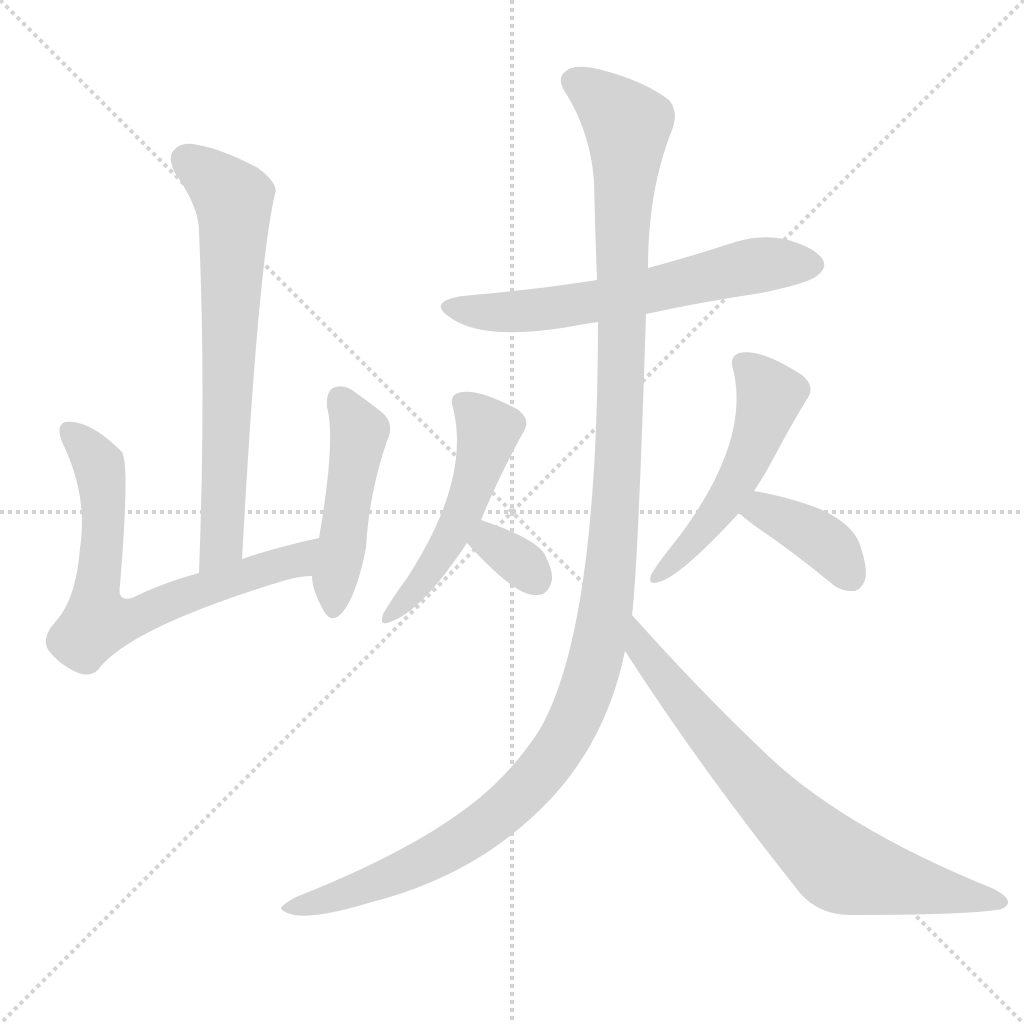
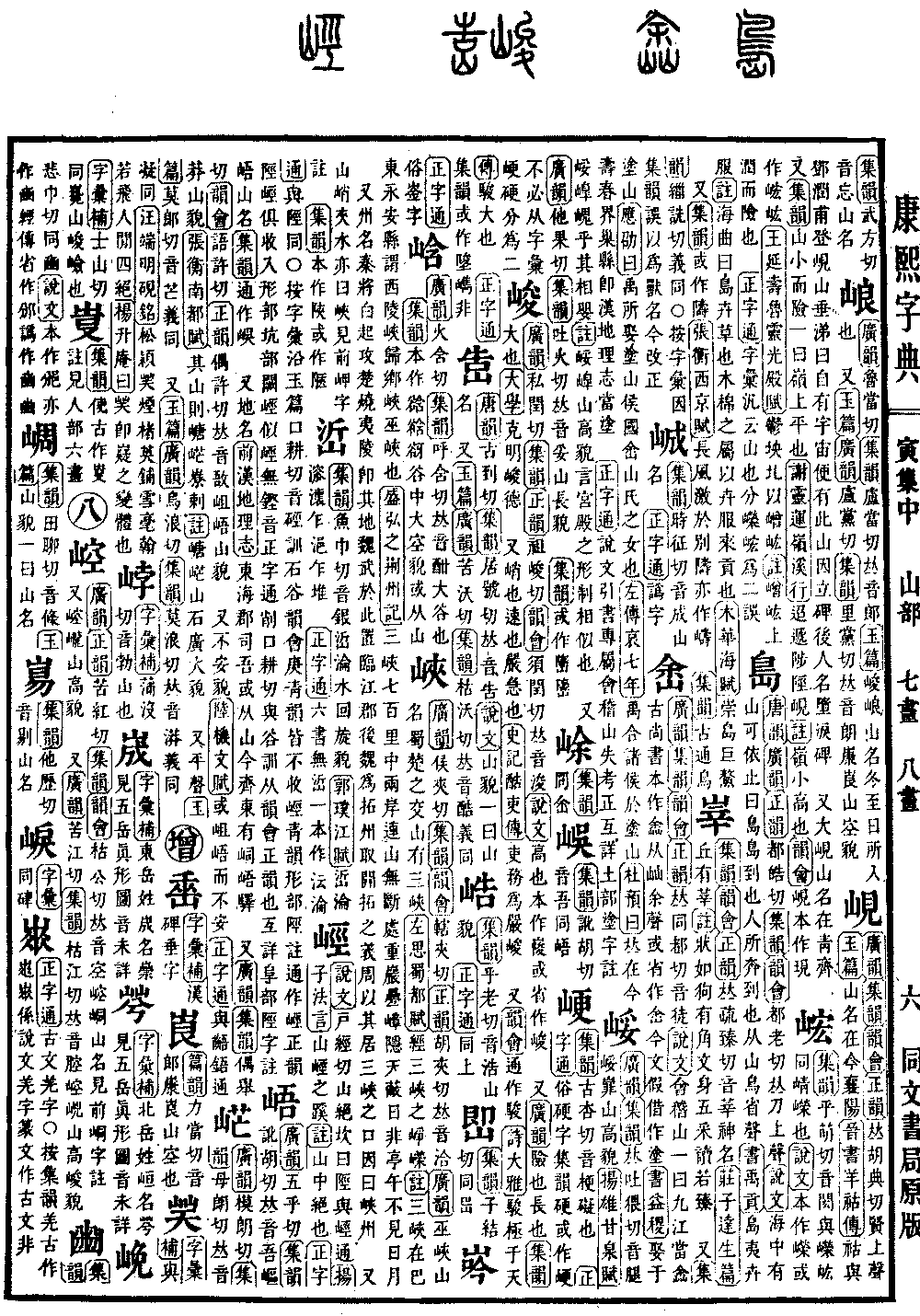
Yin Collection, Middle Volume. Radical: Mountain (shān). Kangxi stroke count: 10. Page 312, Entry 18.
Pronounced xia.
According to the Extensive Rhymes (Guangyun), Wu Gorge is the name of a mountain. It is located at the border of the ancient states of Shu and Chu, where the mountains contain three gorges. As stated in the Rhapsody on the Capital of Shu (Shudu Fu) by Zuo Si: It passes through the lofty and perilous reaches of the Three Gorges. Commentary: The Three Gorges are located in Badong, Yong'an County, referring to Xiling Gorge, Guixiang Gorge, and Wu Gorge. According to the Record of Jingzhou (Jingzhou Ji) by Sheng Hongzhi: Throughout the seven hundred li of the Three Gorges, the mountains on both banks connect without interruption. The overlapping cliffs and layered precipices obscure the sky and the sun; if it is not high noon, one cannot see the sun or the moon.
It is also the name of a prefecture. The Qin general Bai Qi attacked the state of Chu and burned Yiling, which is this location. Emperor Wu of Wei established Linjiang Commandery here. During the Later Wei, it was renamed Tuo Prefecture, derived from the meaning of expansion. The Northern Zhou dynasty named it Xia Prefecture because it was located at the exit of the Three Gorges. Additionally, when a mountain is steep and a body of water flows between its sides, it is also called a gorge. See the previous entry for the character jia.
According to the Collected Rhymes (Jiyun), it was originally written as the character sha. It is also sometimes written as the character xia.