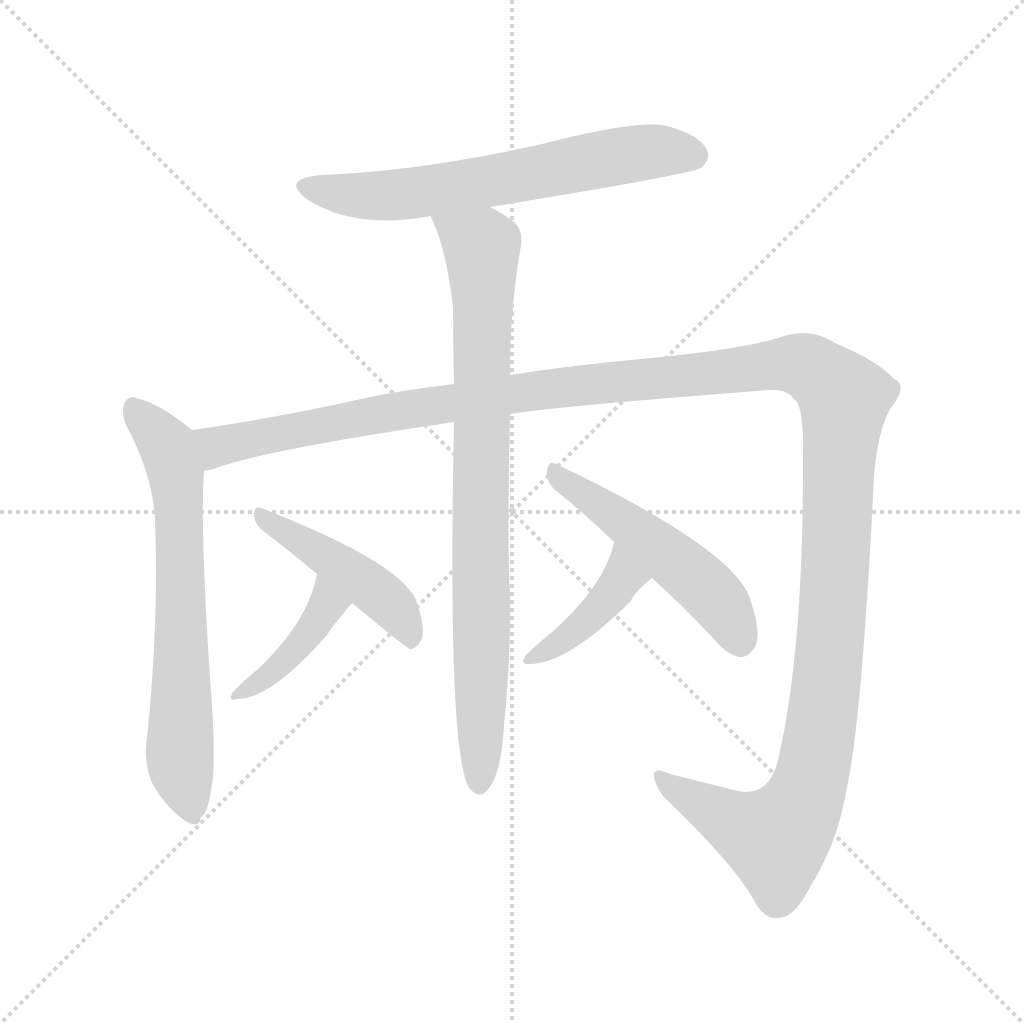
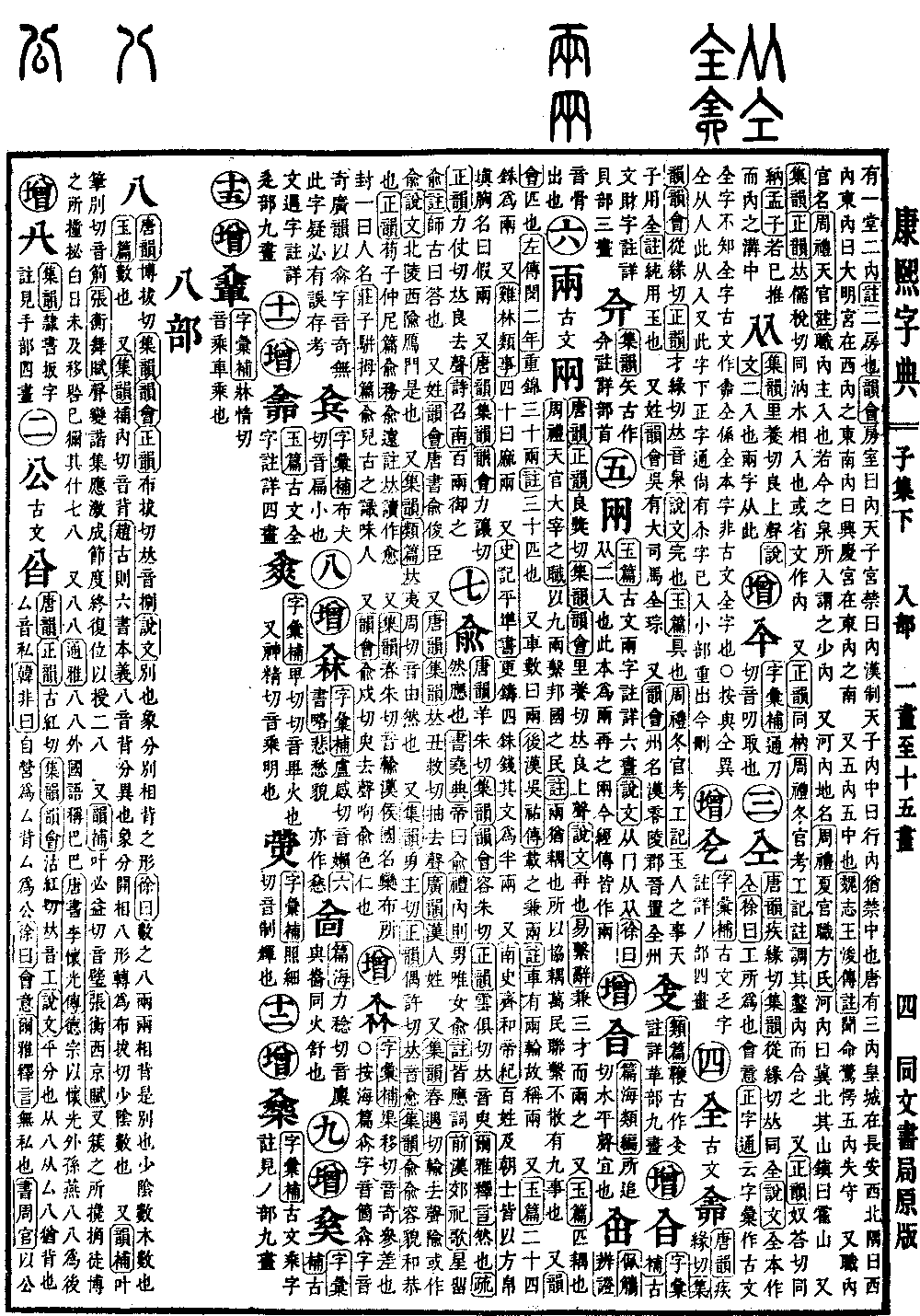
Zi Collection, Page Position: Lower. Radical: Enter (rù). Character: liǎng. Kangxi Strokes: 8. Page: Page 126, Number 13.
Ancient script form. According to Tang Rhymes (Tangyun) and Correct Rhymes (Zhengyun), the pronunciation follows the fanqie of the characters liáng and jiǎng. According to Collected Rhymes (Jiyun) and Rhyme Assembly (Yunhui), it follows the fanqie of lǐ and yǎng. It is pronounced as the rising tone of the character liáng.
The Analytical Dictionary of Characters (Shuowen Jiezi) explains it as again, meaning twice.
The Book of Changes (Yijing), Appended Phrases (Xici) states: Combining the three powers and doubling them. This means the three powers of heaven, earth, and humanity are each divided into yin and yang, totaling six lines of a hexagram.
Also, the Jade Chapters (Yupian) explains it as a pair or mate, meaning to match.
The Rites of Zhou (Zhouli), Offices of Heaven (Tianguan), Duties of the Prime Minister records: Using the nine liǎng to connect the people of the state. The commentary says that liǎng is like the term ǒu, meaning a pair, used to coordinate the masses so their connections do not disperse, consisting of nine methods.
Also, the Rhyme Assembly explains it as a bolt of cloth, meaning a match or counterpart.
The Zuo Commentary (Zuozhuan), Second Year of Duke Min mentions: Thirty liǎng of heavy brocade. The commentary says this means thirty bolts.
Also, the count of carriages is called liǎng.
The Book of the Later Han (Hou Hanshu), Biography of Wu You mentions: Carrying them in double liǎng. The commentary says that because a carriage has two wheels, it is called a liǎng.
Also, the Jade Chapters records that twenty-four zhū make one liǎng.
Also, the Matters of the Forest of Roosters (Jilin Leishi) records that forty is called má liǎng.
Also, the Records of the Grand Historian (Shiji), Treatise on the Balanced Standard (Pingzhun Shu) records the recasting of four-zhū coins with the inscription half liǎng.
Also, the History of the Southern Dynasties (Nanshi), Annals of Emperor He of Qi records that commoners and court officials used square silk to fill the chest area, called false liǎng.
Also, according to Tang Rhymes, Collected Rhymes, and Rhyme Assembly, the pronunciation follows the fanqie of the characters lì and ràng. According to Correct Rhymes, it follows the fanqie of lì and zhàng. It is pronounced as the departing tone of the character liáng.
The Book of Odes (Shijing), Odes of Shao and the South (Shaonan) contains the line: A hundred liǎng meet her.