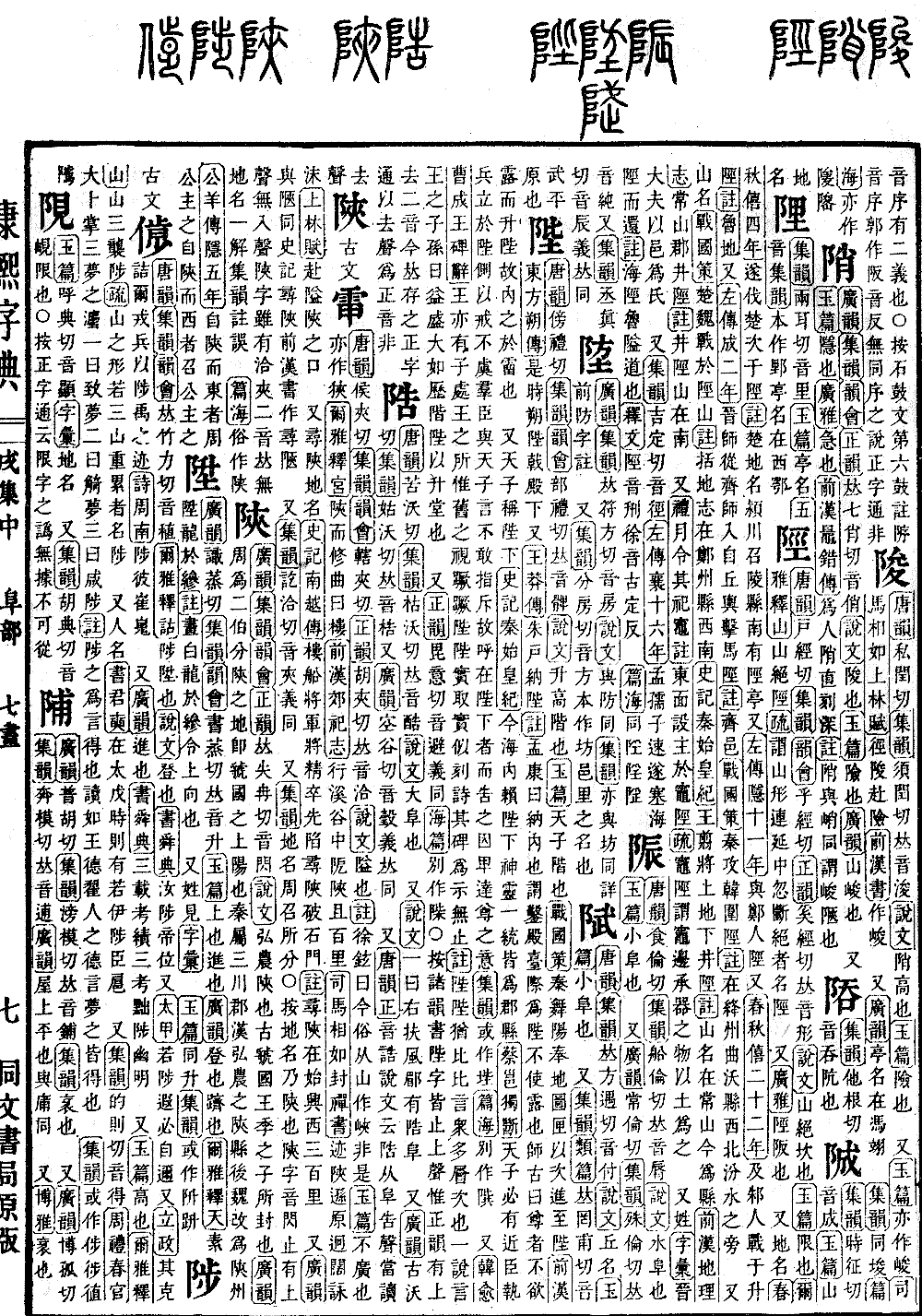
Xu Collection, Middle Volume
Radical: Mound (fù)
Kangxi Strokes: 15
Page Number: 1351, Entry 12
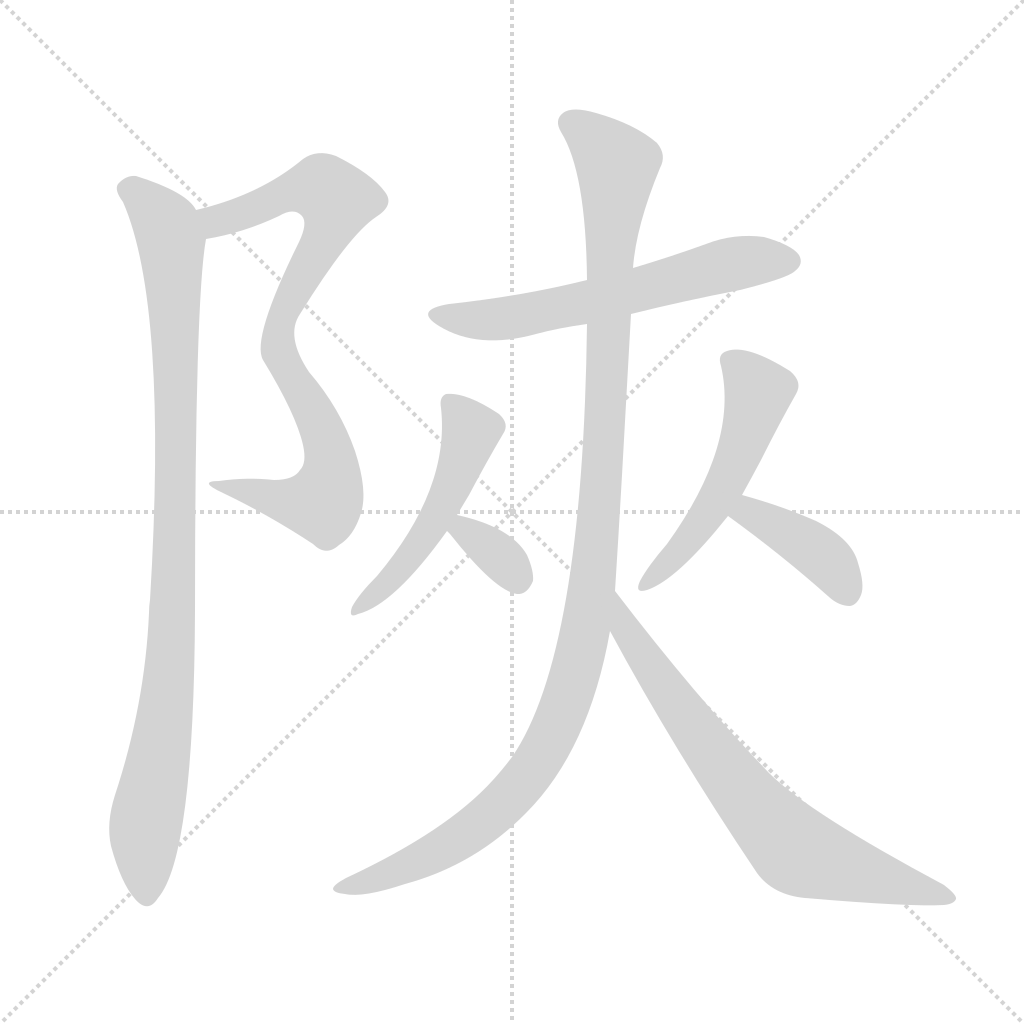
Ancient character. The Tang Rhyme Dictionary (Tangyun) gives the pronunciation as *hóujiā qiè*. The Collection of Rhymes (Jiyun) and The Unified Rhymes (Yunhui) give *xiájiā qiè*. The Correct Rhymes (Zhengyun) gives *hújiā qiè*. The sound is *qià*. The Analytical Dictionary of Characters (Shuowen Jiezi) states it means "narrow, confined." Its commentary by Xu Xuan says: "Today, people popularly write *xiá* (峡) with the 'mountain' (shān) radical, which is incorrect." The Jade Chapters (Yupian) says it means "not broad." It is also written as *xiá*. In the Erya, "Explanation of Buildings" (Shigong) chapter: "A narrow and winding path is called *lóu*." In the History of the Former Han (Qian Han Shu), "Treatise on Suburban Sacrifices" (Jiaosi Zhi): "Traveling through valleys, it was narrow and confined for nearly a hundred *li*." Sima Xiangru's "Treatise on Feng and Shan Sacrifices" (Fengshan Shu): "The traces were narrow, yielding to the plain, distant and vast, chanting and frothing." In the "Rhapsody on the Imperial Park" (Shanglin Fu): "Proceeding to the narrow and confined entrance."
Also, Xúnshǎ, a place name. In the Records of the Grand Historian (Shiji), "Biographies of Nanyue" (Nanyue Zhuan): "The General of Towered Warships led elite troops, first seizing Xúnshǎ and breaking through Shímén." The commentary states: "Xúnshǎ is 300 *li* west of Shǐxīng."
Also, The Broad Rhymes (Guangyun) states it is the same as *xiá*. In the Records of the Grand Historian (Shiji), Xúnshǎ is written as Xúnxiá in the History of the Former Han (Qian Han Shu).
Also, The Collection of Rhymes (Jiyun) gives the pronunciation as *qìqià qiè*, with the sound *jiā*. The meaning is the same.
Also, The Collection of Rhymes (Jiyun) lists it as a place name, the area divided by the Duke of Zhou and the Duke of Shao. However, the place name is actually *shǎn*. The character *shǎn* is pronounced *shǎn*, with only an ascending tone and no entering tone. Although the character *shǎ* has the two pronunciations *qià* and *jiā*, it does not have the meaning of a place name. The commentary in The Collection of Rhymes (Jiyun) is mistaken. The Sea of Characters (Pianhai) states that it is popularly written as *shǎn*.