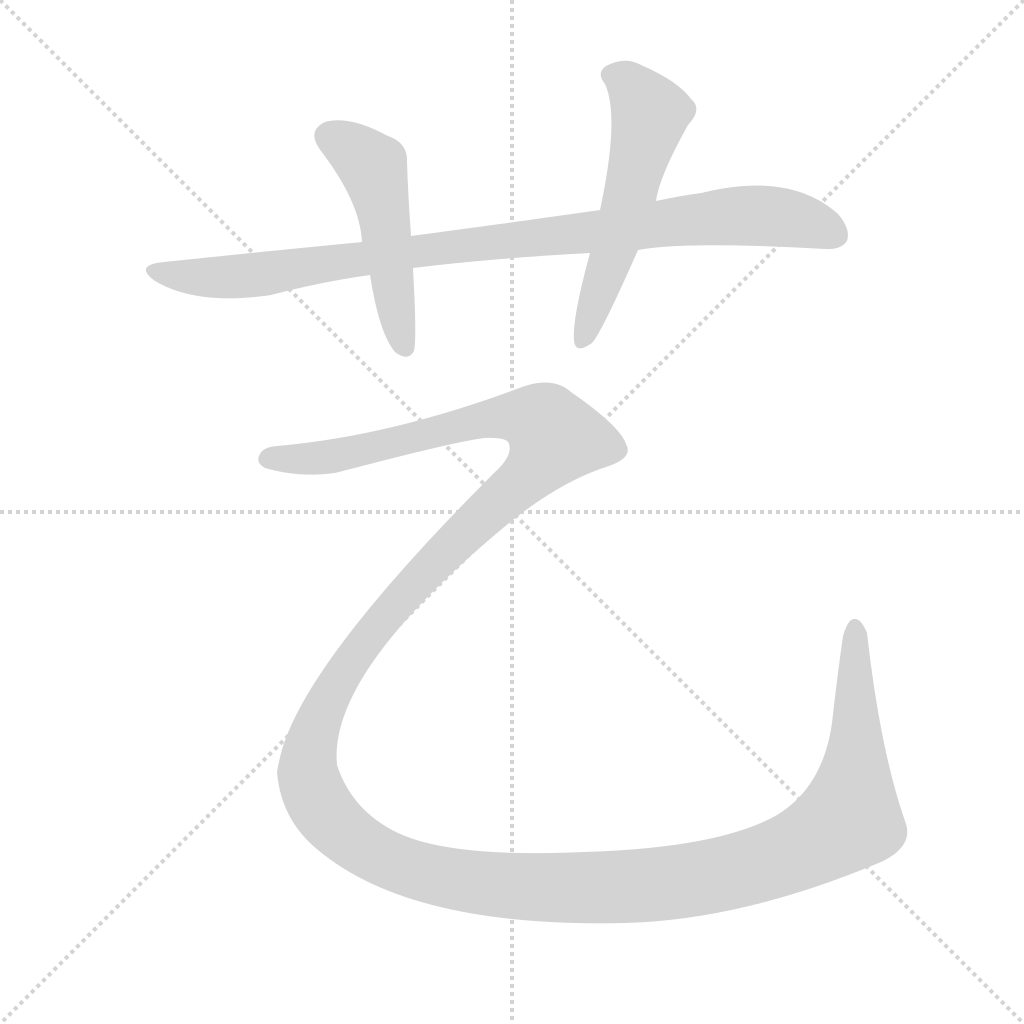
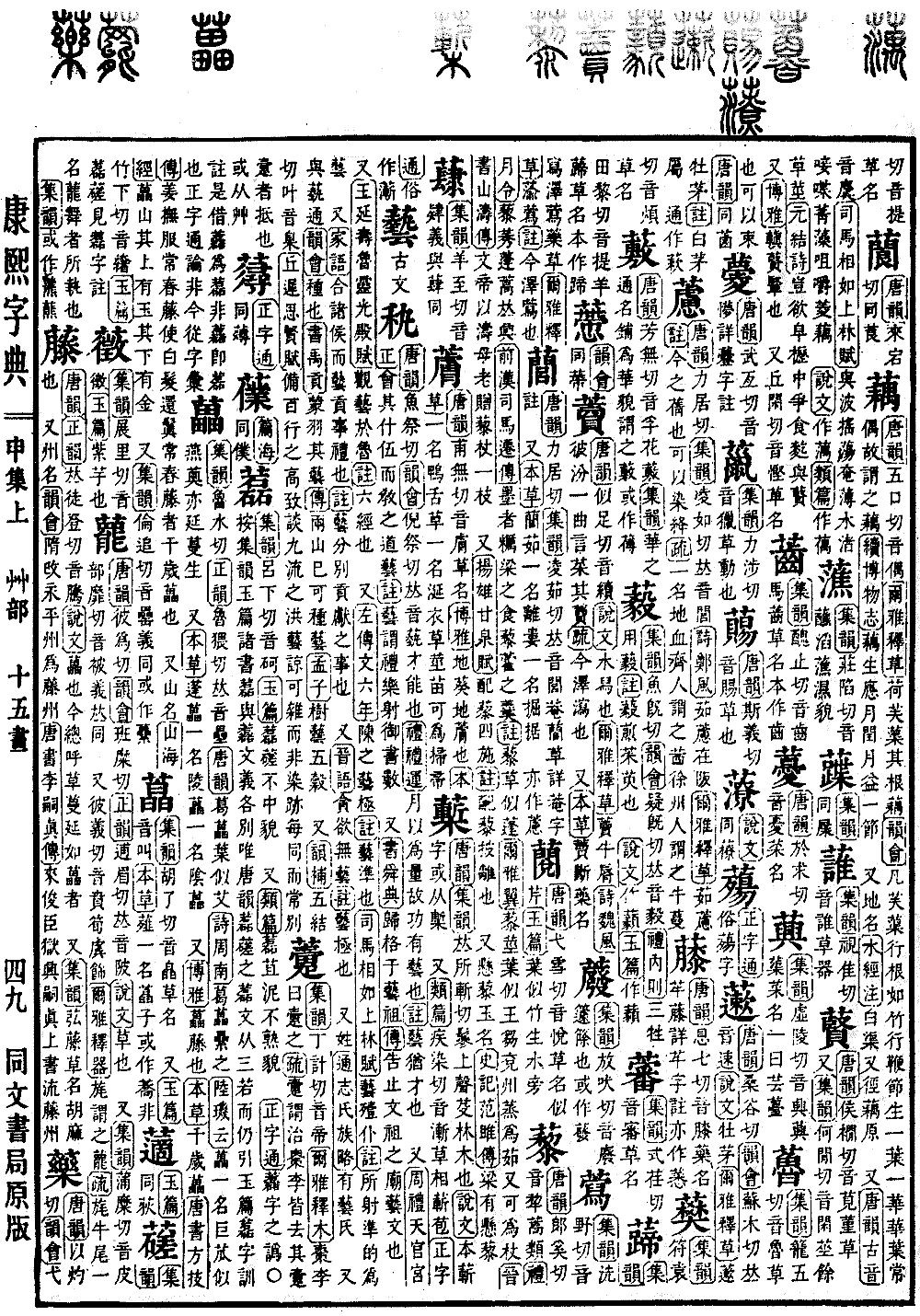
Shen Collection, Upper Volume
Radical: Grass (cǎo)
Kangxi stroke count: 21
Page 1065, Entry 01
Ancient form: yi
Pronounced yi (falling tone)
Meaning: Talent or ability.
Book of Rites (Liji), Rites Conveyed (Liyun): The month is used as a measure, therefore achievements have their measure of ability.
Commentary: Ability is synonymous with talent.
Additionally, in the Rites of Zhou (Zhouli), Office of Heaven, Palace Warden: Assemble the units of ten and five, and teach them the path of arts and skills.
Commentary: Arts and skills refer to the six arts: rites, music, archery, charioteering, calligraphy, and mathematics.
Additionally, in the Book of Documents (Shushijing), Canon of Shun: He returned and arrived at the temple of the cultivated ancestor.
Commentary: Proclaiming arrival at the temple of the literary ancestor. Yi means literary or cultivated.
Additionally, in Wang Yanshou, Rhapsody on the Lingguang Hall of Lu: Observe the literary arts in the state of Lu.
Commentary: Refers to the Six Classics.
Additionally, in the Zuo Tradition (Zuozhuan), Sixth Year of Duke Wen: Display the standards and limits.
Commentary: Yi means standard or norm.
In Sima Xiangru, Rhapsody on the Shanglin Park: Aiming at the target with precision.
Commentary: That which is aimed at is the target, referred to as the yi.
Additionally, in the School Sayings of Confucius (Kongzi Jiayu): Assemble the feudal lords to distinguish the ritual duties of tribute.
Commentary: Yi means to categorize or distinguish the matters of tribute.
Additionally, in the Discourses of Jin (Jinyu): Greed and desire have no limit.
Commentary: Yi means limit or extremity.
Additionally, a surname.
In the General Records (Tongzhi), Treatise on Clans: There is the Yi clan.
Additionally, interchangeable with the character meaning to plant.
In the Rhyme Collection (Yunhui): To plant.
In the Book of Documents (Shushijing), Tribute of Yu: The mountains of Meng and Yu can be planted.
Commentary: Both mountains are suitable for planting and cultivation.
In the Mencius (Mengzi): Planting the five grains.
Additionally, in the Rhyme Supplement (Yunbu), pronounced nie (entering tone).
In Qiu Chi, Rhapsody on Thinking of the Virtuous: Possessing the lofty nature of the hundred virtues, discussing the vast arts of the nine schools of thought. Truly, one may be mingled but not stained, the traces often similar yet always distinct.
Textual Research: In the Book of Documents (Shushijing), Canon of Shun, the commentary originally stated "proclaiming stop at the temple of the literary ancestor." It has been corrected to "proclaiming arrival at the temple of the literary ancestor" in accordance with the original text.