Si Collection, Middle Volume
Radical: Fire (huǒ)
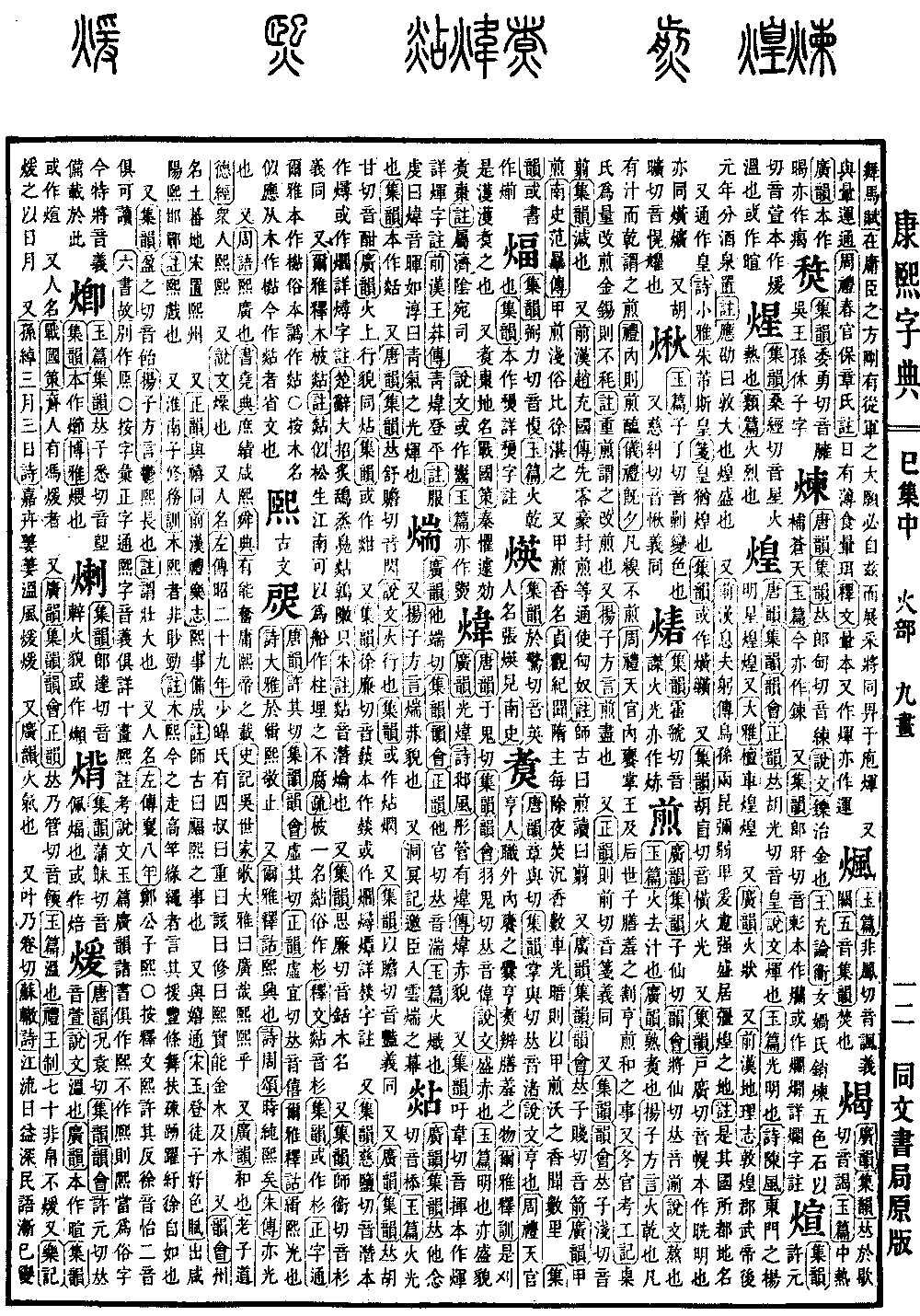
熙
Kangxi Stroke Count: 13
Page 676, Entry 03
Ancient form: 焈
Pronounced xi (level tone)
Book of Rites (Erya), Interpretation of Words: "Ji-xi means light."
Book of Odes (Shijing), Greater Odes: "In the pursuit of bright and reverent behavior."
Also, Book of Rites (Erya), Interpretation of Words: "Xi means to flourish."
Book of Odes (Shijing), Odes of Zhou: "This is the pure flourishing."
Zhu Xi's Commentary: "Also means light."
Also, Discourses of the States (Guoyu): "Xi means vast."
Book of Documents (Shangshu), Canon of Yao: "All achievements were made vast."
Canon of Shun: "There are those who can exert effort to make the Emperor's tasks vast."
Records of the Grand Historian (Shiji), House of Wu: "The song of the Greater Odes says: Vast and brilliant is it."
Also, Book of Rhymes (Guangyun): "Harmony."
Laozi, Tao Te Ching: "The masses are harmonious and cheerful."
Also, Explaining Graphs and Analyzing Characters (Shuowen): "To dry."
Also, a person's name.
Zuo Tradition (Zuozhuan), Year 29 of Duke Zhao: "The Shaohao clan had four uncles: named Zhong, Gai, Xiu, and Xi, who were able to manage metal, wood, and water."
Also, Book of Rhymes (Yunhui): "The name of a prefecture. Territory of the Tibetans. The Song dynasty established Xi Prefecture."
Also, Correct Rhymes (Zhengyun): "The same as xi (happiness)."
Book of Han, Treatise on Rites and Music: "The auspicious affairs are prepared and completed."
Commentary by Yan Shigu: "Refers to affairs of good fortune and happiness."
Also, used interchangeably with xi (to play).
Song Yu, Rhapsody on Master Dengtu the Lecher: "He went out from Xianyang and played in Handan."
Commentary: "Xi means to play."
Also, Huainanzi, Cultivating Conduct: "The wood-xi performers are not merely agile."
Commentary: "Mu-xi refers to the modern-day pole climbers and rope walkers; it describes how they grasp the luxuriant branches, dance among the foliage, and leap or linger with ease."
Also, Collection of Rhymes (Jiyun): Pronounced yi (level tone).
Yang Xiong, Dialects (Fangyan): "Yu-xi means long."
Commentary: "Refers to being robust and large."
Also, a person's name.
Zuo Tradition (Zuozhuan), Year 8 of Duke Xiang: "Zheng's公子 (Gongzi) Xi."
Note: In the Explanation of Sounds, Xi is pronounced xi (rising tone). Xu pronounces it yi (level tone). Both pronunciations are acceptable.
Six Writings (Liushugu): Also written in a variant form.
Note: According to the Dictionary (Zihui) and Comprehensive Corrected Characters (Zhengzitong), the pronunciations and meanings of the character Xi are detailed in the entry for the 10-stroke variant. Upon examination of Explaining Graphs (Shuowen), the Jade Collection (Yupian), and the Book of Rhymes (Guangyun), all books use the character Xi and do not use the variant, so the variant should be considered a common, non-standard form. The pronunciations and meanings are recorded here in full.