Shen Collection, Upper Volume
Radical: Grass (cǎo)
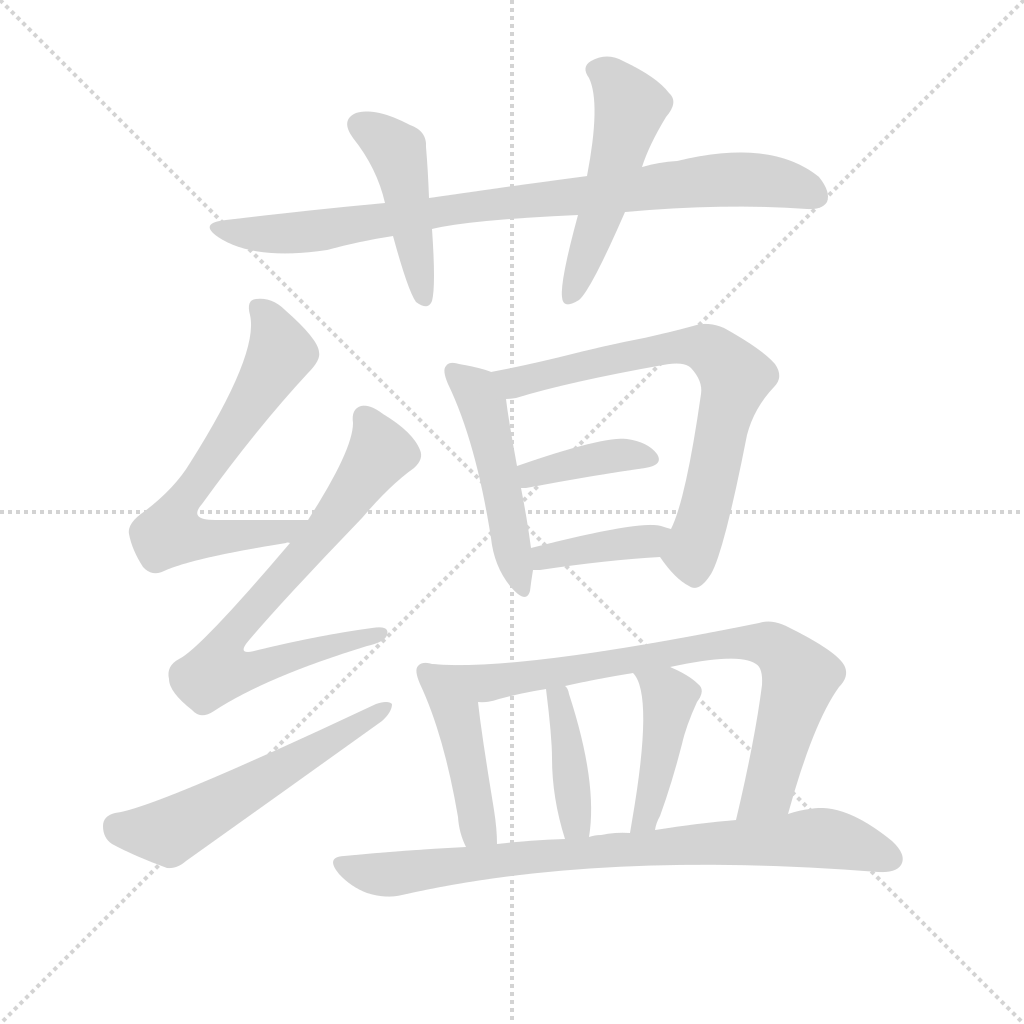
Yun
Kangxi strokes: 22
Page 1068, Entry 01
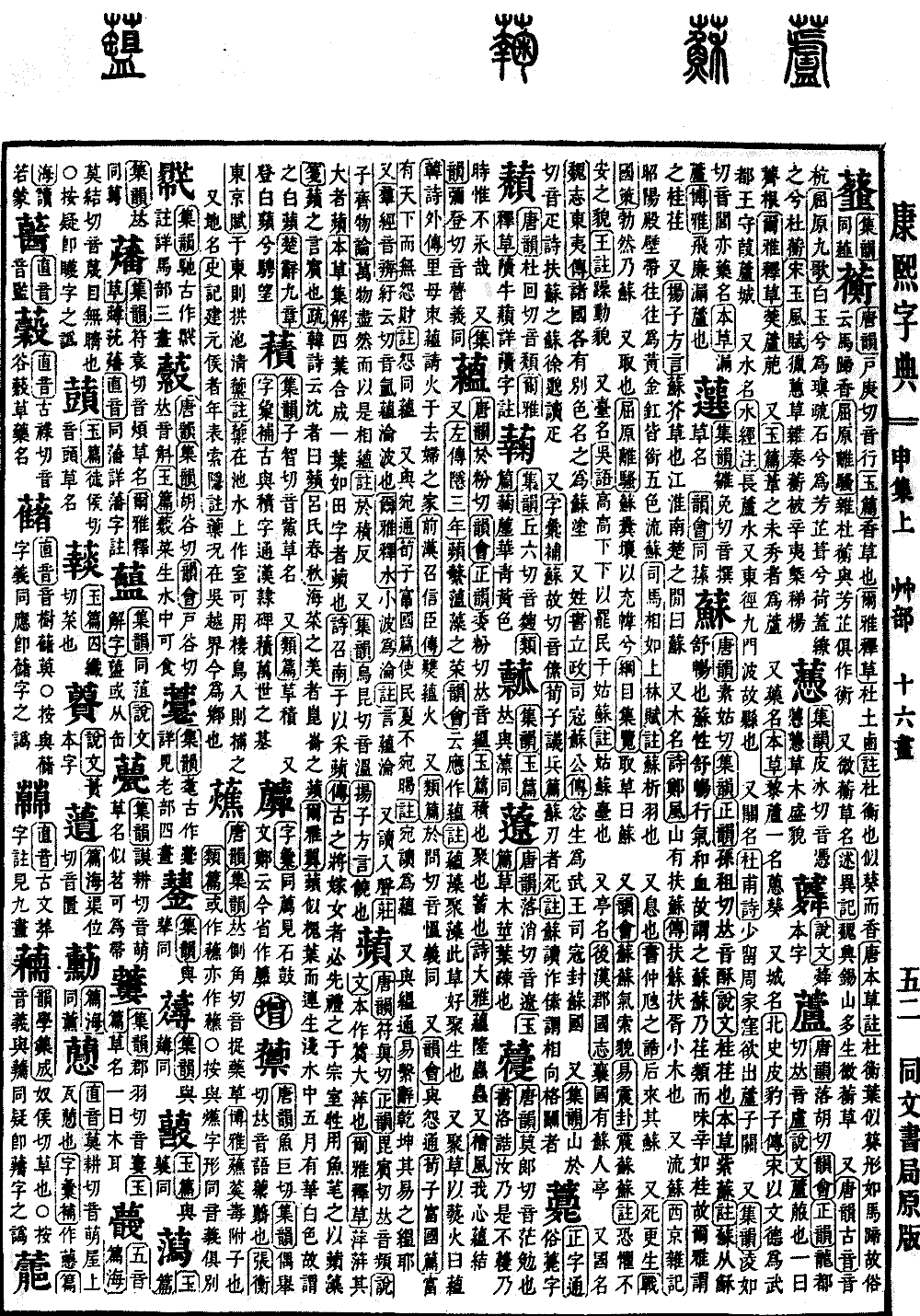
Pronounced yun (falling tone).
According to the Jade Chapters (Yupian), it means to accumulate, to gather, or to store.
As stated in the Book of Odes (Shijing), Great Odes (Daya): accumulated heat with steam rising, a sweltering, dry heat.
Also, in the Book of Odes, Odes of Gui (Guifeng): a knotted, unresolved feeling within the heart.
In the Commentary of Zuo (Zuozhuan), Year 3 of Duke Yin: wild vegetables such as duckweed, artemisia, yun, and algae.
The Rhyme Collection (Yunhui) notes: it should be written as yun. The commentary states: yun algae refers to gathered algae, a type of grass that likes to grow in clusters.
Also, gathering grass for burning is called yun.
In the Outer Commentary of Han Poetry (Han Shi Waizhuan): village women bind hemp and borrow fire from a discarded wife.
In the History of the Former Han (Qian Han Shu), Biography of Shao Xinchen: to store fire.
According to the Classified Chapters (Leipian), it is pronounced yun (falling tone). The meaning is the same.
Also, the Rhyme Collection (Yunhui) states that it is interchangeable with the character for resentment (yuan).
In the Xunzi, Chapter on Enriching the State (Fuguo pian): possessing the wealth of the world without having accumulated assets. The commentary notes: resentment (yuan) is the same as yun.
Also, it is interchangeable with the character for bend (wan).
In the Xunzi, Chapter on Enriching the State (Fuguo pian): so that the people will not suffer from heatstroke in summer. The commentary notes: wan is read as yun.
Also, it is interchangeable with the character for hemp floss (yun).
In the Book of Changes (Yijing), Appended Remarks (Xici): Heaven and Earth are perhaps the gathering place (yun) of the Dao of change.
According to the Distinction of Sounds in the Classics (Qunjing Yinbian), it is pronounced yun (level tone). Yunlun refers to water ripples.
In the Erya, Explaining Water (Shishui): small ripples are called lun. The commentary notes: it refers to yunlun.
Also read in the entering tone. In the Zhuangzi, Discourse on Making All Things Equal (Qiwulun): all things are thus accumulated and contained within one another. The commentary notes: read as yun (entering tone).
According to the Collected Rhymes (Jiyun), it is pronounced wen.
In the Yangzi Dialect (Fangyan): it means to be broad and generous.