Shen Collection, Upper Volume
Radical: Grass (cǎo)
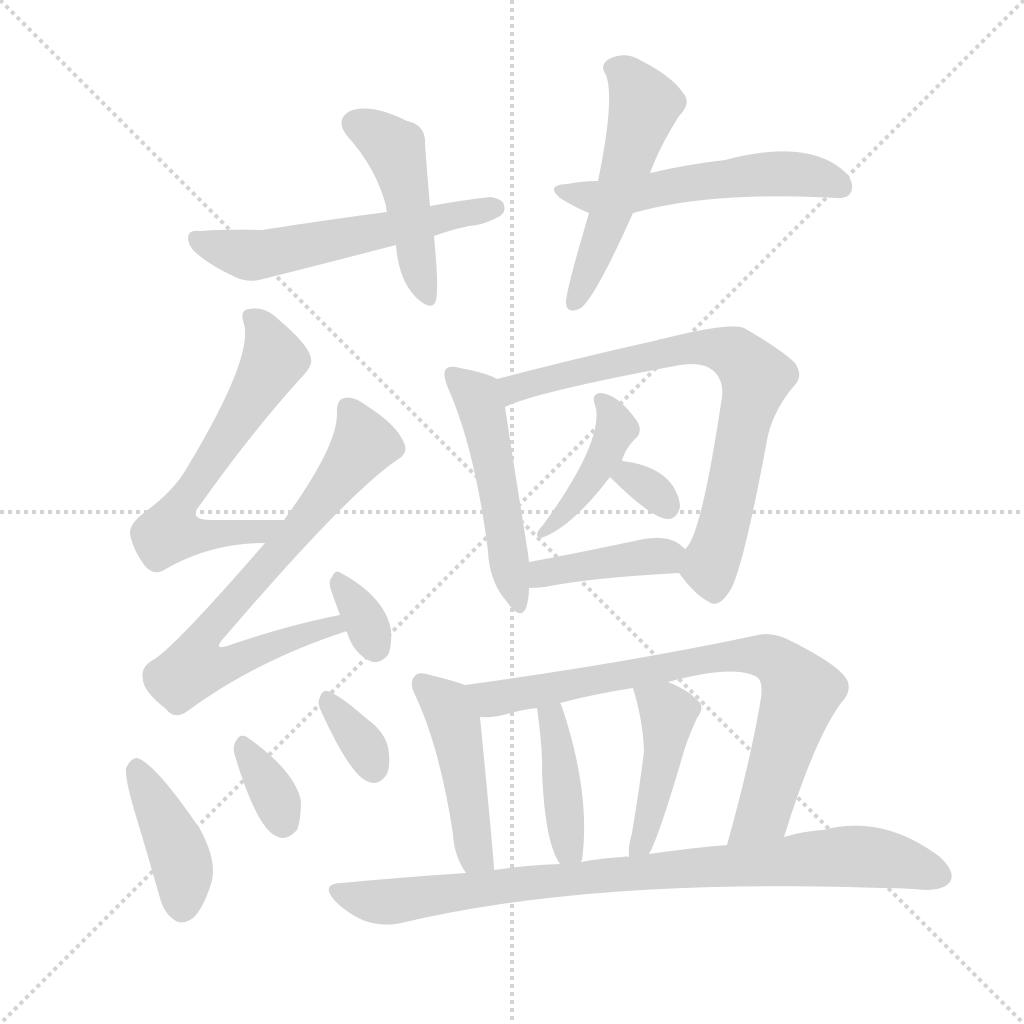
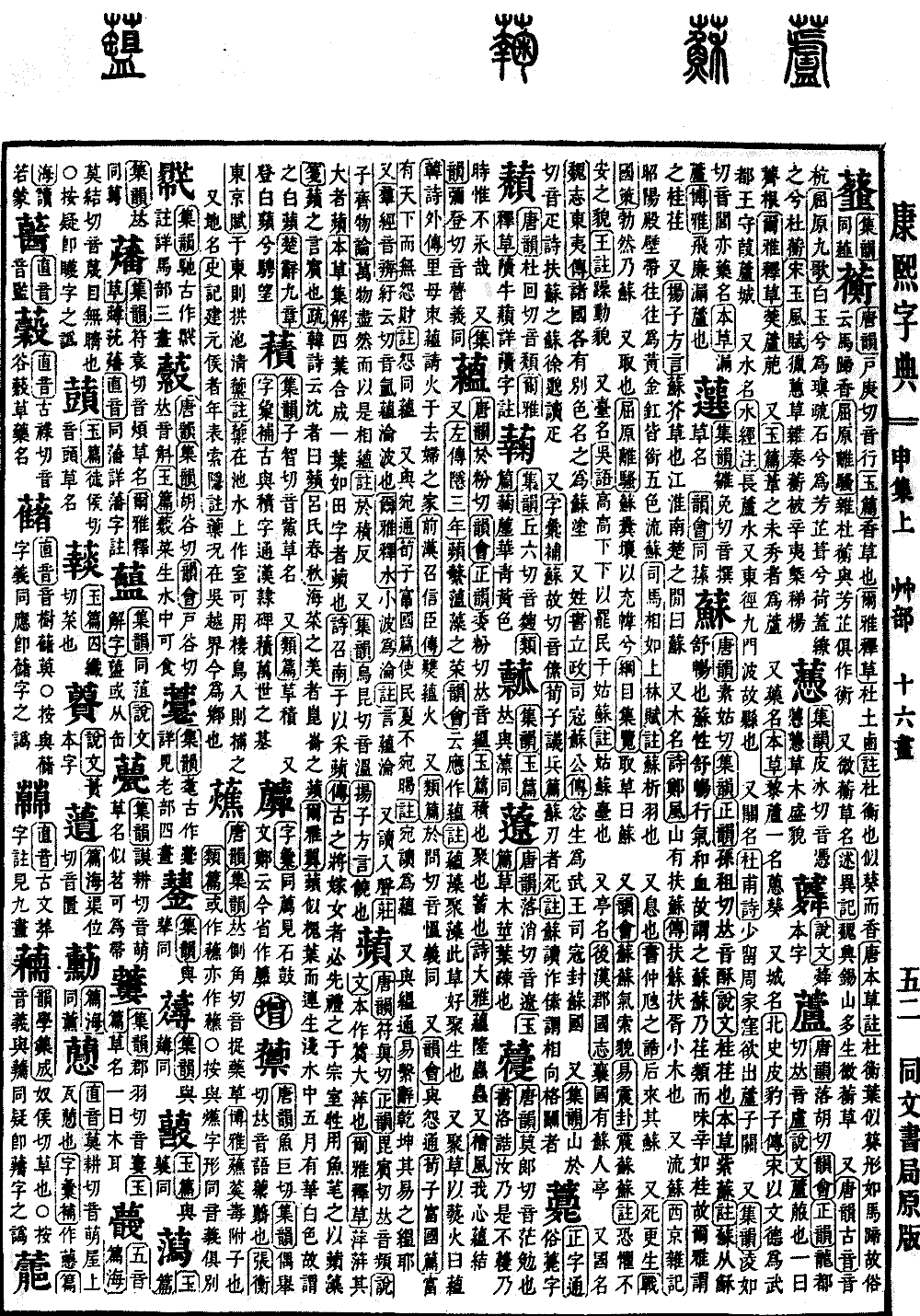
蘊
Kangxi Strokes: 22
Page 1068, Entry 14
Pronounced yun (falling tone).
Jade Chapters (Yupian): To accumulate, to gather, to store.
Book of Odes (Shijing), Greater Odes (Daya): Accumulated and stifling heat.
Also, Cypress Wind (Kuaifeng): My heart is knotted and entangled.
Also, Zuo Tradition (Zuo Zhuan), Third Year of Duke Yin: The vegetables known as pin, fan, yun, and zao.
Dictionary of Rhymes (Yunhui) states: It should be written as 蘊.
Commentary: Yunzao refers to gathered algae; these plants grow well in clusters.
Also, gathering grass for a fire is called yun.
Han Shi Waizhuan: A village woman bundled grass and asked for fire from the house of a divorced wife.
History of the Former Han (Qian Han), Biography of Shao Xinchen: Accumulated fire.
Also, Lei Pian: Pronounced yun (falling tone). The meaning is the same.
Also, Dictionary of Rhymes (Yunhui): Interchangeable with yuan (resentment).
Xunzi, Rich Country (Fuguo): Possessing the wealth of the world without accumulated (yun) resources.
Commentary: Yuan is the same as yun.
Also, interchangeable with wan.
Xunzi, Rich Country (Fuguo): To ensure the people do not suffer from heat exhaustion (wan) in the summer.
Commentary: Wan is read as yun.
Also, interchangeable with yun (hemp floss).
Book of Changes (Yijing), Appended Remarks (Xici): Are Heaven and Earth the essence (yun) of the Book of Changes?
Also, Distinction of Sounds in the Classics (Qunjing Yinbian): Pronounced yun (level tone).
Yunlun refers to small waves.
Erya, Explanation of Water (Shishui): Small waves are called lun.
Commentary: It refers to yunlun.
Also, read as an entering tone.
Zhuangzi, Discussion on Making All Things Equal (Qiwulun): All things are thus, and by this are mutually accumulated (yun).
Commentary: Pronounced yu plus ji (entering tone).
Also, Collection of Rhymes (Jiyun): Pronounced wen.
Yangzi, Dialect (Fangyan): To be abundant.