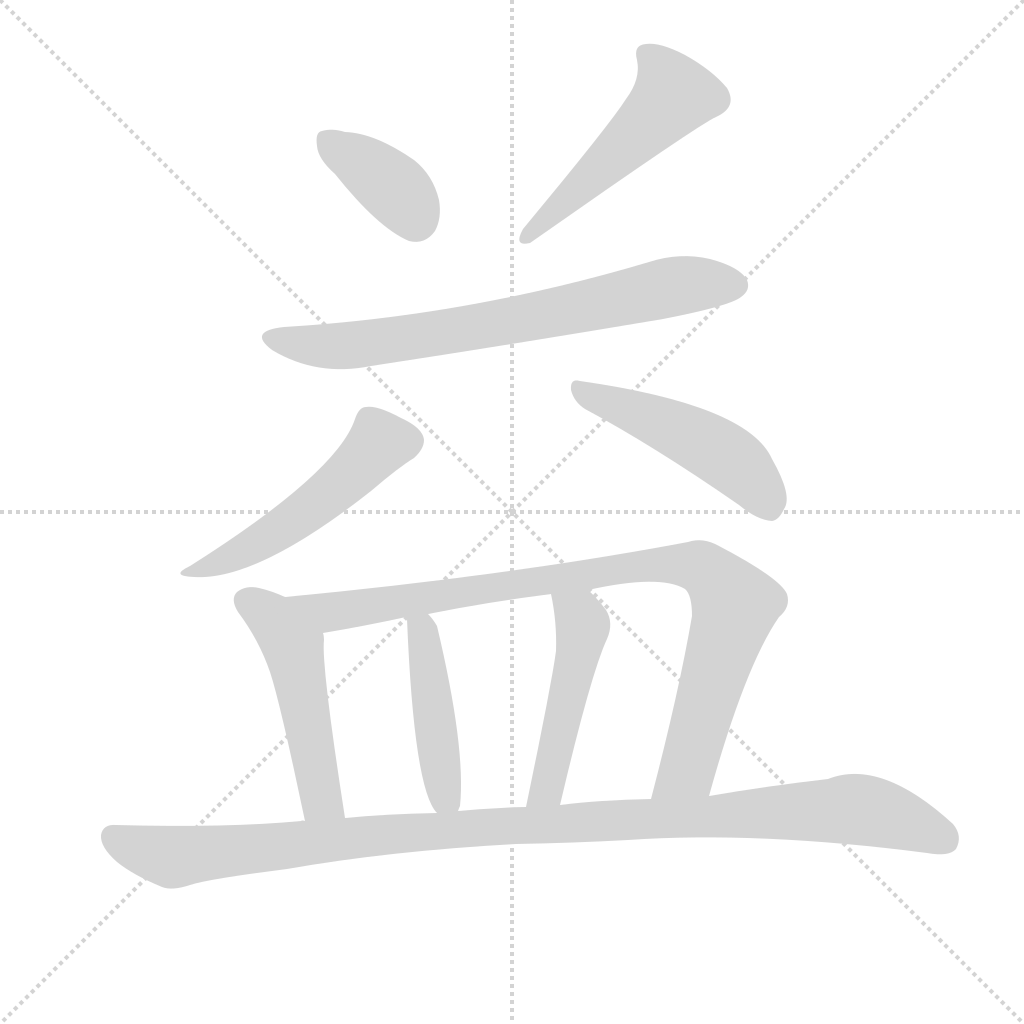
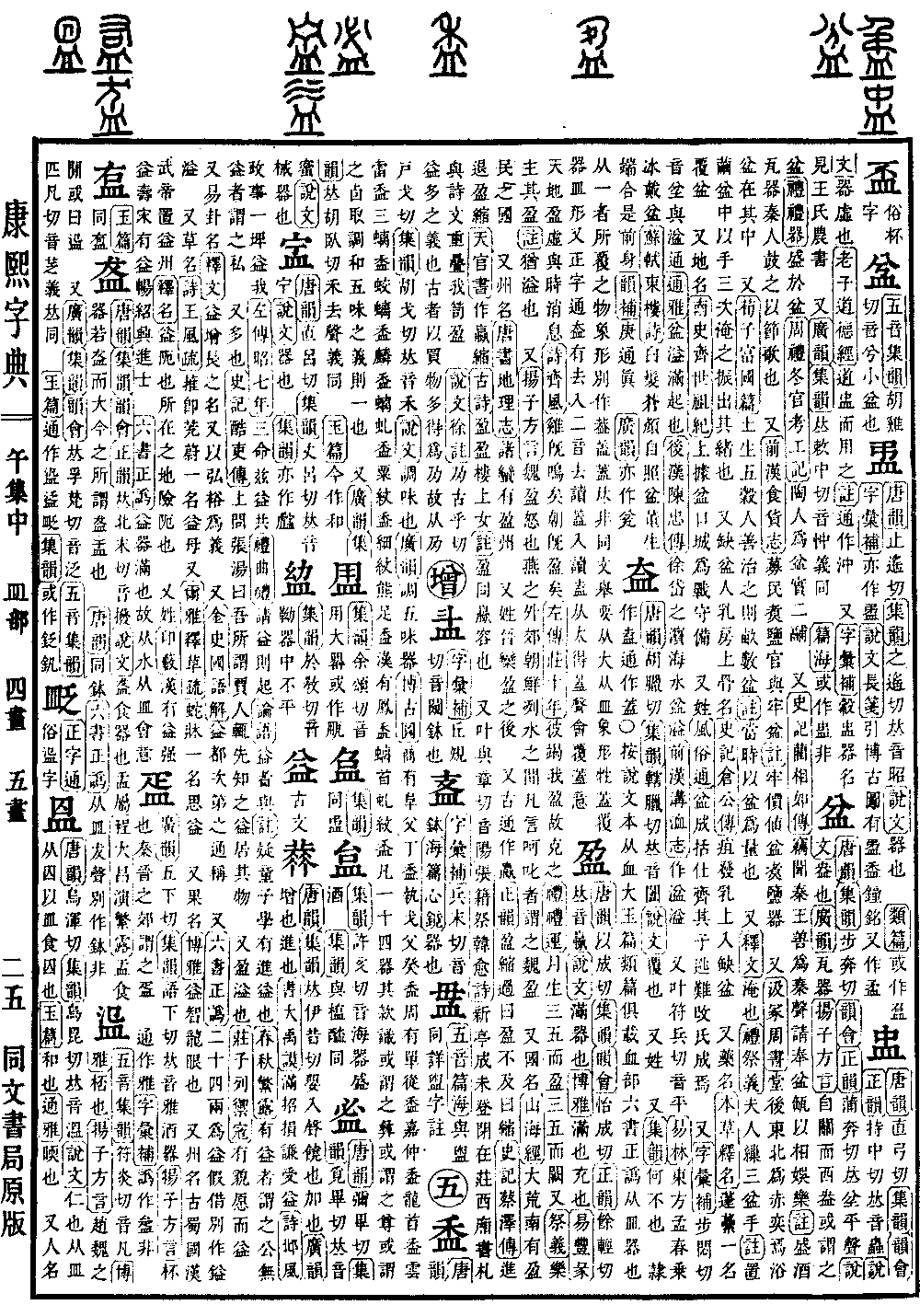
Wu Collection, Middle Volume. Radical: Vessel (mǐn). Kangxi Strokes: 10. Page 793, Entry 18.
Ancient script. According to Tang Rhymes (Tangyun) and Collection of Rhymes (Jiyun), pronounced yi (entering tone). To be abundant; to add. According to Broad Rhymes (Guangyun), to increase; to advance. In the Book of Documents (Shangshu), it is said that self-satisfaction leads to loss, while humility leads to benefit. In the Book of Odes (Shijing), it is said that administrative affairs are all added unto me. In the Zuo Tradition (Zuo Zhuan), it is said that three appointments lead to even greater respect. In the Book of Rites (Liji), it is said that when requesting an increase, one must stand. In the Analects (Lunyu), it is asked: Is this beneficial? The commentary notes that it questions whether the child has made progress and gains in learning. In the Luxuriant Gems of the Spring and Autumn Annals (Chunqiu Fanlu), that which is beneficial is called public, and that which is not is called private. Also, to be many. In the Records of the Grand Historian (Shiji), the Emperor asked Zhang Tang: My intentions are always known by merchants first, who then hoard more of those goods. Also, to overflow. In the Zhuangzi, it refers to those with an honest appearance but a prideful heart overflowing within. Also, the name of a hexagram in the Book of Changes (Yijing). According to the Explanation of Texts (Shiwen), Yi signifies growth. It also holds the meaning of being broad and abundant. In the History of Jin (Jin Shi), Yidu is noted as a general term for order. According to the Six Scripts Corrected (Liushu Zheng'e), twenty-four taels are equal to one yi, which is sometimes written with the characters for yi (a unit of weight) or yi (to overflow). Also, the name of a plant. The commentary to the Book of Odes (Shijing) notes that tui is motherwort, also known as yimu. According to the Erya, shechuang is also known as siyi. Also, the name of a fruit. According to the Guangya, yizhi is the longan. Also, the name of a prefecture. It was the ancient state of Shu, and Emperor Wu of the Han dynasty established Yizhou. According to the Explanation of Names (Shiming), Yi means a dangerous and narrow pass, referring to a place that is strategically located and obstructed. Also, a surname. According to the Yin Sou, there was Yi Qiang and Yi Shou during the Han dynasty, and Yi Chang, a presented scholar during the Shaoxing era of the Song dynasty. According to the Six Scripts Corrected, the character Yi depicts a vessel filled to the brim. Therefore, it is composed of the radicals for water and vessel, making it a compound ideograph.