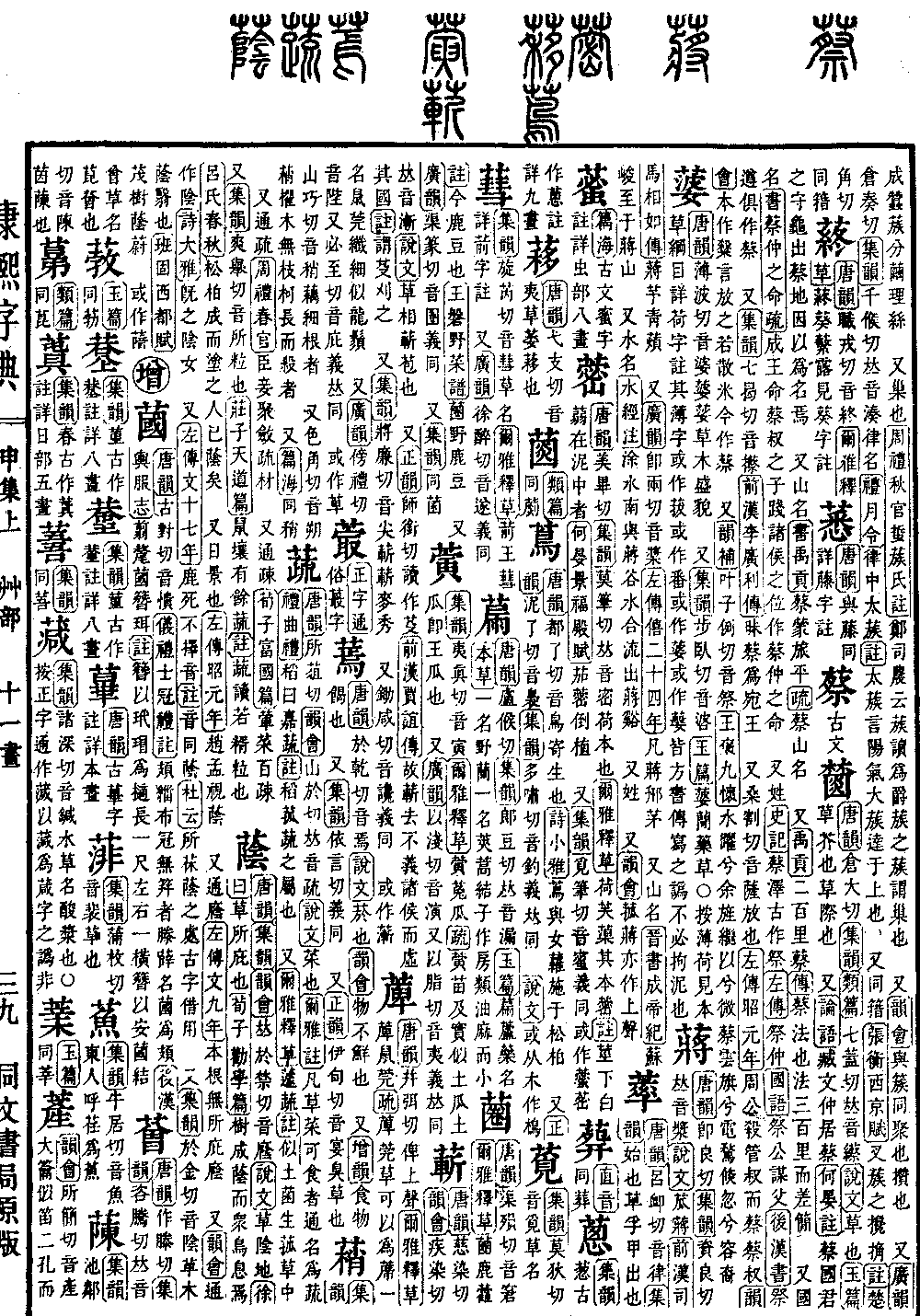
Shen Collection, Upper Volume
Radical: Grass (cǎo)
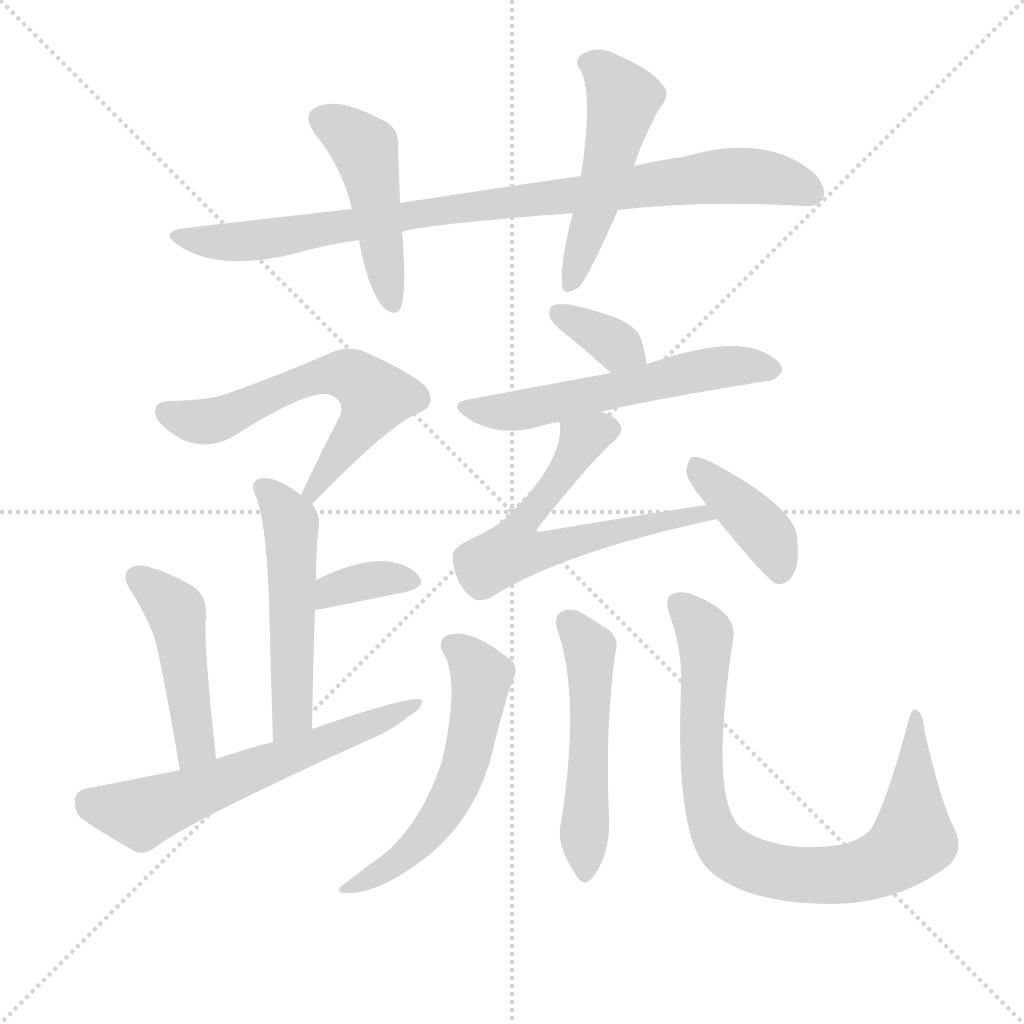
蔬
Kangxi Dictionary strokes: 17
Page 1055, Entry 25
Pronounced shu.
According to the Explaining Graphs and Analyzing Characters (Shuowen Jiezi), it refers to vegetables.
According to the Commentary on the Erya (Erya Zhu), all plant-based greens that are edible are collectively referred to as shu.
According to the Book of Rites (Liji), specifically the section on Summary of the Rules of Propriety (Qu Li): Rice is called jia shu. The commentary notes that rice belongs to the category of water-grass and vegetable produce.
Also appears in the Erya, section on Explaining Grasses (Shi Cao): Qu shu. The commentary notes it resembles a ground fungus that grows among water-grasses.
Also used interchangeably with the character pronounced shu (meaning sparse/distant).
According to the Rites of Zhou (Zhouli), section on Offices of Heaven (Tianguan): Subjects gather sparse materials.
Also used interchangeably with the character pronounced shu (meaning sparse/distant).
According to the Xunzi, section on Enriching the State (Fu Guo Pian): A hundred kinds of vegetables and greens.
According to the Compilation of Rhymes (Jiyun), pronounced suo. It means grains.
According to the Zhuangzi, section on The Way of Heaven (Tiandao Pian): The soil has surplus grain. The commentary notes that here, shu is read as xu, meaning grains.
Textual research: In the Rites of Zhou, section on Offices of Spring (Chunguan), it says subjects gather sparse materials. We have corrected this to Offices of Heaven (Tianguan) in accordance with the original text.