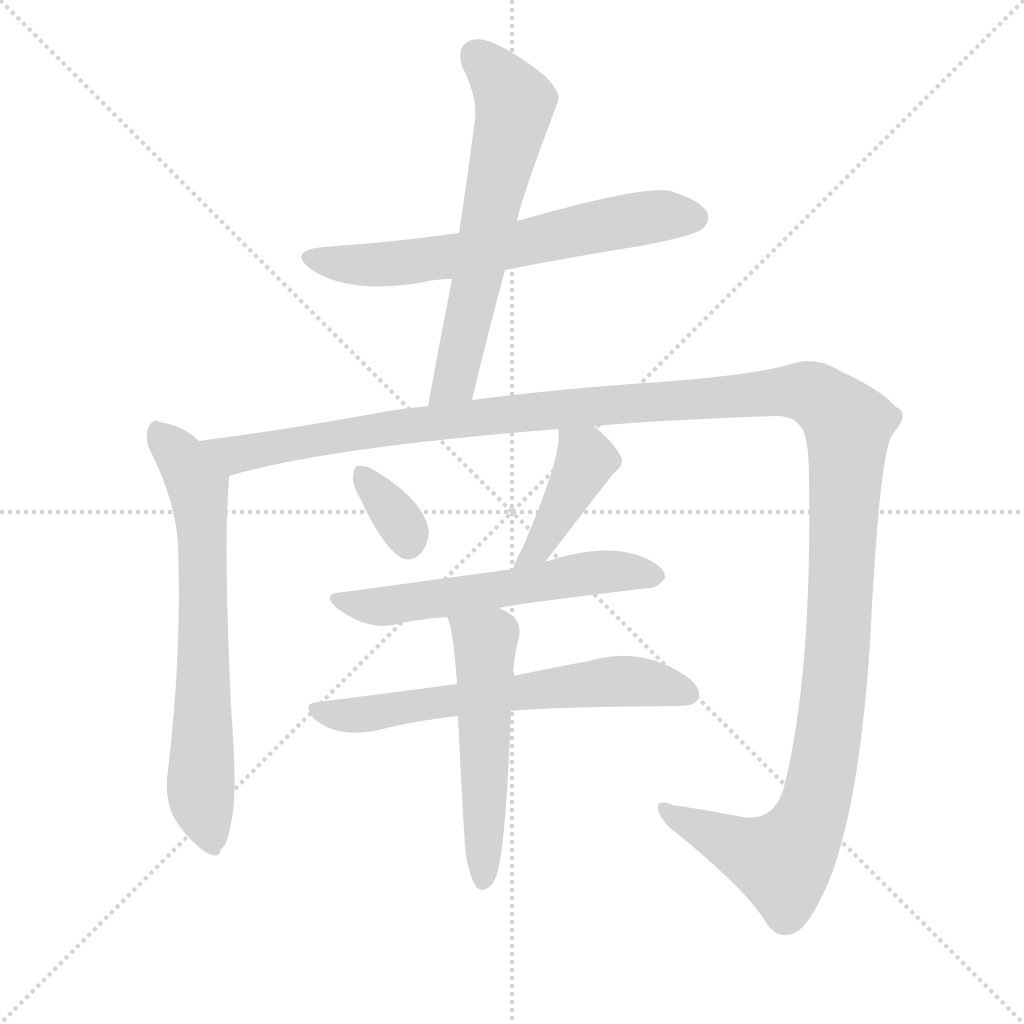
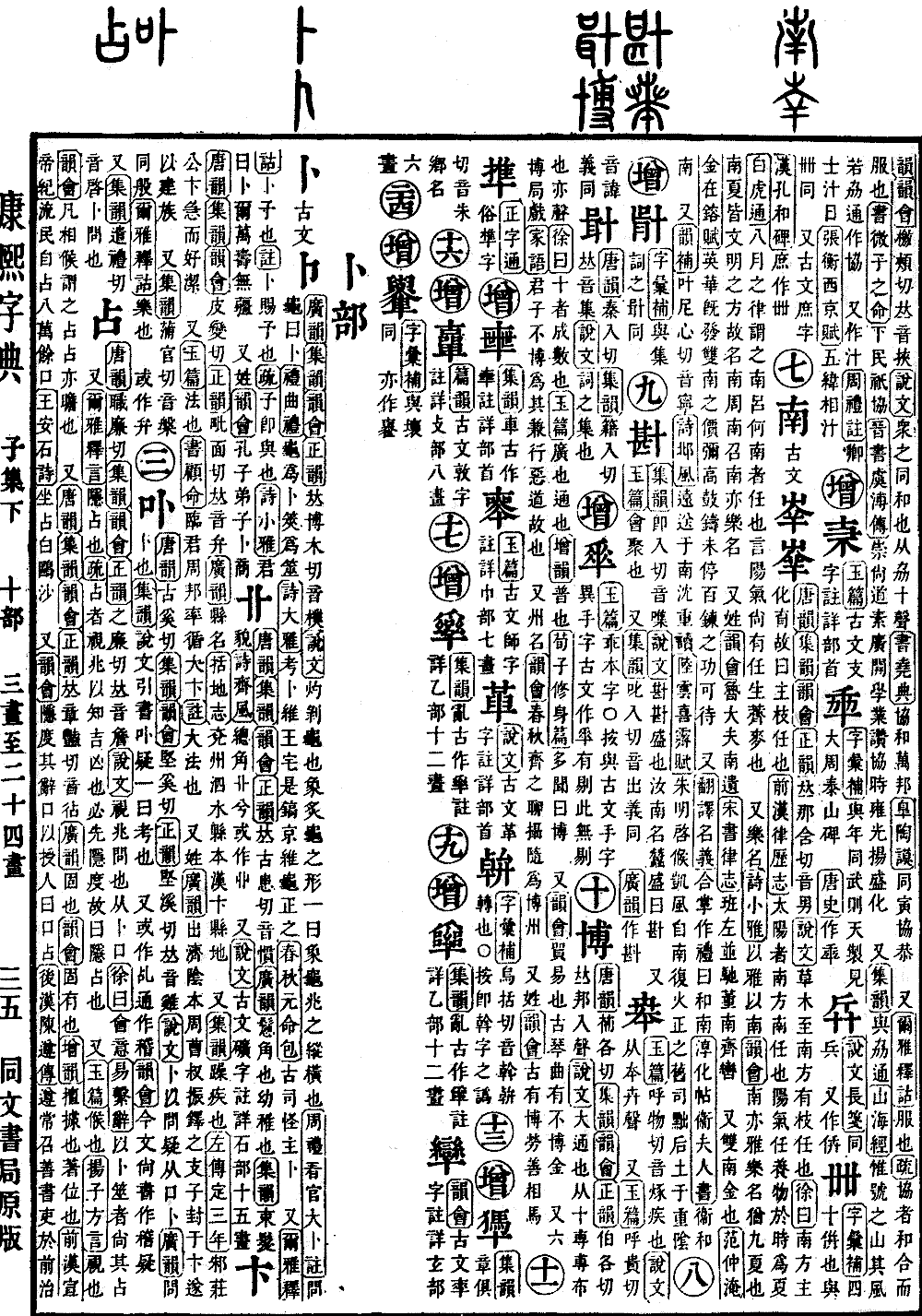
Zi Collection, Page Position: Lower
Radical: Ten (shí)
Kangxi stroke count: 9
Page 157, Entry 05
Ancient character form.
Pronounced nan.
According to the Book of Tang (Tangyun), Collection of Rhymes (Jiyun), Collected Rhymes (Yunhui), and Correct Rhymes (Zhengyun), it is pronounced nan (rising tone).
The Explanation of Graphs and Analysis of Characters (Shuowen Jiezi) states that when plants reach the south, they have branches capable of sustaining growth.
Xu states that the south governs transformation and nourishment; therefore, it is said to govern the burden of the branches.
The History of the Former Han (Qianhan Shu), Treatise on Harmonics and Calendrical Astronomy (Luli Zhi) notes that the Great Sun is the south. Nan signifies to bear or sustain. The yang energy sustains the nourishment of all things, corresponding to summer in the seasons.
The White Tiger Hall Discussions (Baihu Tong) asks why the musical pitch of the eighth month is called Nanlü. Nan means to bear. It refers to the fact that the yang energy still has the capacity to foster the growth of shepherd's purse and wheat.
Also refers to a type of musical piece.
The Book of Odes (Shijing), Lesser Odes (Xiao Ya) mentions performing refined music and southern music.
The Collected Rhymes (Yunhui) notes that Nan is also the name of a type of refined music, similar to the Nine Summers (Jiuxia). Nan and Summer both represent the direction of civilization, hence it is called Nan. Zhou Nan and Zhao Nan are also names of musical pieces.
Also refers to a surname.
The Collected Rhymes (Yunhui) notes there was a high official in the State of Lu named Nanyi.
The Book of Song (Song Shu), Treatise on Harmonics (Lü Zhi) mentions that Ban Gu and Zuo Si are of equal stature, and Dong Zhongshu and the Nan family are on par with each other.
Also, double nan refers to gold.
Fan Zhongyan in his Rhapsody on Gold in the Crucible (Jin Zai Rong Fu) writes that once the essence has manifested, the value of the double nan gold becomes even higher. The bellows blow and casting never ceases; one can look forward to the results of a thousand hammerings and hundred refinings.
Also, according to the Translation of Terms (Fanyi Mingyi), pressing palms together in greeting is called henan.
In the Chunhua Imperial Model Calligraphy (Chunhua Tie), Lady Wei writes: Wei henan (Lady Wei respectfully presents).
Also, according to the Rhyme Supplement (Yunbu), it is pronounced ning (level tone).
The Book of Odes (Shijing), Odes of Bei (Beifeng) mentions sending someone off far to the south. Shen Chong reads this as the sound of ning.
Lu Yun, in his Rhapsody on Rejoicing at the Clearing Sky (Xi Ji Fu), writes that midsummer begins, the gentle breeze blows from the south, restoring the original duties of the Fire Officer (deity of summer), and dismissing the Earth Deity (Houtu) from the heavy yin energy.