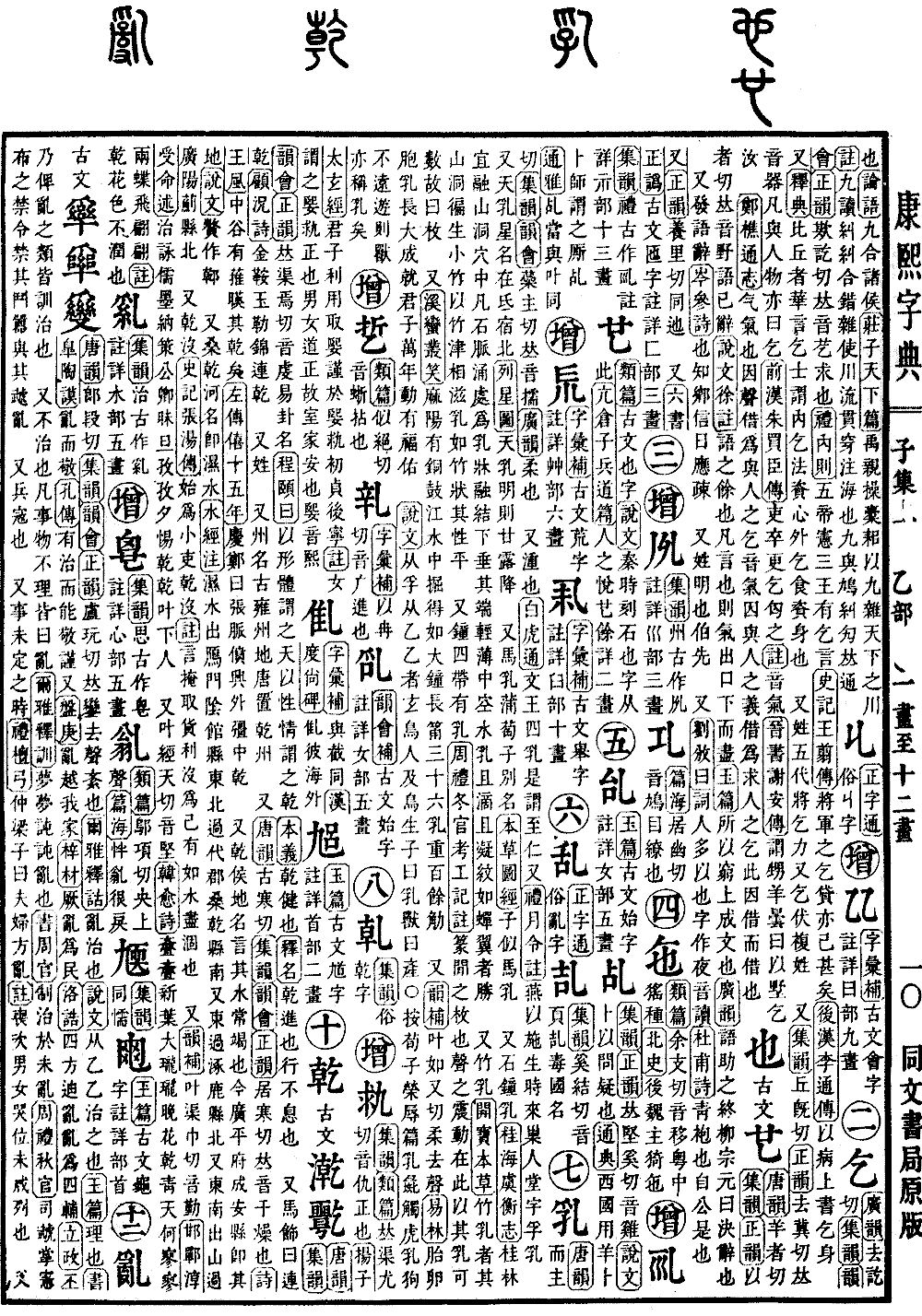
Zi Collection, Page Position: Upper. Radical: Second (yǐ). Qian. Kangxi Dictionary strokes: 11. Page 84, Line 25. Written as jian in ancient texts. Tang Rhymes (Tangyun), Collected Rhymes (Jiyun), Rhyme Assembly (Yunhui), and Correct Rhymes (Zhengyun) indicate the pronunciation as a fanqie of qu and yan, pronounced the same as qian. It is the name of a hexagram in the Book of Changes (Yijing). Cheng Yi said: In terms of physical form it is called Heaven (tian), and in terms of character it is called Qian. The original meaning of Qian is strong and vigorous. Explaining Names (Shiming) states: Qian means to advance, moving without ceasing. It also refers to horse ornaments called lianqian. Gu Kuang's poem states: Golden saddles and jade bridles with brocade lianqian. It is also a surname. It is also the name of a prefecture. In ancient times it belonged to the region of Yongzhou; Qian Prefecture (Qianzhou) was established during the Tang Dynasty. Also, Tang Rhymes indicates the pronunciation as a fanqie of gu and han, while Collected Rhymes, Rhyme Assembly, and Correct Rhymes indicate it as a fanqie of ju and han, pronounced the same as gan. It means dry. Book of Odes (Shijing) states: In the valley is the motherwort, parched and dry. Zuo Commentary (Zuozhuan) for the 15th Year of Duke Xi states: Qing Zheng said: The blood vessels are swollen, appearing strong on the outside but dry on the inside. There is also Qianhou, which is a place name. It means the water there often dries up. This place is in present-day Cheng'an County, Guangping Prefecture. In Explaining Graphs and Analyzing Characters (Shuowen Jiezi), it is written in a specific ancient form. There is also Sanggan, the name of a river. It is the Shi River (Shishui). Commentary on the Water Classic (Shuijingzhu) states: The Shi River originates northeast of Yinguan County in Yanmen, flows past the south of Sanggan County in Dai Commandery, then flows east past the north of Zhuolu County, and then southeast out of the mountains past the north of Ji County in Guangyang. There is also qianmei. Records of the Grand Historian (Shiji) in the Biography of Zhang Tang states: When he first served as a minor official, he practiced qianmei. The note explains that it means to embezzle wealth and benefits for oneself, just as water completely dries up. Also, Rhyme Supplement (Yunbu) indicates a rhyming pronunciation as a fanqie of qu and jin, pronounced the same as qin. Han Dan Chun's Shou Ming Shu states: Studying and chanting the doctrines of Confucianism and Mohism, presenting strategies to the high officials. Diligent in the morning and vigilant at night. The rhyming sound rhymes with ren. Also, another rhyming pronunciation is a fanqie of jing and tian, pronounced the same as jian. Han Yu's poem states: New leaves are large, the late flowers appear dry. The blue sky is so vast, rain butterflies fly gracefully. The note explains that gan refers to the color of the flower not being moist.