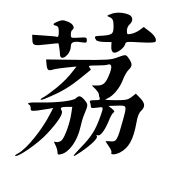
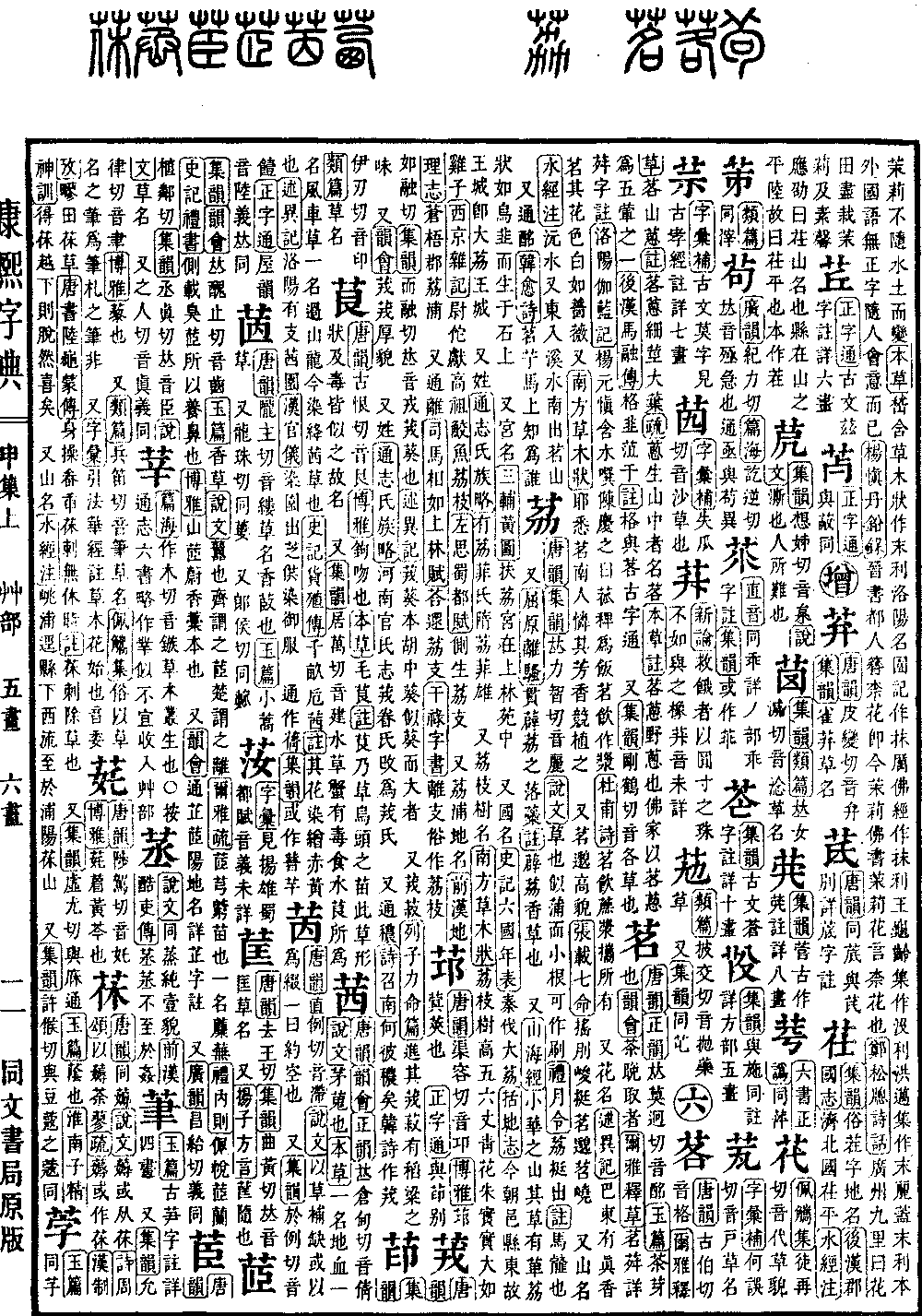
Shen Collection, Upper Volume
Radical: Grass (cǎo)
Kangxi Strokes: 12
Page 1027, Entry 23
Tang Rhymes (Tangyun), Collected Rhymes (Jiyun): Pronounced li (falling tone).
Shuowen Jiezi: A type of grass, similar to cattail but smaller; the roots can be used to make brushes.
Book of Rites (Liji), Monthly Ordinances (Yueling): The liting grass emerges. Commentary: Refers to horse chives.
Also, Qu Yuan, Encountering Sorrow (Lisao): Stringing together the fallen blossoms of the creeping fig (bìlì). Commentary: Bìlì is a type of fragrant herb.
Also, Classic of Mountains and Seas (Shanhaijing): On Small Flower Mountain, there is a grass called beili, which looks like black spleenwort and grows on stones.
Also, the name of a palace. Three Capitals Yellow Map (Sanfu Huangtu): Fuli Palace, located within the Shanglin Park.
Also, a state name. Records of the Grand Historian (Shiji), Chronological Tables of the Six States: The State of Qin attacked the State of Dali. Geography of National Histories (Kuodizhi): The current old royal city east of Chaoyi County is the capital of the King of Dali.
Also, a surname. Comprehensive Record (Tongzhi), Treatise on Clans: There is the Lifei clan; during the Sui Dynasty, there was Lifei Xiong.
Also, litchi, a tree name. Plants and Trees of the South (Nanfang Caomuzhuang): The litchi tree is five or six zhang tall, blooms with green flowers, and bears red fruit; the fruit is as large as a chicken egg. Western Capital Miscellaneous Records (Xijing Zaji): Zhao Tuo presented a shark and litchis to the Gaozu Emperor. Zuo Si, Rhapsody on the Capital of Shu (Shudu Fu): Litchi trees grow on the sides.
Also, Lipu, a place name. Book of Han (Hanshu), Treatise on Geography: Cangwu Commandery has Lipu County.
Also, interchangeable with the character li (to separate). Sima Xiangru, Rhapsody on the Shanglin Park (Shanglin Fu): The clustering of litchi trees. Book of Characters for Official Salary (Ganlu Zishu): Li-zhi is commonly written as litchi.