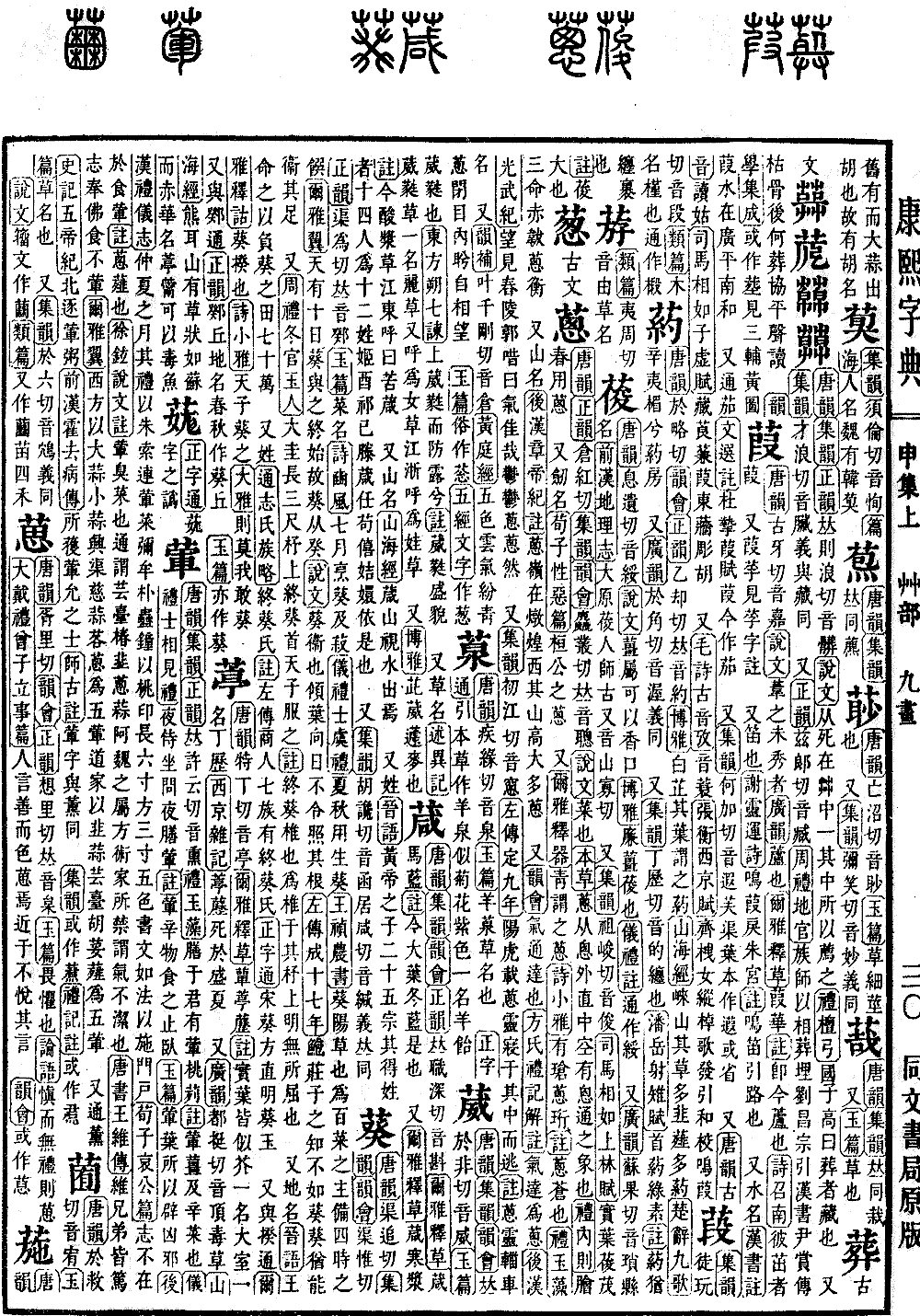
Shen Collection, Upper Volume
Radical: Grass (cǎo)
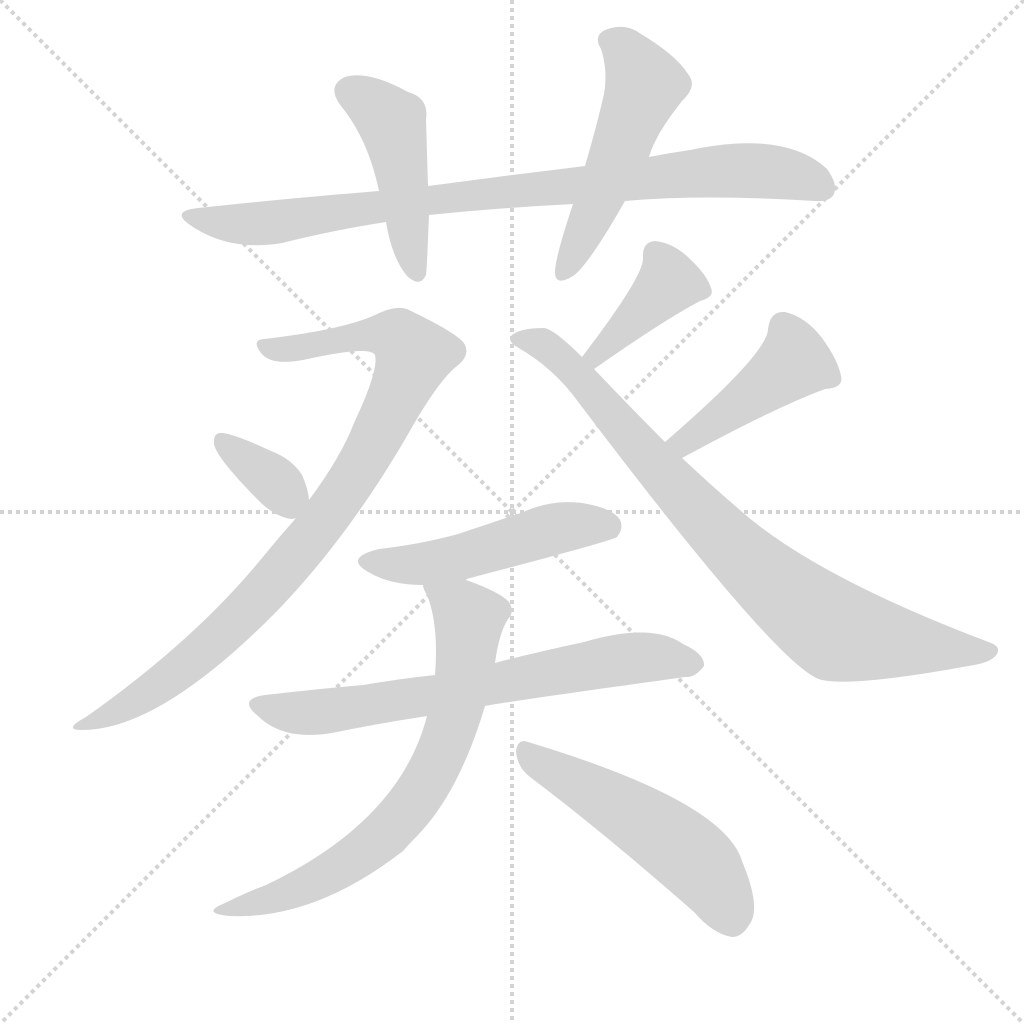
Kui
Kangxi stroke count: 15
Page 1046, Entry 20
Pronounced kui (level tone).
Yupian (Dictionary of Characters): The name of a vegetable.
Book of Odes (Shijing): In the seventh month, we cook mallow and beans.
Book of Etiquette and Ceremonial (Yili): In the notes on the guest ritual, it is recorded that raw mallow is used in summer and autumn.
Wang Zhen’s Book of Agriculture (Nongshu): Mallow is a plant that follows the sun. It is the master of all vegetables and is available in all four seasons.
Wings of the Er’ya (Eryayi): There are ten suns in the sky, and the mallow follows them from start to finish; therefore, the character for mallow is derived from the character for kui.
Zuo Commentary (Zuozhuan), seventeenth year of Duke Cheng: The wisdom of Bao Zhuangzi is not equal to that of the mallow, for the mallow is still able to protect its roots. Du Yu’s commentary notes that the mallow tilts its leaves toward the sun to shade its roots.
Rites of Zhou (Zhouli): The Great Jade Tablet is three feet long; it is tapered at the top, with a Zhongkui (a mallet-shaped head), which the Son of Heaven wears.
Commentary: Zhongkui is a mallet. It is shaped like a mallet on the tablet, signifying that there is no yielding.
Also a place name.
Discourses of the States (Jinyu): I bestowed upon him seven hundred thousand fields in Fukui.
Also a surname.
Comprehensive Treatise (Tongzhi), Treatise on Clans and Lineages: The Zhongkui clan.
Commentary: In the Zuo Commentary, it is noted that among the seven clans of the Shang dynasty, there was the Zhongkui clan.
True Meaning of Characters (Zhengzitong): Song dynasty Kui Fangzhi; Ming dynasty Kui Yu.
Also used interchangeably with kui (to measure or manage).
Er’ya: Mallow means to manage.
Book of Odes (Shijing): The Son of Heaven manages it.
Great Elegantia (Daya): Then no one dares to manage me.
Also used interchangeably with the place name Kui (qí).
Standard Rhymes (Zhengyun): Kuiqiu is a place name; in the Spring and Autumn Annals (Chunqiu), it is written as Kuiqiu.
Yupian (Dictionary of Characters): Also written as the variant form (kui).
Shuowen Jiezi (Explanation of Characters): This is the original character for mallow.
Textual research:
Book of Etiquette and Ceremonial (Yili): Summer and autumn use raw mallow. We note that this is the commentary by Zheng and not the original scripture text; we have added the two words for record and note following the original text.
Shuowen Jiezi (Explanation of Characters): Mallow, to protect, tilting its leaves toward the sun so as not to let the sun shine on its roots. We note that this text does not appear in the Shuowen; we have amended the citation from the Zuo Commentary below to read: Zuo Commentary, seventeenth year of Duke Cheng, the wisdom of Bao Zhuangzi is not equal to that of the mallow, for the mallow is still able to protect its roots. Du Yu’s commentary notes that the mallow tilts its leaves toward the sun to shade its roots.
Discourses of the States (Jinyu): The king bestowed upon him seven hundred thousand fields in Fukui. We have corrected the king to I in accordance with the original text.