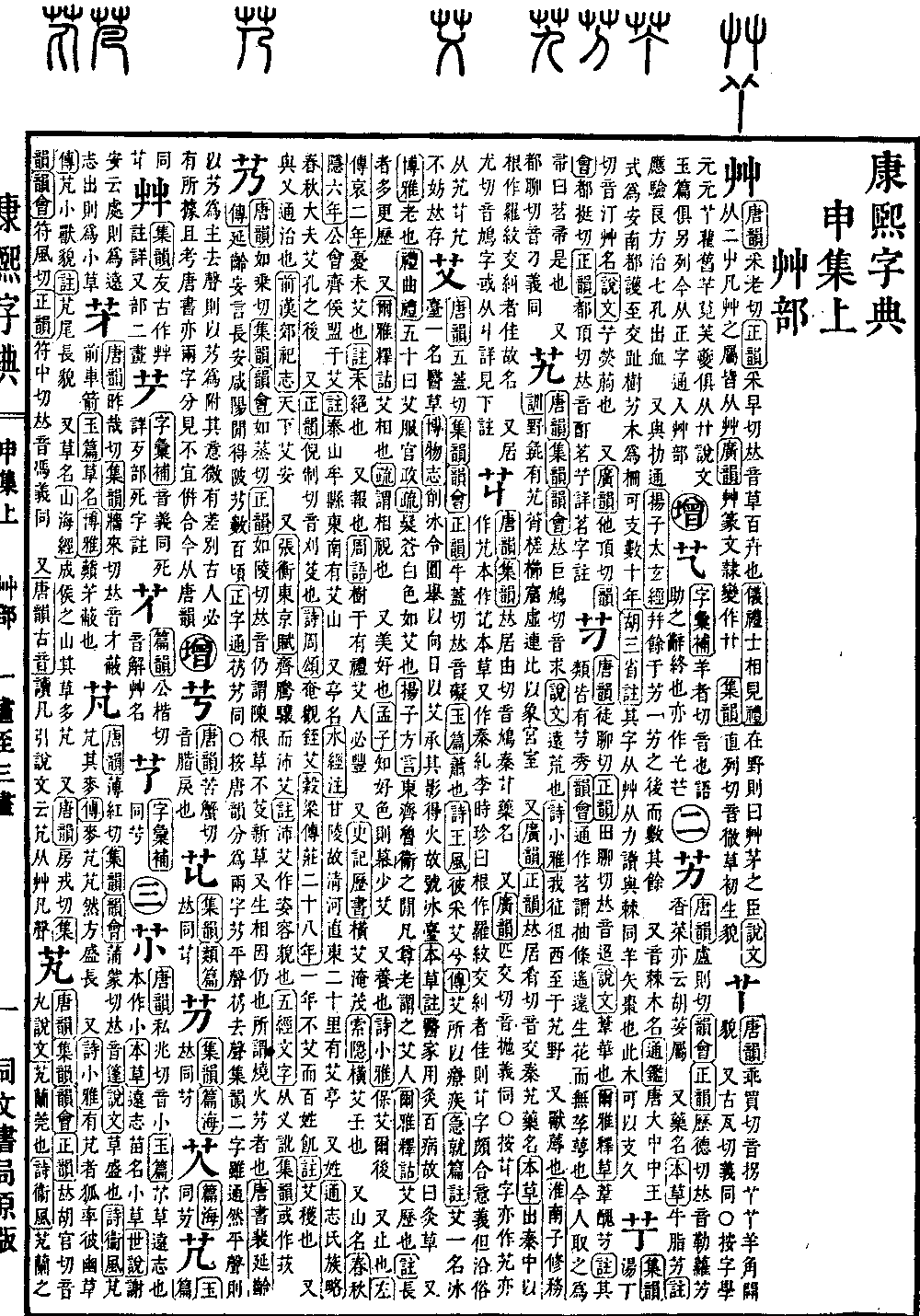
Shen Collection, Upper Volume
Radical: Grass (cǎo)
艿
Kangxi strokes: 8
Page 1017, Entry 10
Pronounced reng (level tone). Refers to old grass roots that have not been cleared away, with new grass growing over them in a continuous, connected manner. This is what is meant by grass that is burned for fuel.
Tang Dynasty History (Tangshu), Biography of Pei Yanling: Pei Yanling claimed in his confusion that he had obtained several hundred qing of land covered in nai grass near the ponds in the Chang'an and Xianyang regions.
Orthography Manual (Zhengzitong): The characters reng and nai are the same. According to the Tang Rhymes (Tangyun), they are separated into two distinct characters; nai is read with a level tone, and reng is read with a departing tone. While the Rhyme Collection (Jiyun) suggests these two characters are interchangeable, it specifies that when read with a level tone, nai is the primary form, and when read with a departing tone, nai is considered a subordinate form, noting that their meanings differ slightly and that the ancients surely had a basis for this distinction. Furthermore, examination of the Tang Dynasty History (Tangshu) shows both characters appearing separately; they should not be conflated. We now follow the Tang Rhymes (Tangyun).