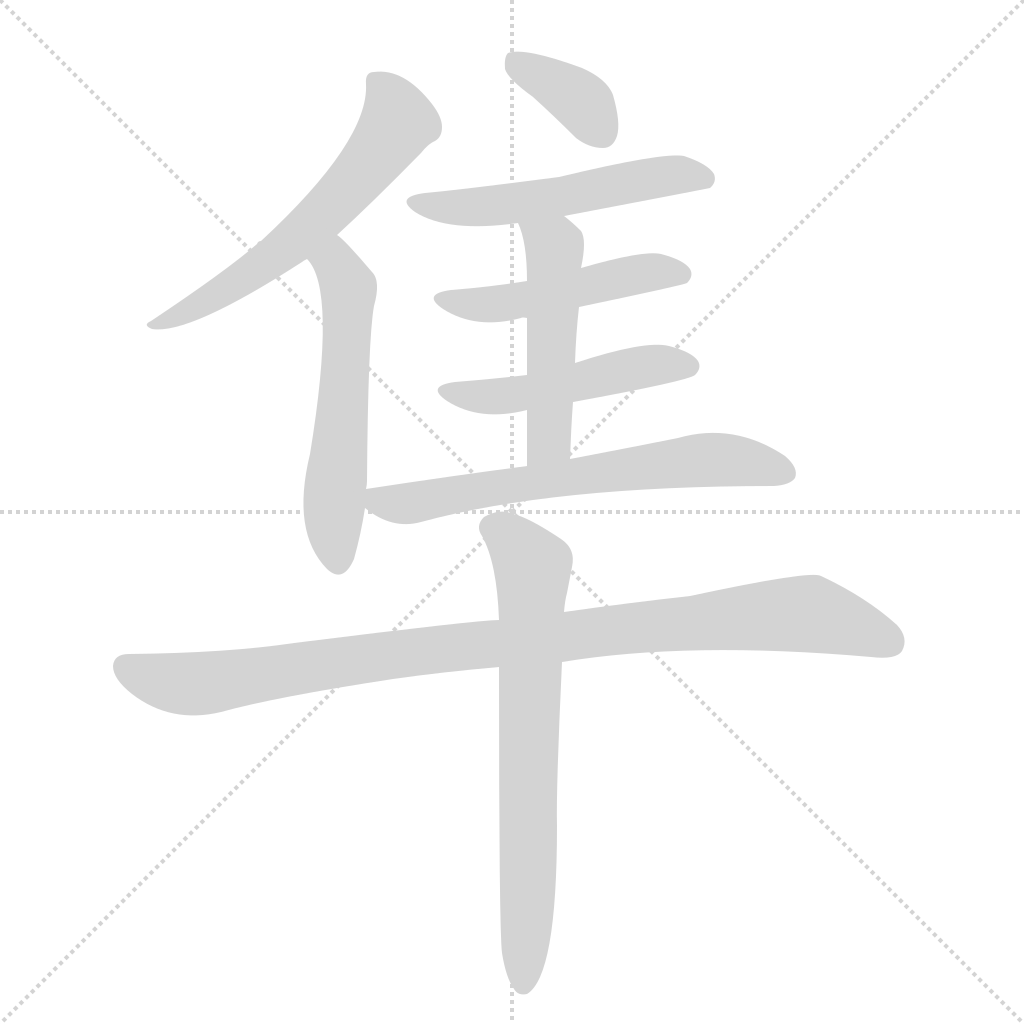
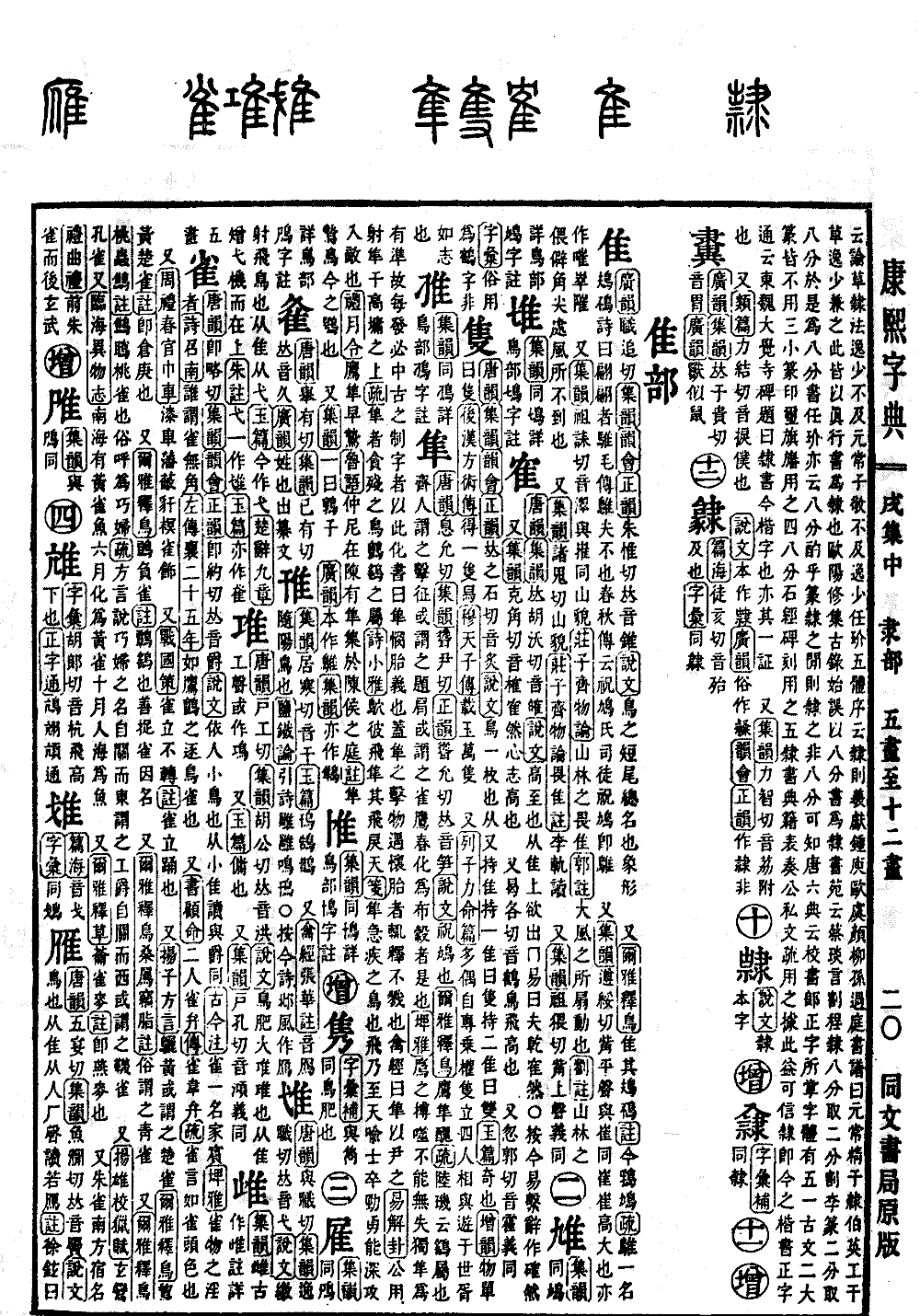
Xu Collection, Middle Volume
Radical: Short-tailed bird (zhuī)
Kangxi Strokes: 10
Page 1364, Entry 11
Pronounced sun (rising tone).
Explaining Characters and Writing (Shuowen): A type of dove.
Approaching Elegance (Erya), Explanation of Birds: The hawk and falcon group.
Commentary: Lu Ji states: It belongs to the hawk family. The people of Qi call it the attacking征 (zhēng), or sometimes the shoulder-striker, or the sparrow hawk. In the spring, it transforms into a cuckoo.
Expanded Elegantia (Piya): When hawks hunt, they cannot avoid mistakes, but the falcon alone is precise, so every strike hits its mark. The creators of ancient characters used this to form the character for falcon, incorporating the meaning of pitying the unborn. When a falcon strikes prey, if it encounters one that is pregnant, it immediately releases it and does not kill it. Classic of Birds (Qin Jing) states: The falcon is the overseer.
Book of Changes (Yi), Interpretation Hexagram: The duke shoots a falcon upon the high wall.
Commentary: The falcon is a greedy and cruel bird, belonging to the species of hawks and harriers.
Book of Odes (Shijing), Lesser Odes: Swiftly flies the falcon, its flight reaching the heavens.
Commentary: The falcon is a swift and fierce bird; its flight reaches the heavens, a metaphor for soldiers who are brave and can penetrate deep into enemy territory.
Book of Rites (Liji), Monthly Ordinances: Hawks and falcons become fierce.
Discourses of the States (Lu Yu): Confucius was present, and a falcon alighted in the courtyard of the Marquis.
Commentary: The falcon is a bird of prey, the modern osprey.
Also, Collective Rhymes (Jiyun): One meaning is a quail chick.
Broad Rhymes (Guangyun): Originally written as a variant form (zhui).
Collective Rhymes (Jiyun): Also written as a variant form (sun).