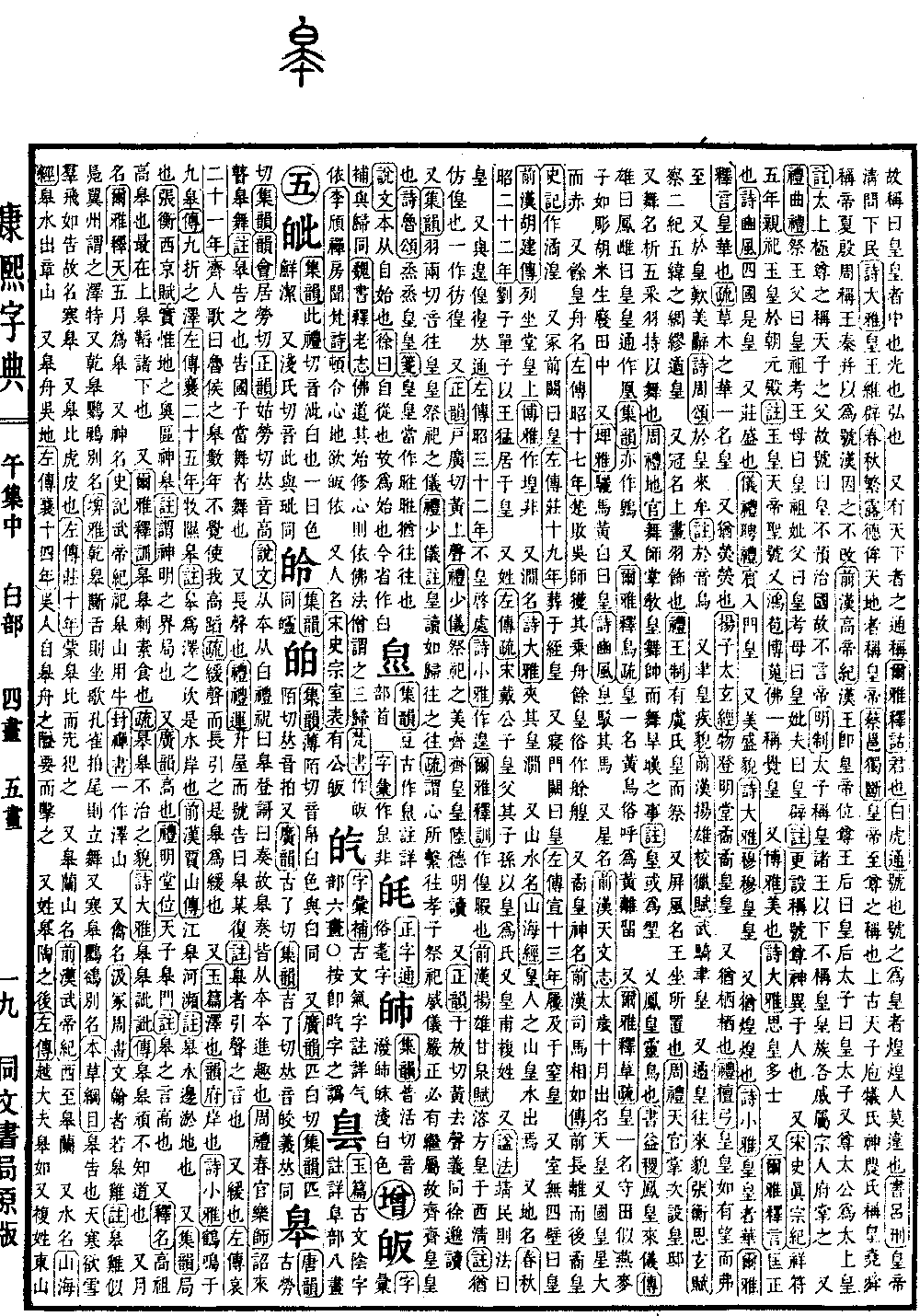
Wu Collection, Middle Volume
Radical: White (bái)
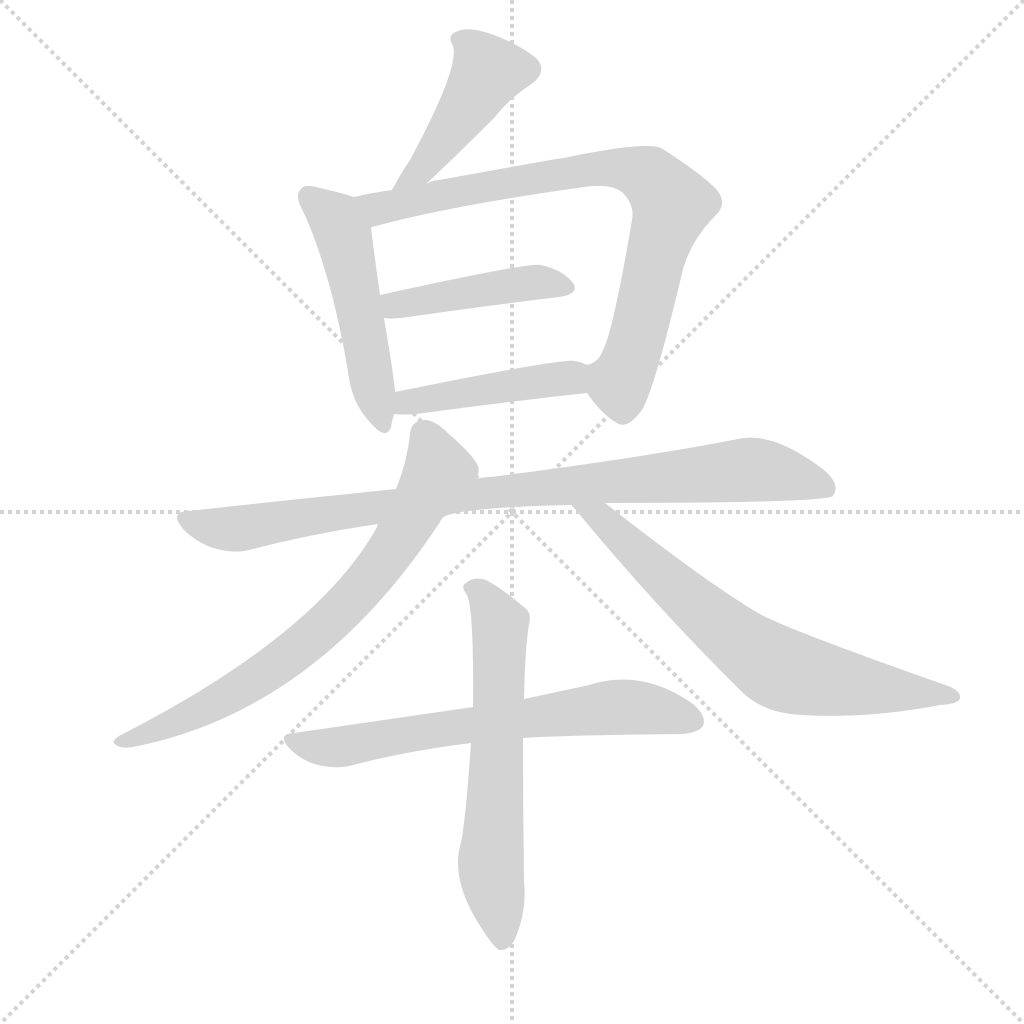
Gao
Kangxi Strokes: 10
Page 787, Entry 10
Pronounced gao.
Shuowen Jiezi (Explanation of Graphs and Analysis of Characters) states: Composed of base and white. In the Book of Rites (Liji), sacrificial prayers are called gao, and song accompaniments during ascents are called zou; thus, both gao and zou are composed of base. Base signifies advancing or striving.
Book of Zhou (Zhouli), Spring Offices, Music Master: Command the coming of the gao dance. Commentary: Gao means to announce; it is to announce to the youths of the state that they should dance. It also signifies a long, drawn-out sound.
Book of Rites (Liji), Record of Rites (Liyun): Climbing to the roof and shouting to announce: Gao, so-and-so returns. Commentary: Gao refers to the elongation of sound.
It also means slow. Zuo Commentary (Zuo Zhuan), 21st Year of Duke Ai: The people of Qi sang, saying: The gao of the Lu people, for years they do not wake, making me step high. Commentary: Slow sounds that are drawn out are what constitute gao as slowness.
Jade Chapters (Yupian): A marsh. Rhyme Repository (Yunfu): A riverbank. Book of Odes (Shijing), Lesser Odes: Cranes calling in the nine gao. Commentary: Nine layers of marshes. Zuo Commentary (Zuo Zhuan), 25th Year of Duke Xiang: Grazing on the marshy lowlands. Commentary: Gao refers to the indentations of a marsh; it is the bank of a body of water. History of the Former Han (Qian Hanshu), Biography of Jia Shan: The banks of the Yangtze and the shores of the Yellow River. Commentary: Gao refers to the alluvial land by the water.
Integrated Rhymes (Jiyun): An enclosure. Zhang Heng, Rhapsody on the Western Capital: Truly the mysterious enclosure of the land, a divine gao. Commentary: Refers to the boundaries or enclosure of the divine realm.
Broad Rhymes (Guangyun): High. Book of Rites (Liji), Record of the Mingtang: The Son of Heaven's gao gate. Commentary: The word gao implies height.
Explanation of Names (Shiming): High Ancestor, high means gao. Being at the very top, one conceals things below.
Erya, Explanation of Teachings: Gao-gao, refers to criticizing those who eat without working. Commentary: Gao-gao is the appearance of being unrefined. Book of Odes (Shijing), Greater Odes: Gao-gao and sui-sui. Commentary: Gao-gao means stubborn and ignorant of the Way.
The name of a month. Erya, Explanation of Heavens: The fifth month is called gao.
The name of a spirit. Records of the Grand Historian (Shiji), Annals of Emperor Wu: Performed ceremonies at Gao Mountain using an ox. Treatise on the Feng and Shan Sacrifices: Also written as Ze Mountain.
The name of a bird. Zhou Documents (Zhou Shu): Those with patterned feathers are like the gao chicken. Commentary: The gao chicken resembles a mallard; in Jizhou, it is called the marsh specialty.
Gan-gao, another name for a parrot. Piya (Amplification of Refinements): When the Gan-gao breaks its tongue, it sits to sing. When a peacock claps its wings, it stands to dance.
Han-gao, another name for a myna. Compendium of Materia Medica (Bencao Gangmu): Gao means to announce. When the weather is cold and snow is expected, they fly in groups as if to announce it, hence the name Han-gao.
Gao-bi, a tiger skin. Zuo Commentary (Zuo Zhuan), 10th Year of Duke Zhuang: Covered in a tiger skin, he charged first.
Gao-lan, the name of a mountain. History of the Former Han (Qian Hanshu), Annals of Emperor Wu: Traveled west as far as Gao-lan.
The name of a river. Classic of Mountains and Seas (Shanhaijing): The Gao River originates from Zhang Mountain.
Gao-zhou, a place in Wu. Zuo Commentary (Zuo Zhuan), 14th Year of Duke Xiang: The people of Wu intercepted and attacked them from the narrow pass of Gao-zhou.
A surname. Descendants of Gao Yao. Zuo Commentary (Zuo Zhuan): The Yue official Gao Ru.
A compound surname. Dongshan Gaoluo clan, a branch of the Red Di tribe.
The same as the gao drum. Book of Zhou (Zhouli), Winter Offices, Artificer's Record: For humans, it is the gao drum. Commentary: A large drum. Also: for the gao pottery-maker. Commentary: Refers to the drum frame.
Also written as gao. Xunzi, Broad Outline: Looking at the mound, it is gao-ru. Commentary: The appearance of being high. Zhuangzi, Difficult Words; Liezi, Celestial Patterns: Both written as gao-ru.
History of the Later Han (Hou Hanshu), Biography of Ma Rong: Gao-lao the mountain pass. Commentary: Gao-lao is similar to to imprison or cage. Xunzi, Kingly Governance: Written as gao-lao.
Sometimes written as gao. Records of the Grand Historian (Shiji), Treatise on the Calendar: The hundred grasses thrive and bloom; the cuckoo calls first at gao. Commentary: The cuckoo emerges first, calling out in the wild marshes.
Interchangeable with lamb. Book of Rites (Liji), Tan Gong: Gao Zigo. Commentary: A disciple of Confucius, named Chai. In the Analects (Lunyu), it is written as Zi Gao. Gao and lamb are ancient interchangeable characters.
Integrated Rhymes (Jiyun): Pronounced hao. To call out. Book of Zhou (Zhouli), Spring Offices, Great Invoker: Command the blind musicians to perform the gao dance. Commentary: Gao is read as hao, meaning to call them to enter. It is interchangeable with the character for shout.
Integrated Rhymes (Jiyun): Pronounced hao. Zhouli, gao dance. Read thus by Liu Changzong. Sometimes written as gao.
Integrated Rhymes (Jiyun): Pronounced gu. Tuo-gao, a place name. Located in Shouchun. History of the Former Han (Qian Hanshu), Commentary by Meng Kang: Tuo-gao is pronounced tuo-gu. Comprehensive Lexicon (Leipian): Used as the standard form. In the classics and commentaries, it is written as gao.