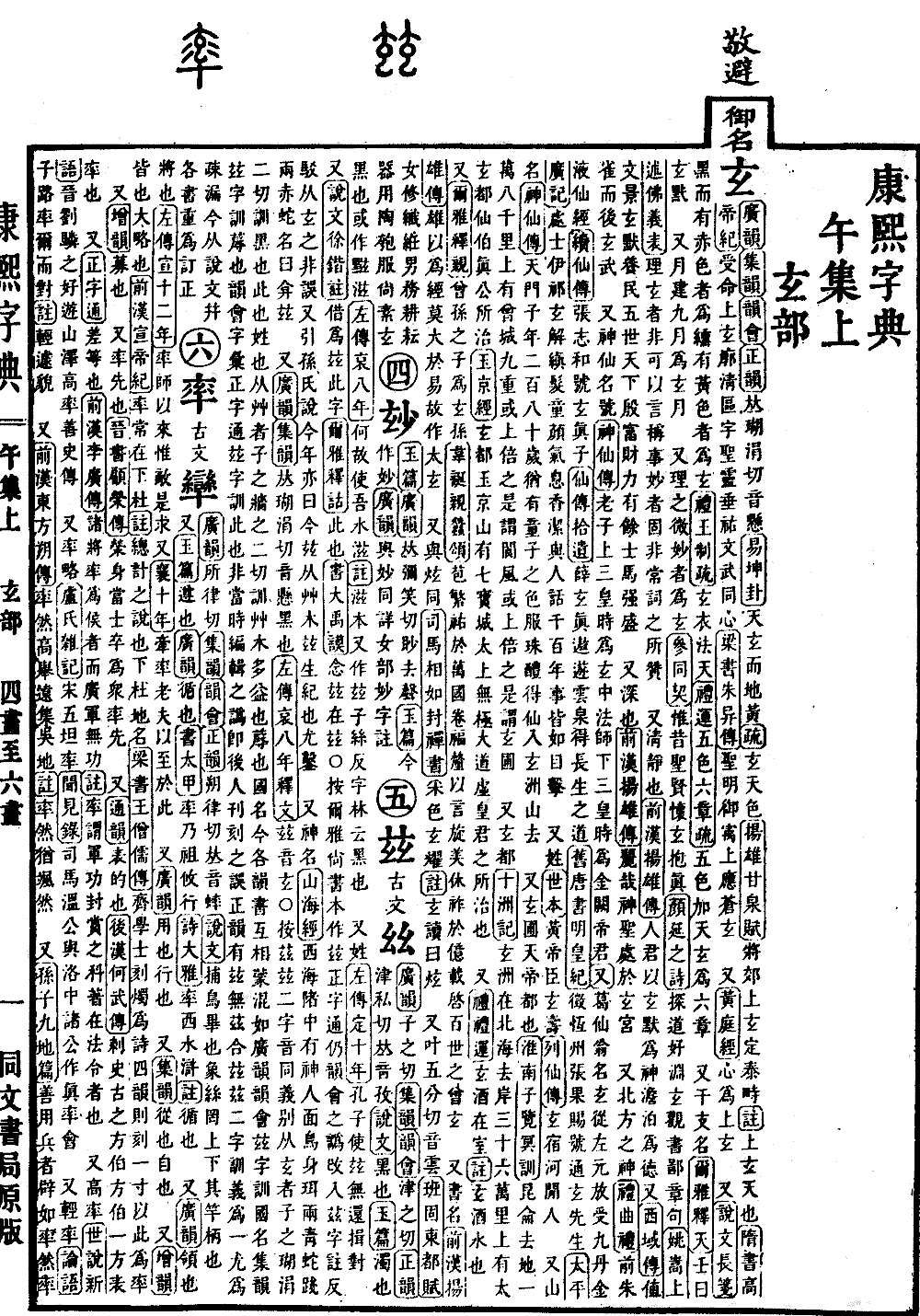
Wu Collection, Upper Volume. Radical: Black (xuán). Kangxi Strokes: 11. Page 725, Entry 05.
In ancient writing, it is written as a variant form (zhuàn).
Guangyun dictionary: Pronounced shuài.
Jiyun, Yunhui, and Zhengyun dictionaries: Pronounced shuài. Pronounced the same as the character meaning cricket.
Shuowen Jiezi dictionary: A net for catching birds. The shape resembles a silk net with handles at the top and bottom.
Also, Yupian dictionary: To follow.
Guangyun dictionary: To follow along.
Book of Documents (Shangshu): Follow the path treaded by your ancestors.
Book of Odes (Shijing): Along the western bank of the river. Note: meaning to follow.
Also, Guangyun dictionary: To lead, to command.
Zuo Tradition (Zuozhuan): Led the army here, only to seek the enemy.
Also: Lead me, this old man, to this place.
Also, Guangyun dictionary: To use, to put into practice.
Also, Jiyun dictionary: To follow, to come from.
Also, Zengyun dictionary: All, for the most part, generally.
Book of Han (Hanshu): Generally in Xia'du. Note: This is an expression of an aggregate total. Xia'du is a place name.
Book of Liang (Liangshu): In the Qi dynasty, scholars would carve candles to time their poetry; for a four-rhyme poem, one inch of candle was carved. This was used as a standard.
Also, Zengyun dictionary: To recruit.
Also: To take the lead, to be a pioneer.
Book of Jin (Jinshu): Gu Rong personally stood among the soldiers, acting as a leader for everyone to follow.
Also, Tongyun dictionary: A model, an example.
Book of the Later Han (Hou Hanshu): The Inspector is an ancient regional leader. A regional leader is a model for his domain.
Also, Zhengzitong dictionary: Rank, degree of difference.
Book of Han (Hanshu): The generals were granted marquisates according to the regulations for military merit, while Li Guang's army had no achievements. Note: "Shuai" refers to the regulations for military merit rewards, which were explicitly stipulated in the laws.
Also: Noble and frank.
A New Account of Tales of the World (Shishuoxinyu): Liu Linzhi of the Jin dynasty liked traveling among mountains and rivers, was noble and frank, and was skilled in historical records.
Also: Brief, unconventional.
Luxi Zaji: During the Song dynasty, one was frank and sincere.
Wenjian Lu: Sima Wengong and various famous scholars in Luoyang held a "frank gathering" (a type of gathering without strict adherence to rituals).
Also: Rash.
Analects (Lunyu): Zilu replied rashly. Note: Appearing hurried and careless.
Also, Book of Han (Hanshu): Soaring high, flying far to the Wu region. Note: "Shuairan" is like "saran" (a description of swift movement).
Also, The Art of War (Sunzi): Those skilled in using military forces are like the "Shuairan." The Shuairan is a snake from Mount Chang. If you strike its head, its tail comes to the rescue; if you strike its tail, its head comes to the rescue; if you strike its middle, both head and tail come to the rescue.
Also: A surname.
Zhengzitong dictionary: During the Ming dynasty, there was a person named Shuai Qing.
Also: Tushita Heaven.
Taiping Guangji: The heart is in the Maitreya Palace of the Tushita Heaven listening to the Dharma.
Also, Tangyun, Jiyun, and Zhengyun dictionaries: Pronounced shuài. Pronounced the same as the word for commander.
Guangyun dictionary: A bird-catching net.
Also, Zhengyun dictionary: Same as the word for commander (meaning a general).
Book of Odes (Shijing): The position of the regional leader and commander. Note: "Shuai" is pronounced shuài.
Records of the Grand Historian (Shiji): District commander. Note: Same as the word for commander.
Also, Jiyun, Yunhui, and Zhengyun dictionaries: Pronounced lèi. Pronounced the same as the word for category.
Jiyun dictionary: A term for counting numbers.
Rites of Zhou (Zhouli): "The tribute is used to manage the expenses." Note: Taxes are collected based on population. Commentary: The commoners of the fiefdom paid taxes based on their number. Exegesis: Regarding "shuai," Xu Miao and Liu Changzong pronounce it as "lei," while Qi Gun pronounces it as "lü." Another pronunciation is "lü."
Also, Zhengyun dictionary: To summarize, roughly.
Book of Changes (Yi Jing): Generally, they are close to each other without responding or joining. "Shuai" is pronounced "lei," but can also be read according to its literal character (its original sound).
Also, Jiyun, Yunhui, and Zhengyun dictionaries: Pronounced lǜ.
Approximate number.
Also: An official title.
Book of Han (Hanshu): Among the subordinate officials of the Chamberlain for Ceremonials, there was the "Shuaigeng." Master Gu's note: In charge of the water clock (timekeeping), hence called Shuaigeng.
Also, Suanjing Shaoguang Zhang: Zu Chongzhi of the Song dynasty had a method of precise calculation for multiplication and division.
Also: Gou-shuai, the limit to which a bow can be drawn.
Mencius (Mengzi): Yi would not change his standard for a full draw of the bow because the archer was clumsy.
Also: Same as the character meaning to weave or to bind the edges.
Book of Rites (Liji): All ribbons (made of boiled silk) only use tightly bound edges without the work of needle and thread. Note: "Shuai" is the same as the character for binding. It means the ribbon uses a single layer of boiled silk with tightly bound edges, where no needlework is visible. Exegesis: "Shuai" is pronounced "lü."
Also, Zuo Tradition (Zuozhuan): Zao-shuai, bi, and ben. Note: "Zao-shuai" is made of boiled leather and is used to cushion jade. "Shuai" is pronounced "lü."
Also, Wuyin Jiyun dictionary: Pronounced shuā.
A unit of weight. Same as the unit "lüe."
Records of the Grand Historian (Shiji): That type of punishment is a fine of one hundred shuai. Note: "Shuai" is the same as "lüe." Pronounced "shua." Kong Anguo states: Six liang (taels) is called one lüe. "Shuai" is also written as "xuan" in old editions.