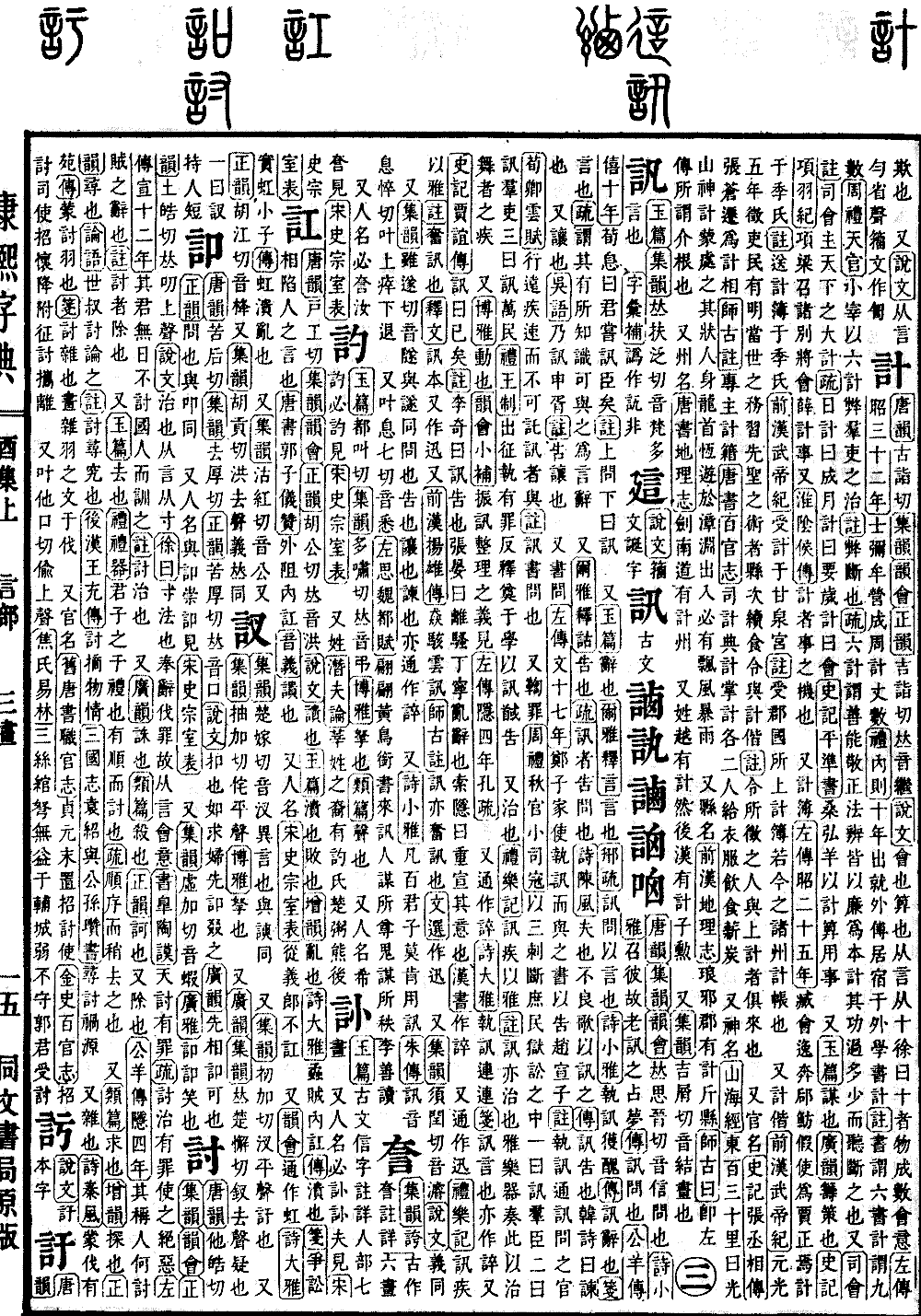
You Collection, Upper Volume
Radical: Speech (yán)
Count: 9 strokes
Page 1147, Entry 01
Pronounced ji. In the Shuo Wen Jie Zi (Explaining Graphs and Analyzing Characters), it means to aggregate or to calculate. Composed of Speech (yán) and Ten (shí). Xu Kai says: Ten represents the completion of a number; it is a compound ideograph. Zuo Zhuan (Chronicle of Zuo): Shi Mimou oversaw the construction of Chengzhou and calculated the measurements. Book of Rites (Liji): At ten years old, one goes to reside with an external tutor, studying writing and calculation. Commentary: Writing refers to the six modes of writing, and calculation refers to the nine mathematical methods. Rites of Zhou (Zhouli): The Small Prefect uses the six calculations to audit the administration of subordinate officials. Commentary: To audit means to decide. Sub-commentary: The six calculations are ability, benevolence, respect, rectitude, law, and discernment, all based on integrity, evaluating merits and faults to make judgments. Also, from the Commentary on the Master of Accounts: The Master of Accounts manages the grand calculations of the realm. Sub-commentary: Daily calculations are called completions, monthly calculations are called summaries, and annual calculations are called totals. Records of the Grand Historian (Shiji): Sang Hongyang rose to power through his talent for calculation.
Also, from the Yu Pian (Jade Chapters): To devise. From the Guang Yun (Broad Rhymes): To plan or strategize. Records of the Grand Historian: Xiang Liang summoned the various commanders to meet at Xue to discuss strategy. Also, from the Biography of the Marquis of Huaiyin: Strategy is the mechanism of affairs.
Also, an account book. Zuo Zhuan: Zang Hui fled to Hou, and Fang Jia caused him to be a market inspector, presenting accounts to the Ji family. Commentary: Delivering the account books to the Ji family. Book of Han (Hanshu): Received accounts at Ganquan Palace. Commentary: Received the account books submitted by the commanderies and kingdoms, similar to modern provincial account ledgers.
Also, to travel together with account books. Book of Han: In the fifth year of the Yuanguang era, those officials and commoners with an understanding of current affairs and an education in the arts of the sages were provided with food and ordered to travel with the account-bearers. Commentary: Ordered the summoned individuals to come together with those bearing the annual accounts.
Also, an official title. Records of the Grand Historian: Zhang Cang was promoted to Minister of Accounts. Commentary by Yan Shigu: Specialized in managing account registers. Old Book of Tang (Tangshu): Officials of Accounts, Registrars of Accounts, and Controllers of Accounts each had two positions, responsible for clothing, food, firewood, and charcoal.
Also, the name of a deity. Classic of Mountains and Seas (Shanhaijing): One hundred and thirty li to the east is Mount Guang, where the deity Jimeng resides. His form has a human body and a dragon head; he constantly wanders the Zhang Abyss, and his arrival is always accompanied by sudden winds and rain.
Also, the name of a county. Book of Han: Langya Commandery contains Jijin County. Yan Shigu says: This is the Jiegen mentioned in the Zuo Zhuan.
Also, the name of a prefecture. Old Book of Tang: Jiannan Circuit contains Jizhou.
Also, a surname. In the state of Yue, there was Fan Li (also known as Jiran); in the Eastern Han, there was Ji Zixun.
Also, pronounced jie. To paint or delineate.