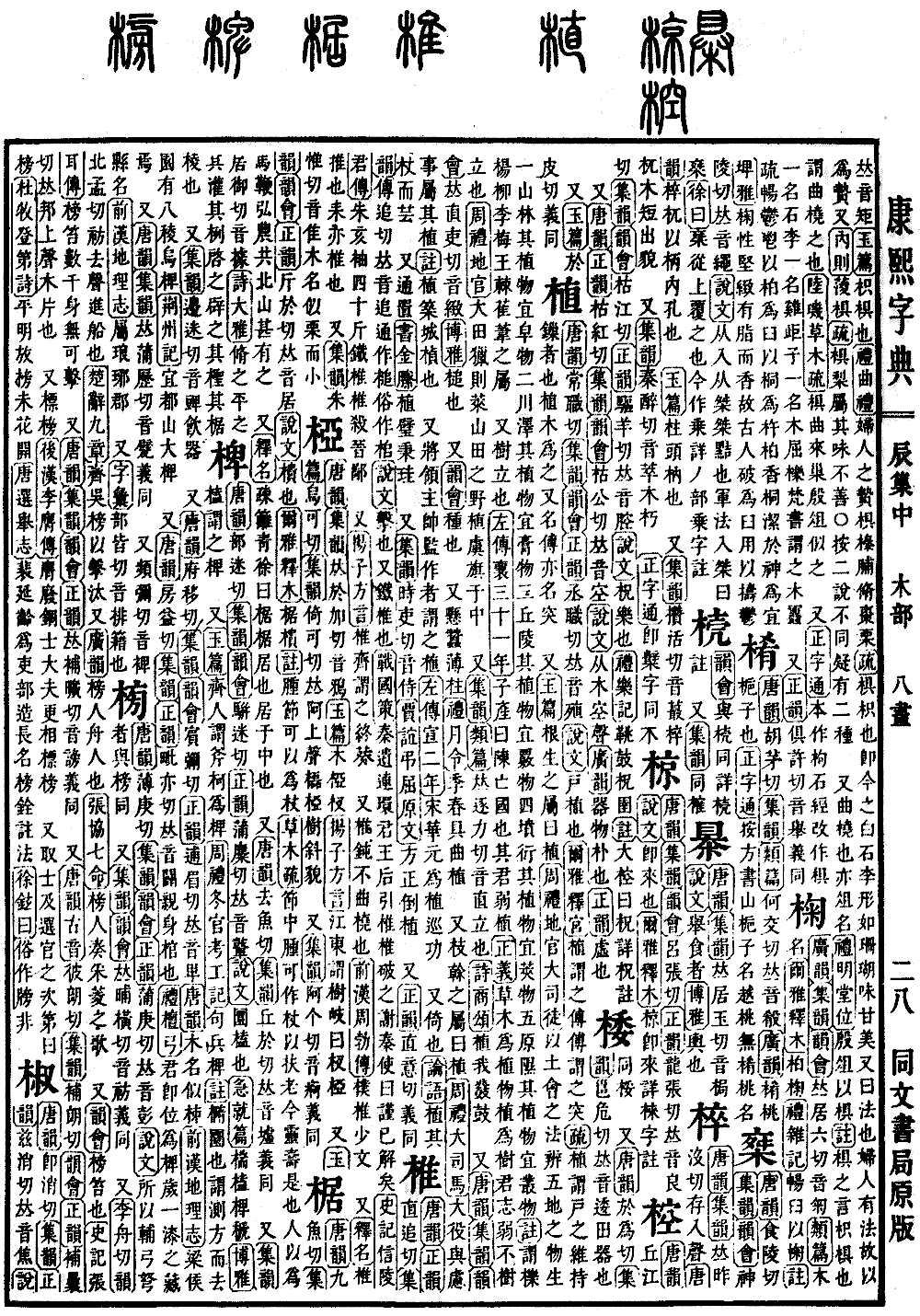
Chen Collection, Middle Volume
Radical: Tree (mù)
Page 536, Entry 14
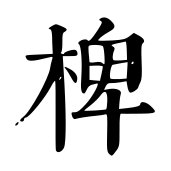
Pronounced pi.
According to the Explaining Graphs and Analyzing Characters (Shuowen Jiezi), it is a round vessel for wine.
In the Urgent Needs Manual (Jijiupian), it is described as a type of drinking vessel.
The Broad Verbatim Dictionary (Guangya) states that a wine vessel is called a pi.
Also, according to the Jade Compendium (Yupian), people in the Qi region refer to an axe handle as a pi.
In the Rites of Zhou (Zhouli), section Winter Officials, Artificers Record (Kaogongji), it refers to a curved weapon with a pi handle. The commentary notes that it is oval in shape, meaning the edges and corners have been planed away to form a square.
Pronounced bi.
A drinking utensil.
Pronounced pi.
The name of a tree, similar to a persimmon.
In the History of the Former Han Dynasty (Qian Hanshu), Geography Treatise (Dilizhi), it is noted that the garden of the Marquis of Liang contained eight-faceted black persimmon trees.
The Jingzhou Record (Jingzhouji) mentions that there are large persimmon trees in the Yidu mountains.
Pronounced pi.
An inner coffin that fits closely to the body.
In the Book of Rites (Liji), section Tan Gong, it is stated that upon ascending the throne, a ruler begins the construction of an inner coffin, lacquering it once each year and storing it away.
Also pronounced pi. The meaning is the same.
Pronounced pi.
The name of a county.
In the History of the Former Han Dynasty (Qian Hanshu), Geography Treatise (Dilizhi), it is recorded as belonging to Langya Commandery.
Pronounced pai.
A register or ledger.