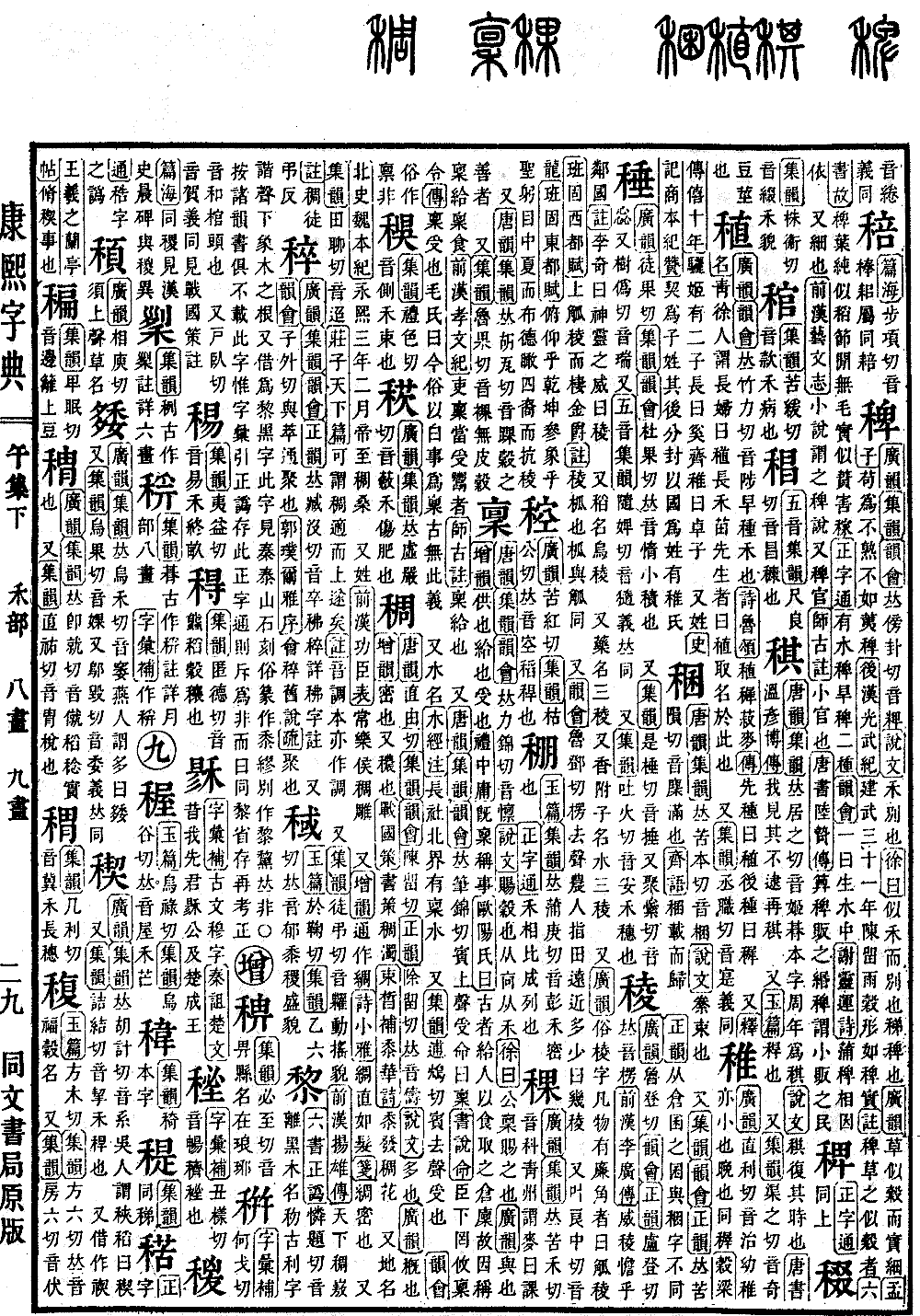
Wu Collection, Lower Volume
Radical: Grain (hé)
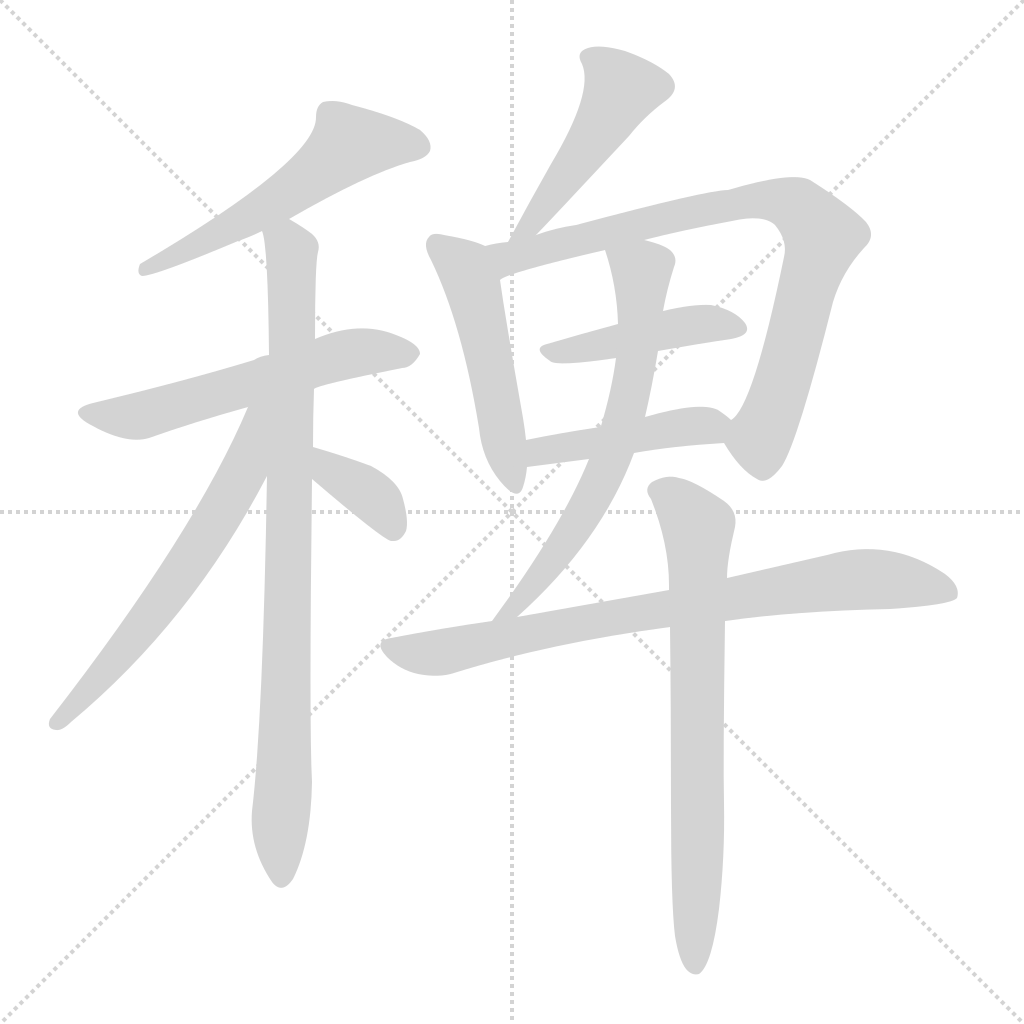
Character: bai
Kangxi stroke count: 13
Page 855, Entry 02
According to the Guangyun (Guangyun), Jiyun (Jiyun), and Yunhui (Yunhui) dictionaries, it is pronounced bai.
According to the Explaining Graphs and Analyzing Characters (Shuowen): a type of grain.
Xu states: It resembles grain but is distinct. It is tibei (a type of weed).
According to the Guangyun: A grass that resembles grain but has fine seeds.
In the Mencius (Mengzi): If the harvest is not ripe, it is not as good as tibei grass.
In the Book of the Later Han (Houhan shu), Biography of Guangwu: In the thirty-first year of Jianwu, grain fell like rain, shaped like the seeds of bai.
Commentary: Bai is a grass that resembles grain.
According to the Explaining the Six Scripts (Liushu gu): Bai has leaves that look like rice, is hairless between the nodes, has seeds like hemp, and damages crops.
According to the Zhengzitong: There are two types, water bai and dry bai.
According to the Yunhui: One definition is that it grows in water.
In the poetry of Xie Lingyun: Reeds and bai rely on one another.
Also means fine or small.
In the Book of Han (Qianhan shu), Treatise on Literature and Arts: Minor novels are called baishuo (minor accounts).
Also refers to baiguan (minor officials).
Shigu commentary: This refers to minor officials.
In the Old Book of Tang (Tang shu), Biography of Lu Zhi: Taxing the money of baifan (petty traders). Bai refers to the common people who are small-scale vendors.