Wei Collection, Upper Volume
Radical: Bamboo (zhú)
12 strokes
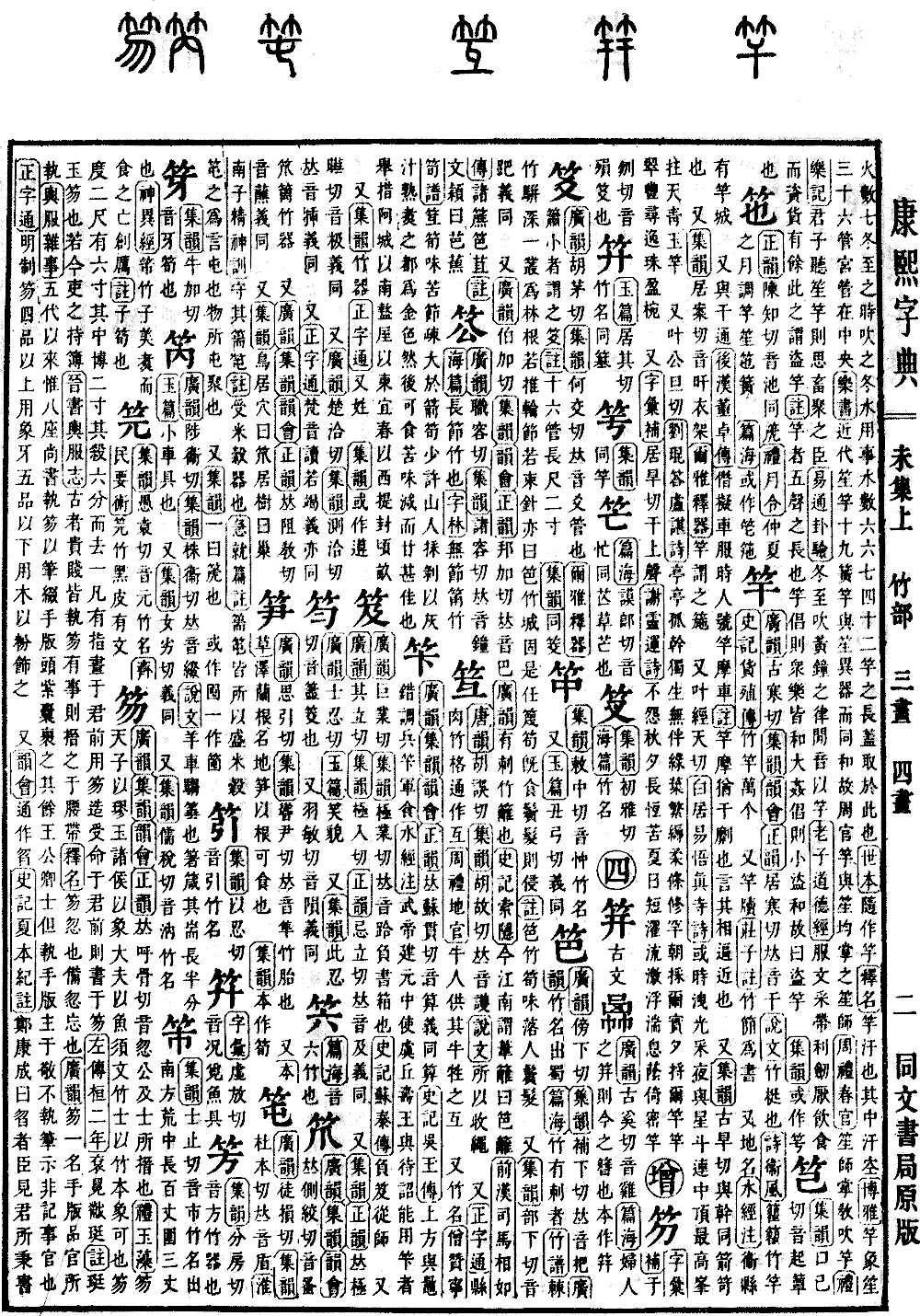
Page 878, Entry 21
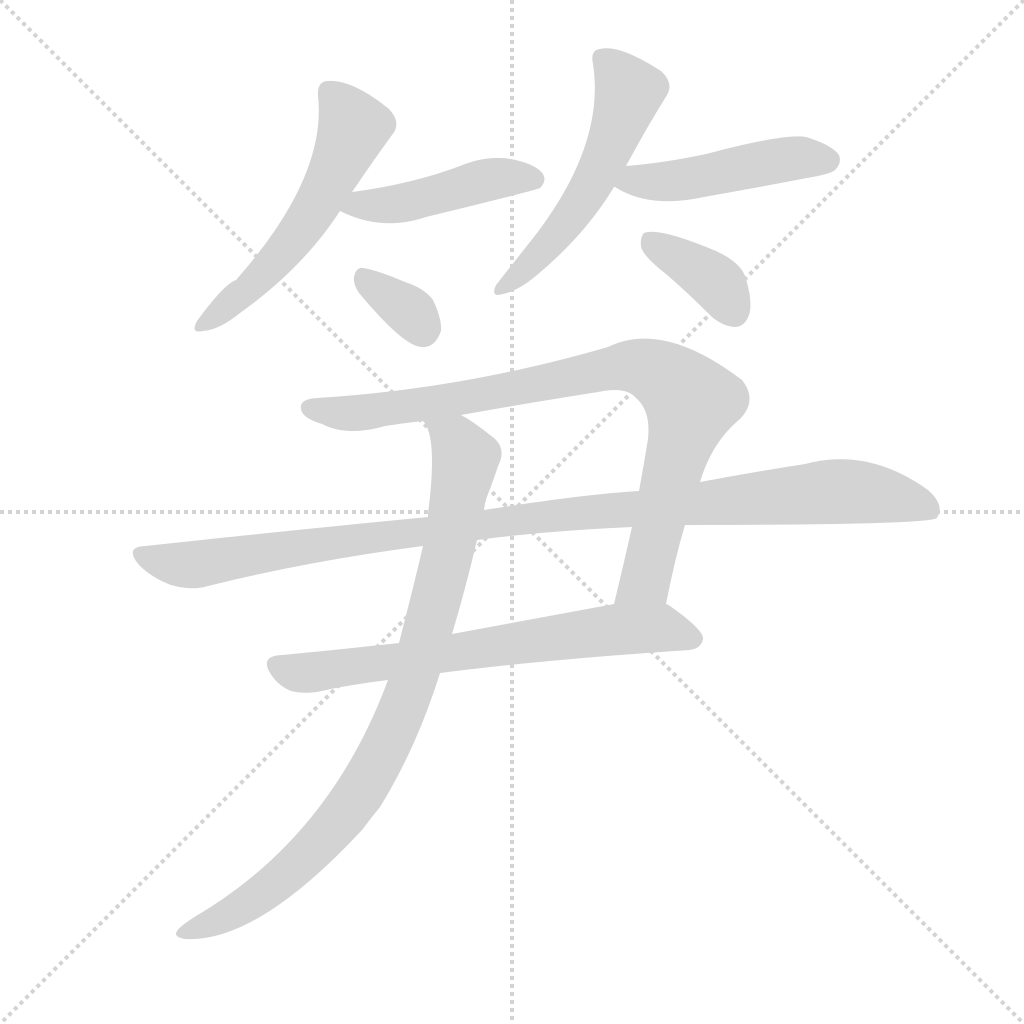
Pronounced sun. The sprout of bamboo. According to the Compendium of Materia Medica (Bencao Gangmu), the roots of the water hemp are called earth bamboo sprouts because the roots are edible.
This character is the original form of the character for bamboo sprout. The bamboo sprout is the ancient form.
Pronounced sun. According to the Explaining Graphs and Analyzing Characters (Shuowen Jiezi), it is the sprout of bamboo. In the Erya (Approaching Elegance), it states that a sprout is the budding of bamboo. The commentary explains that when bamboo first sprouts, it is called a sprout. In the Book of Odes (Shijing), it asks: what are these? They are sprouts and rushes. Lu Ji notes that all bamboo sprouts emerge in the fourth month, with the exception of the Ba bamboo sprout, which emerges in the eighth or ninth month. When they first emerge from the ground, they are several inches long; if boiled and soaked in vinegar, they can be served with wine or eaten as food. In the History of the Tang Dynasty (Tangshu), the Records of Officials state that the Bureau of Bamboo Management was responsible for planting bamboo and reeds, and annually provided sprouts for the imperial kitchens. The Compendium of Materia Medica notes that bamboo has male and female properties; the female produces more sprouts. When the bamboo roots spread runners, the tender ones are dug up and called whip sprouts. Those dug in winter from beneath the roots of large bamboo before they emerge from the soil are called winter sprouts, which can be eaten fresh and are considered a delicacy. In the south, they are dried and known as jade tablet sprouts, clear sprouts, or fire-dried sprouts; those salted and sun-dried are called salted sprouts and can be eaten as vegetables. All bamboo sprouts are sweet in flavor, slightly cold, and non-toxic.
Also, the crossbeam used to suspend bells and chimes is called a sun, which is the same as the character for a rack crossbeam. In the Rites of Zhou (Zhouli), the section on the winter offices and the records of the artisans mentions the catalpa wood maker and the rack crossbeam. The commentary explains that the horizontal piece used to hang musical instruments is called a sun, and the vertical piece is a ju. The commentary notes that sun is pronounced the same as the word for bamboo sprout.
According to the Classified Compendium (Leipian), it is pronounced lun. It refers to a weak bamboo that can be used for mats. In the Book of Documents (Shangshu), there is a mention of spreading layered bamboo mats. The commentary states that sun refers to a soft bamboo. Xu suggests that it refers to bamboo used to make mats.
According to the Collected Rhymes (Jiyun) and other dictionaries, it is pronounced jun. It refers to a bamboo litter. In the Gongyang Commentary on the Spring and Autumn Annals (Gongyang Zhuan), there is a mention of the people of Qi returning the remains of Gongsun Ao, bringing them back with the goods and the litter. The commentary explains that a sun is a bamboo carrier. Another name for it is a woven litter, and in regions north of Qi and Lu, it is called a sun.
The character is sometimes written as a variant form, and the common form is written as the present character. The character for a rack crossbeam was originally composed of the bamboo radical and the component for humble.