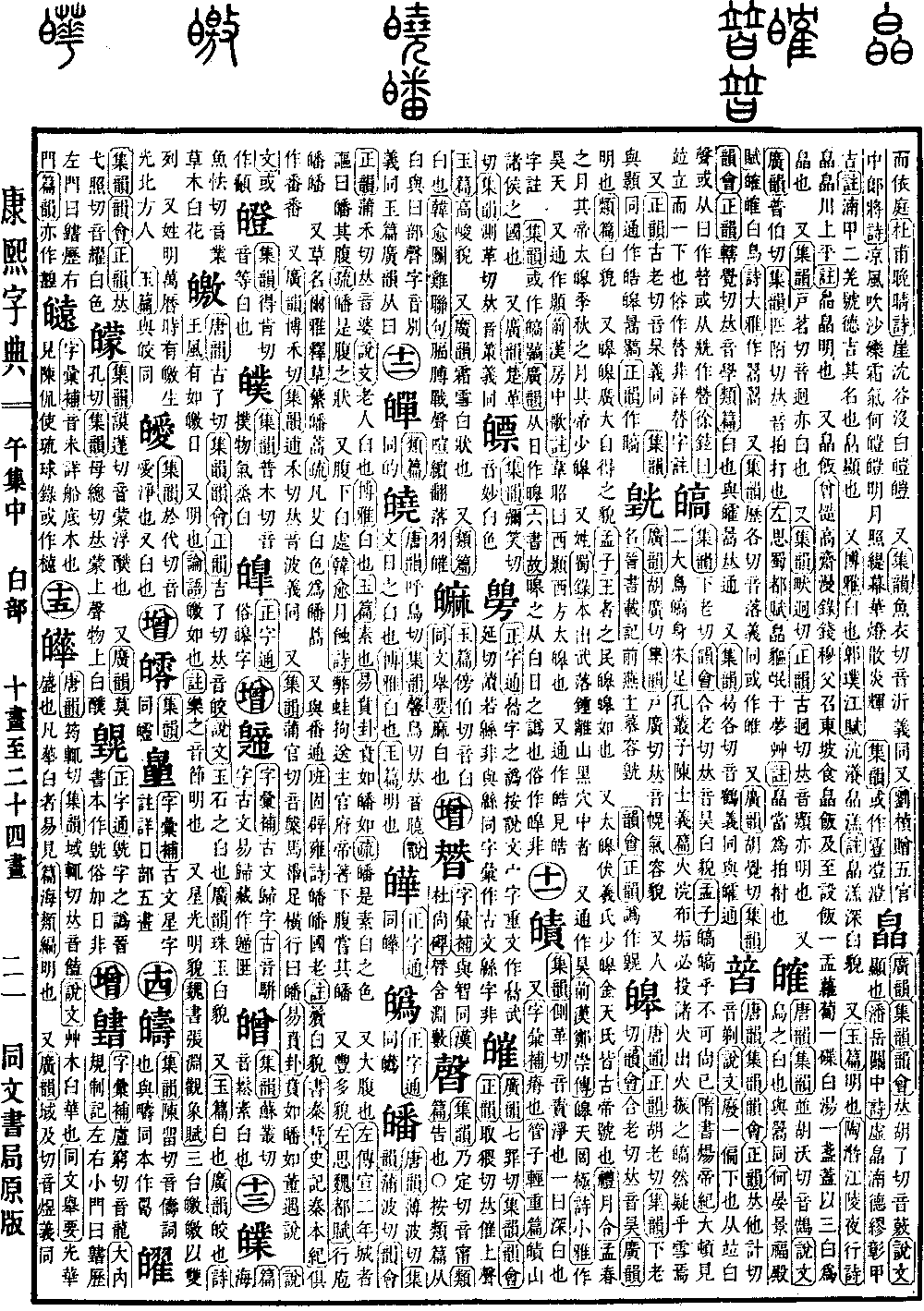
Wu Collection, Middle Volume
Radical: White (bái)
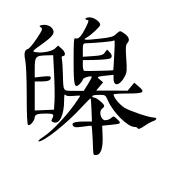
皞
Kangxi Stroke Count: 15
Page 789, Entry 06
Pronounced hào
According to the Guangyun, it means bright.
According to the Leipian, it describes a pure white appearance. It also refers to the state of being vast and self-satisfied.
According to the Mencius (Mengzi), the people under the rule of sage kings are described as being in a state of vast and self-satisfied ease.
It also refers to Taihao, the title of Fuxi, and Shaohao, the title of the Jintian lineage; both are titles of ancient emperors.
According to the Book of Rites (Liji), Monthly Ordinances (Yueling), the first month of spring is governed by the Emperor Taihao, and the final month of autumn is governed by the Emperor Shaohao.
It is also a surname. According to the Record of Shu (Shulu), the family originally descended from people in the black cave of Mount Wuluo Zhongli.
It is also used as a phonetic loan for hao. According to the History of the Former Han (Qianhan), Biography of Zheng Chong, it is written as great heaven (hào tiān) without limit. In the Book of Odes (Shijing), Lesser Odes (Xiaoya), it is written as vast heaven (hào tiān).
It is also used as a phonetic loan for hao. According to the History of the Former Han (Qianhan), Commentary on the Chamber Songs (Fangzhong ge), Wei Zhao states that West Hao refers to the Taihao of the west.
It is also used as a phonetic loan for hao. See the detailed entry for the character hao.
According to the Jiyun, it is sometimes written as gǎo.
According to the Guangyun, when written with the sun radical, it is written as hào.
According to the Principles of the Six Scripts (Liushu gu), the character hào is written with the white radical, and the version with the sun radical is a corruption. The common variant form is incorrect.