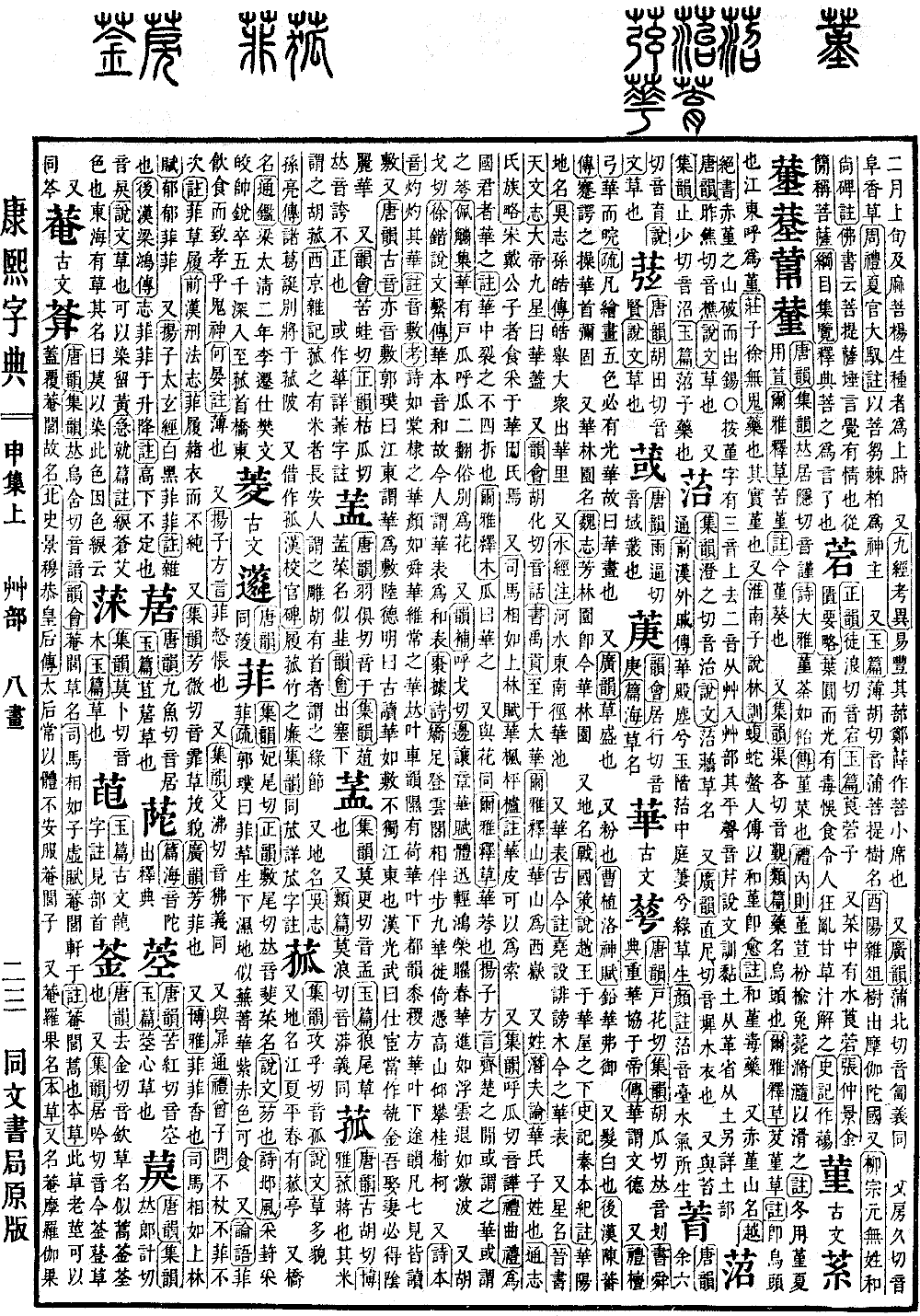
Shen Collection, Upper Volume
Radical: Grass (cǎo)
Kangxi Strokes: 14
Page 1039, Entry 14
Ancient form. Pronounced hua.
Book of Documents (Shangshu), Chapter on the Canon of Yao (Shundian): "Chonghua was in harmony with the Emperor." Commentary: Hua refers to literary virtue.
Also, Book of Rites (Liji), Chapter on Tan Gong: "Ornate and bright." Commentary: In all paintings, the five colors must have brilliance, hence the term hua refers to painting.
Also, Guangyun: Lush vegetation.
Also, face powder. Cao Zhi, Rhapsody on the Luo Goddess (Luoshen Fu): "Without applying lead-based cosmetics."
Also, white hair. Records of the Later Han (Hou Hanshu), Biography of Chen Fan: "His upright integrity remained firm even as his head turned white."
Also, Hualin, a garden name. Records of the Three Kingdoms (Weizhi): "The Fanglin Garden is the present-day Hualin Garden."
Also, a place name. Strategies of the Warring States (Zhanguo Ce): "Persuading the King of Zhao beneath the magnificent halls." Records of the Grand Historian (Shiji), Annals of Qin (Qin Benji), Commentary: Huayang is a place name. Records of the Three Kingdoms (Wuzhi), Biography of Sun Hao: "Hao led a great crowd to exit at Huali."
Also, Commentary on the Water Classic (Shuijing Zhu): "The Yellow River flows southeast passing Huachi."
Also, Huabiao (ornamental column). Records of Ancient and Modern Matters (Gujin Zhu): "Emperor Yao set up a wooden pillar for criticism; this is the present-day Huabiao."
Also, a star name. Book of Jin (Jinshu), Treatise on Astronomy: "The nine stars of the Great Emperor are called Huagai."
Pronounced hua.
Book of Documents (Shangshu), Tribute of Yu (Yugong): "Reaching Mount Taihua." Erya (Literary Expositor), Treatise on Mountains: "Mount Hua is the Western Peak."
Also, a surname. Qianfu Lun: "The Hua family, sons of a surname." Comprehensive Records (Tongzhi), Treatise on Clans: "Descendants of Dai of Song held the fief of Hua and adopted it as their surname."
Also, Sima Xiangru, Rhapsody on the Shanglin Park (Shanglin Fu): "Birch, maple, and boxwood." Commentary: The bark of the birch can be used to make rope.
Pronounced hua.
Book of Rites (Liji), Summary of the Rules of Propriety (Qu Li): "For a ruler of a state, one should split it." Commentary: Hua means splitting it down the middle without tearing it into four parts. Erya (Literary Expositor), Treatise on Trees: "For a melon, it is called hua."
Also, the same as flower. Erya (Literary Expositor), Treatise on Herbs: "Hua is the flower." Yangzi, Dialect (Fangyan): "Between Qi and Chu, some call it hua, others call it fu." Peiqi Ji: "Hua has the sounds of hu and gua, but common custom distinguishes it as the word for flower."
Also, pronounced ge. Bian Rang, Rhapsody on Zhanghua (Zhanghua Fu): "Body as swift as a wild swan, glory shining like spring blossoms. Advancing like floating clouds, retreating like surging waves."
Also, pronounced ge. Xu Kai, Explanation of Characters (Shuowen Xichuan): "Hua was originally pronounced he, which is why people today call the Huabiao the Hebiao." Zao Ju's Poetry: "With lifted feet I climb the cloud pavilion, walking together toward the nine flowers. Leaning against the high mountain, I look up to grasp the cassia branch."
Also, Pronounced fu. Records of Poetry (Shi): "Bright are its flowers." Commentary: Pronounced fu. Note: In the Book of Poetry, phrases such as the flowers of the cherry tree, the beauty of the hibiscus, and the blooming of the millet appear seven times, and all are read as fu.
Also, in the ancient pronunciation of the Tangyun: also pronounced fu. Guo Pu says: In the Jiangdong region, hua is pronounced as fu. Lu Deming says: The ancient reading of hua as fu is not limited to Jiangdong alone. Emperor Guangwu of Han said: "When holding office, one should be like a palace guard (zhi jin wu); when taking a wife, one must obtain Yin Lihua."
Pronounced kua. Not straight or correct. Sometimes written as a variant form. See detailed entry for that character.