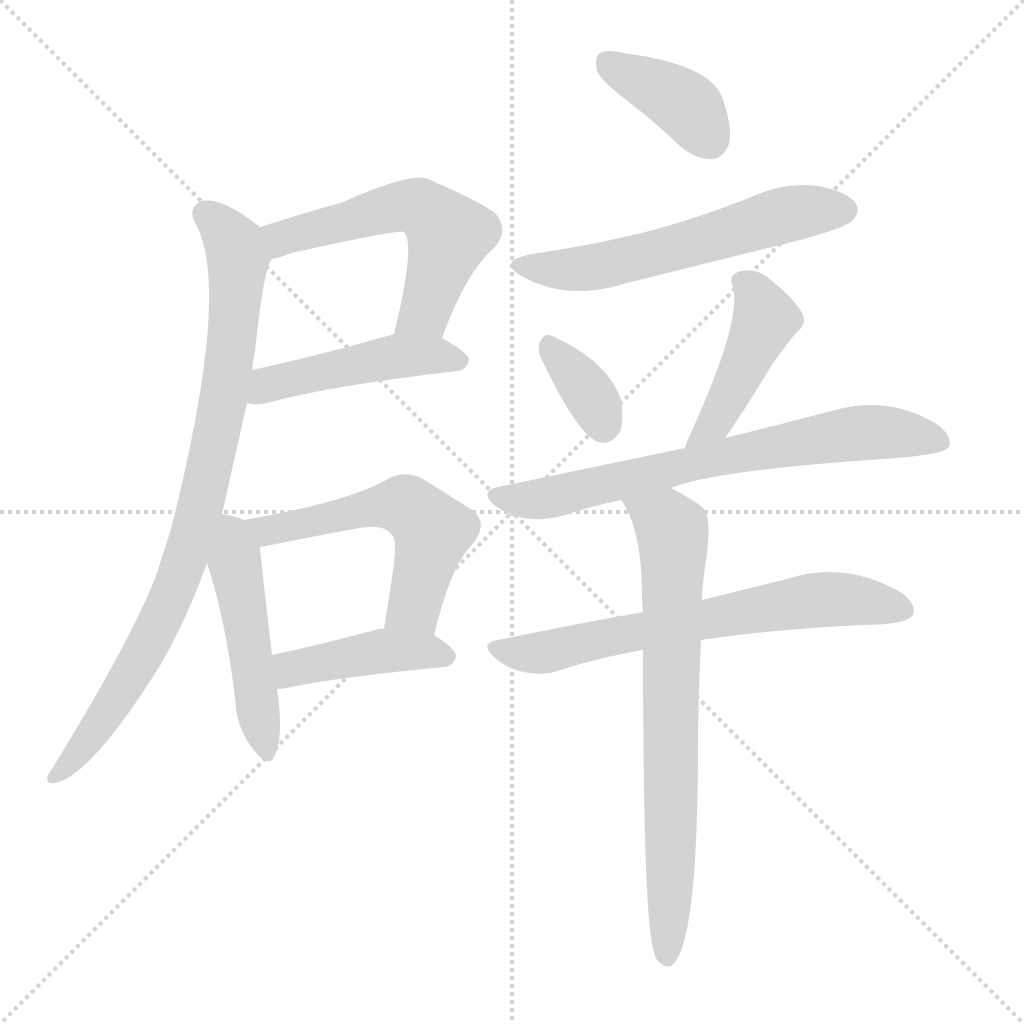
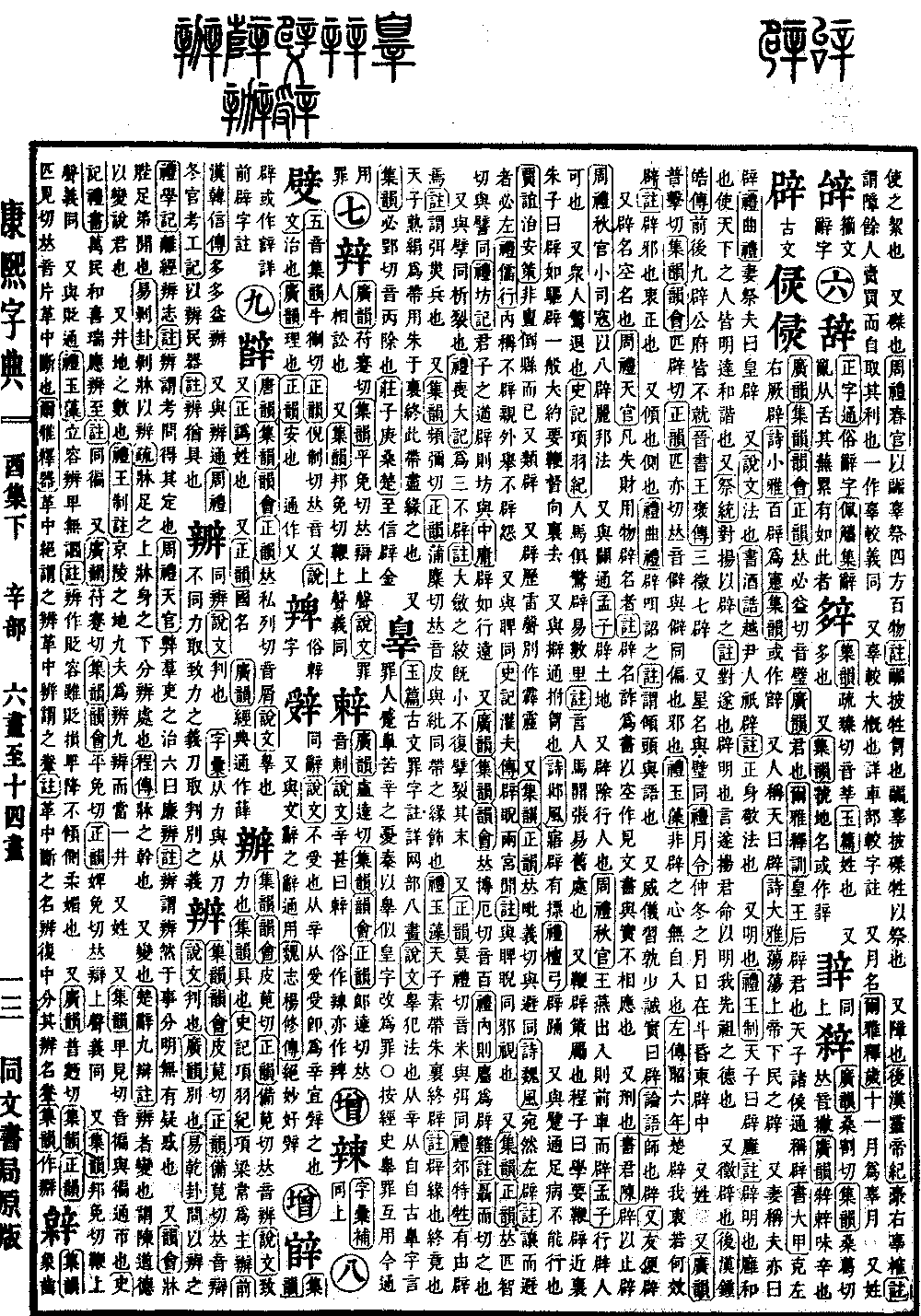
You Collection, Lower Volume
Radical: Bitter (xīn)
Page 1251, Entry 06
Ancient form. Pronounced bi (falling tone).
Pronounced bi (falling tone).
Broad Rime (Guangyun), Collection Rime (Jiyun), Rime Compendium (Yunhui), Correct Rime (Zhengyun): Pronounced bi (falling tone). Pronounced the same as bi (falling tone, as in jade).
Broad Rime (Guangyun): Sovereign.
Book of Rites (Liji), Explaining Teachings (Shixun): Emperor, king, queen, and bi all refer to a sovereign. The Son of Heaven and the feudal lords can both be referred to as bi.
Book of Documents (Shujing), Great Announcement (Dajia): Capable of assisting his sovereign.
Book of Odes (Shijing), Lesser Odes (Xiao Ya): The feudal lords take him as a model.
Collection Rime (Jiyun): Sometimes written in a variant form. Also, people refer to the heavens as bi.
Book of Odes (Shijing), Greater Odes (Da Ya): The great God is the sovereign of the people on earth.
Also, a wife referring to her husband is also called bi.
Book of Rites (Liji), Qu Li: When a wife performs sacrifices for her husband, she refers to him as royal sovereign (huang bi).
Also, from the Explaining Characters (Shuowen): Laws and statutes.
Book of Documents (Shujing), Announcement on Wine (Jiu Gao): And the officials respectfully observe the laws.
Commentary: To rectify oneself and respectfully observe the laws.
Also, enlightened and harmonious.
Book of Rites (Liji), Royal Regulations (Wangzhi): The Son of Heaven has the Biyong.
Commentary: Bi means enlightened and harmonious. Yong means harmony. It means to cause the people of the world to be enlightened and harmonious.
Also, from the Record of Sacrifices (Jitong): To make manifest through praise.
Commentary: Dui means to complete. Bi means to manifest. This means completing and proclaiming the sovereign's commands to manifest the virtues of our ancestors.
Also, to summon or employ.
History of the Later Han (Hou Hanshu), Biography of Zhong Hao: Summoned by the ducal offices nine times in succession, but did not accept.
History of the Jin (Jinshu), Biography of Wang Bao: Summoned three times, employed seven times.
Also, name of a constellation, identical to the jade constellation (bi).
Book of Rites (Liji), Monthly Ordinances (Yueling): In the middle of winter, the sun is in the Dipper mansion, and at dusk, the eastern bi star is in the center of the sky.
Also, a surname.
Also, Broad Rime (Guangyun): Pronounced pi (falling tone). Collection Rime (Jiyun), Rime Compendium (Yunhui): Pronounced pi (falling tone). Correct Rime (Zhengyun): Pronounced pi (rising tone). Pronounced the same as pi (crooked).
The same as pi (crooked). Partial, evil, or perverse.
Book of Rites (Liji), Jade Pattern (Yuzao): Do not allow perverse thoughts the opportunity to enter.
Zuo Tradition (Zuo Zhuan), Sixth Year of Zhao: The State of Chu is perverse, we are upright; why should we imitate what is perverse?
Commentary: Bi means perverse. Zhong means upright.
Also, to tilt or move sideways.
Book of Rites (Liji), Qu Li: To tilt the head when speaking to him.
Commentary: This means tilting the head to converse with someone.
Also, being polished in demeanor but lacking sincerity is called bi.
Analects (Lunyu): Zizhang is extreme.
Also, to befriend those who are sycophantic.
Also, bi ming: empty name, false reputation.
Rites of Zhou (Zhouli), Offices of Heaven (Tianguan): All instances where financial expenditures have falsified accounts.
Commentary: Bi ming refers to forging documents, using falsehoods to represent reality, where documents do not correspond to the actual situation.
Also, criminal punishment.
Book of Documents (Shujing), Prince of Lu (Jun Shi): Use punishment to stop crime.
Rites of Zhou (Zhouli), Autumn Office (Qiu Guan), Minor Minister of Justice: Use the eight categories of deliberative punishment to adhere to the laws of the state.
Also, synonymous with bi (to open).
Mencius: To open up land.
Also, to clear the way for pedestrians, to make people move aside.
Rites of Zhou (Zhouli), Autumn Office (Qiu Guan): When the King goes out for leisure, he clears the road ahead of the carriage so that people move aside.
Mencius: It is permissible to make people move aside (in the presence of superiors).
Also, for a crowd to be terrified and retreat.
Records of the Grand Historian (Shiji), Annals of Xiang Yu: Both people and horses were terrified, retreating several miles.
Commentary: This refers to people and horses scattering, changing their original positions.
Also, bian bi: to encourage or urge. Cheng (Hao) says: Study requires urging oneself to exert effort toward profound depths. Zhu (Xi) says: It is like driving, generally meaning to urge and supervise progress.
Also, synonymous with pi (to strike the chest).
Book of Odes (Shijing), Bei Winds (Beifeng): Waking up, beating my chest and slapping myself.
Book of Rites (Liji), Tan Gong: Beating the chest and stamping the feet.
Also, synonymous with bi (to be lame).
Jia Yi, Policy on Peace and Order (Zhi'an Ce): Not merely like being hung upside down.
Also, similar to a foot ailment.
Also, bi li: sound of thunder. Also written as pi li.
Also, Collection Rime (Jiyun), Correct Rime (Zhengyun): Pronounced pi (falling tone). Synonymous with bi (to avoid).
Book of Odes (Shijing), Wei Winds (Weifeng): Lightly moving aside to the left.
Commentary: When yielding or avoiding, one must move to the left.
Book of Rites (Liji), The Conduct of Scholars (Ruxing): When recommending internally, do not avoid relatives; when recommending externally, do not avoid enemies.
Also, synonymous with pi (to squint).
Records of the Grand Historian (Shiji), Biography of Guan Fu: Squinting between the two palaces.
Commentary: Synonymous with pi ni. Looking with slanted eyes.
Also, Collection Rime (Jiyun), Correct Rime (Zhengyun): Pronounced pi (falling tone). Synonymous with pi (to compare).
Book of Rites (Liji), Fang Ji: The way of the gentleman is like a dike, is it not?
Doctrine of the Mean (Zhongyong): Comparing it to walking a long distance.
Also, Broad Rime (Guangyun), Collection Rime (Jiyun), Rime Compendium (Yunhui): Pronounced bai (entering tone).
Book of Rites (Liji), Internal Rules (Neize): Making bi ji with muntjac meat.
Commentary: To cut into thin slices and then mince.
Also, synonymous with bo (to split/rip).
Book of Rites (Liji), Greater Records of Mourning (Sang Daji): Tearing one piece of cloth into three strips, not ripping the ends.
Commentary: The binding used for the great shrouding is already narrow; do not rip its ends further.
Also, Correct Rime (Zhengyun): Pronounced mi (rising tone). Synonymous with mi (to eliminate).
Book of Rites (Liji), Jiao Tesheng: Sacrifices used to eliminate (disasters).
Commentary: This refers to eliminating disasters and warfare.
Also, Collection Rime (Jiyun): Pronounced pi (rising tone). Correct Rime (Zhengyun): Pronounced pi (rising tone). Synonymous with pi (piping).
Book of Rites (Liji), Jade Pattern (Yuzao): The Son of Heaven's white sash is edged with scarlet to the very end.
Commentary: Bi means edge. Zhong means to the end. The Son of Heaven uses cooked silk for the sash and uses scarlet for the edging, with the entire sash edged.
Also, Collection Rime (Jiyun): Pronounced bing (falling tone). To exclude or eliminate.
Zhuangzi, Geng Sang Chu: The highest integrity can eliminate reliance on (metal/tokens of) trust.
Verification: Also synonymous with bo (to split/rip). Book of Rites (Liji), Greater Records of Mourning: Tearing into three strips without ripping. Commentary: The binding used for the great shrouding is already narrow; do not rip its ends further. Note: The two characters wei san (make three) have an incomplete meaning. Following the original text, I have added the three characters jiao yi fu (twist one piece) before wei san. The commentary has been changed to sub-commentary.