Wei Collection, Upper Volume
Radical: Bamboo (zhú)
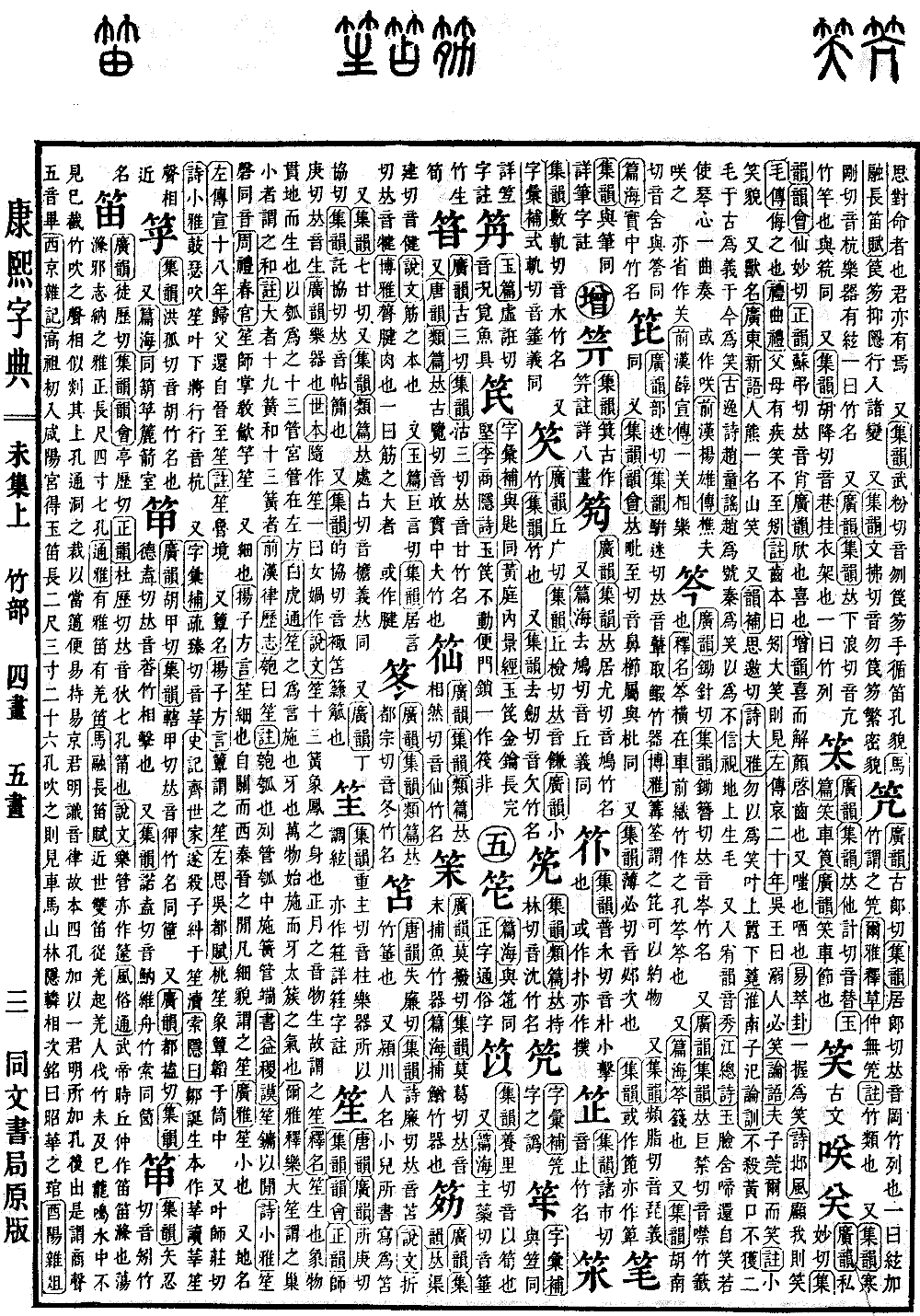
Brush. Kangxi strokes: 12. Page 879, Entry 08.
Collected Rhymes (Jiyun): Same as brush. Refer to the detailed entry for the character for brush.
Textual research: Broad Rhymes (Guangyun) says pronounced bi (falling tone). Rhyme Compilation (Yunhui) says pronounced bi (falling tone). Correct Rhymes (Zhengyun) says pronounced bi (high-rising tone).
Explanation of Names (Shiming): A brush is to recount. It recounts affairs and records them.
Approaching Elegance (Erya), Explanation of Implements (Shiqi): Non-standard terms for a brush are called bu-lu. Commentary: The people of Shu call a brush bu-lu.
Explaining Graphs and Analyzing Characters (Shuowen): The state of Chu calls it yu; the people of Wu call it bu-lu; the state of Yan calls it fu; the state of Qin calls it brush.
Records of Past and Present (Gujinzhu): Ancient brushes, whether made of bamboo or wood, as long as they could dip in ink and form characters, were called brushes. When Qin swallowed the six states, it destroyed the excellences of the preceding ages, thus Meng Tian became renowned at that time. Meng Tian created the brush; this was merely the Qin brush. Using withered wood for the shaft, deer hair for the inner core, and sheep hair for the outer covering, this is what is called cang-hao. The vermillion shaft was simply coated in red lacquer, used by the court historians to record events.
Examination of Calligraphic Standards (Fashukao): Yu Shinan said: A brush should be no longer than six inches; for regular script use one part, for semi-cursive use two, and for cursive use three, with fingers firm and palm empty.
Book of Rites (Liji), Summary of the Rules of Propriety (Quli): The historian carries a brush; the scholar carries records. Commentary: Brush refers to the category of writing implements.
Also refers to the Brush Star. Explanation of Names (Shiming): The Brush Star is a celestial vapor shaped like a branch, blunt at the end and sharp like a brush.
Also a flower name. Commentary on the Songs of Chu (Chuci): When the magnolia flower first blooms, it looks like a brush; northerners call it wood-brush.
Also Collected Rhymes (Jiyun): Pronounced bie (entering tone). In Shandong, it is called brush.
Also written as yin. See the Han dynasty Inscription of Fan Yi. Also in Yan Xin it is written as ba-yin; see Summarized Essentials (Juyao). Collected Rhymes (Jiyun): Sometimes written as brush.