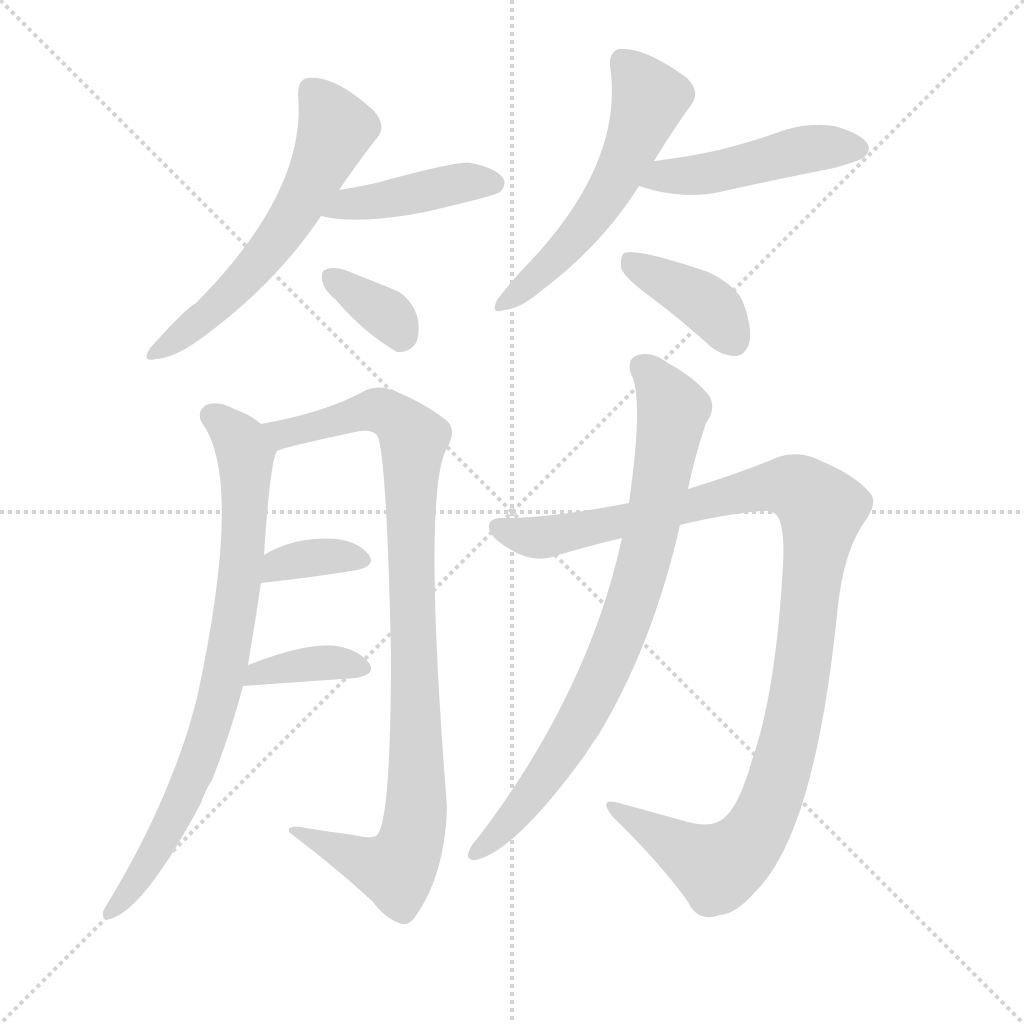
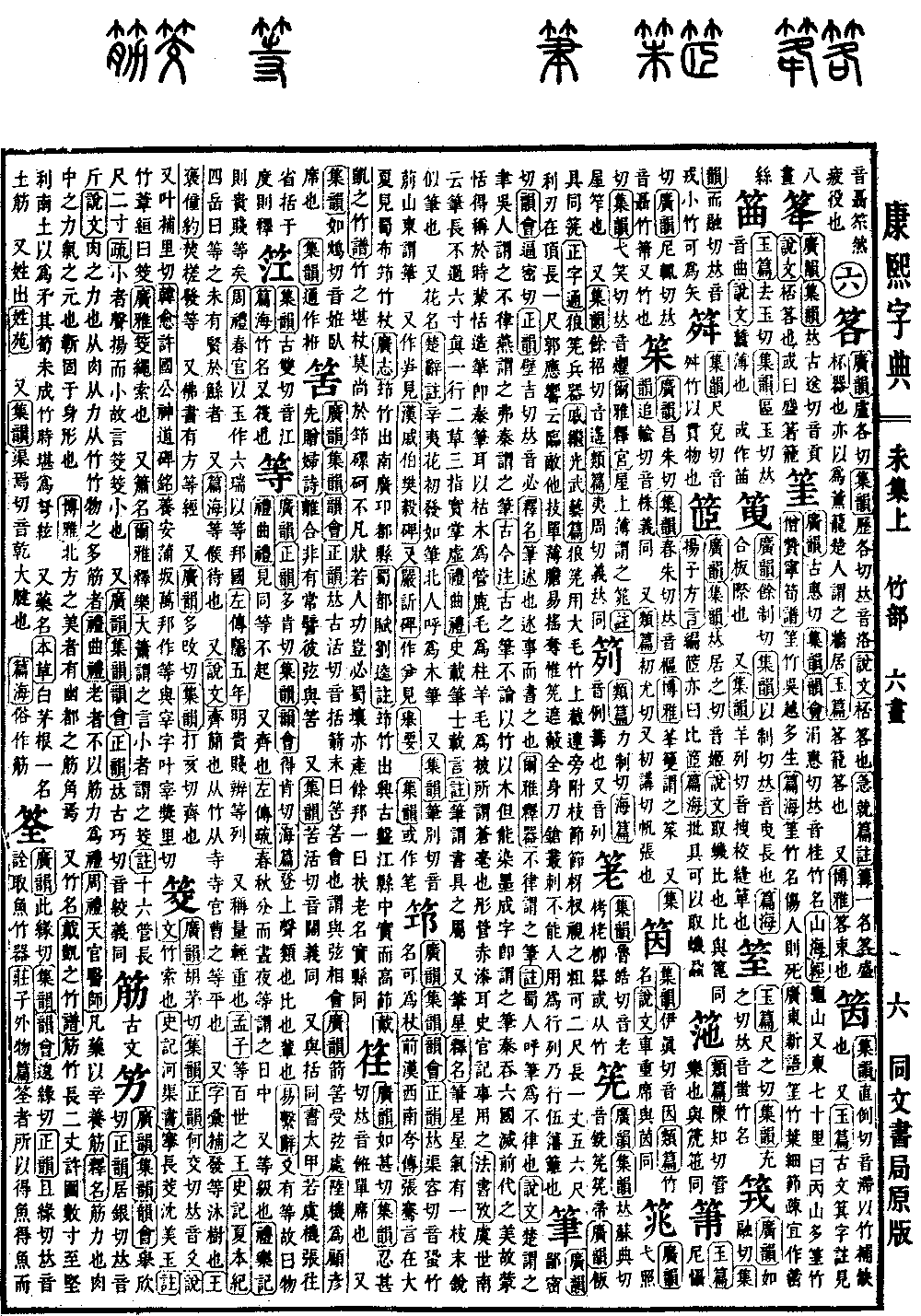
Wei Collection, Upper Volume
Radical: Bamboo (zhú)
Kangxi Strokes: 12
Page 882, Entry 26
In ancient texts, written as a variant form (lè).
According to the Extensive Rhymes (Guangyun), Collected Rhymes (Jiyun), and Rhyme Meeting (Yunhui), pronounced jin. According to the Correct Rhymes (Zhengyun), pronounced jin, with a pronunciation identical to jin.
Explained in the Explaining Graphs and Analyzing Characters (Shuowen Jiezi) as: the strength of the muscles. The character is composed of the radicals for meat, force, and bamboo. Bamboo is used as the representative plant known for its many fibers.
Recorded in the Book of Rites (Liji), section on Inner Rituals: Elders need not exert physical strength to perform rituals.
Recorded in the Rites of Zhou (Zhouli), section on Heavenly Officials, Physicians: Among all medicinal substances, the acrid flavor is used to nourish the tendons.
Explained in the Explaining Names (Shiming): The term for tendon (jin) is synonymous with strength. It is the power within the muscles, the root of vital energy, serving to firmly bind and constrain the body.
Recorded in the Boya: Among the fine products of the north, there are the tendons and horns from Youdu.
Also refers to a type of bamboo.
Recorded in the Bamboo Treatise (Zhupu) by Dai Kaizhi: The jin bamboo grows to about two zhang in height and several inches in thickness; it is extremely hard and sharp. In the southern regions, it is used to manufacture spears. When the shoots have not yet matured into bamboo, they can be fashioned into bowstrings for crossbows.
Also refers to a medicinal ingredient.
Recorded in the Materia Medica (Bencao): The rhizome of the cogon grass, also known as earth tendon.
There are also those who use this as a surname, appearing in the Surname Garden (Xingyuan).
Additionally, according to the Collected Rhymes (Jiyun), pronounced qian. Refers to large tendons.
Recorded in the Pianhai: Commonly written as a variant form.