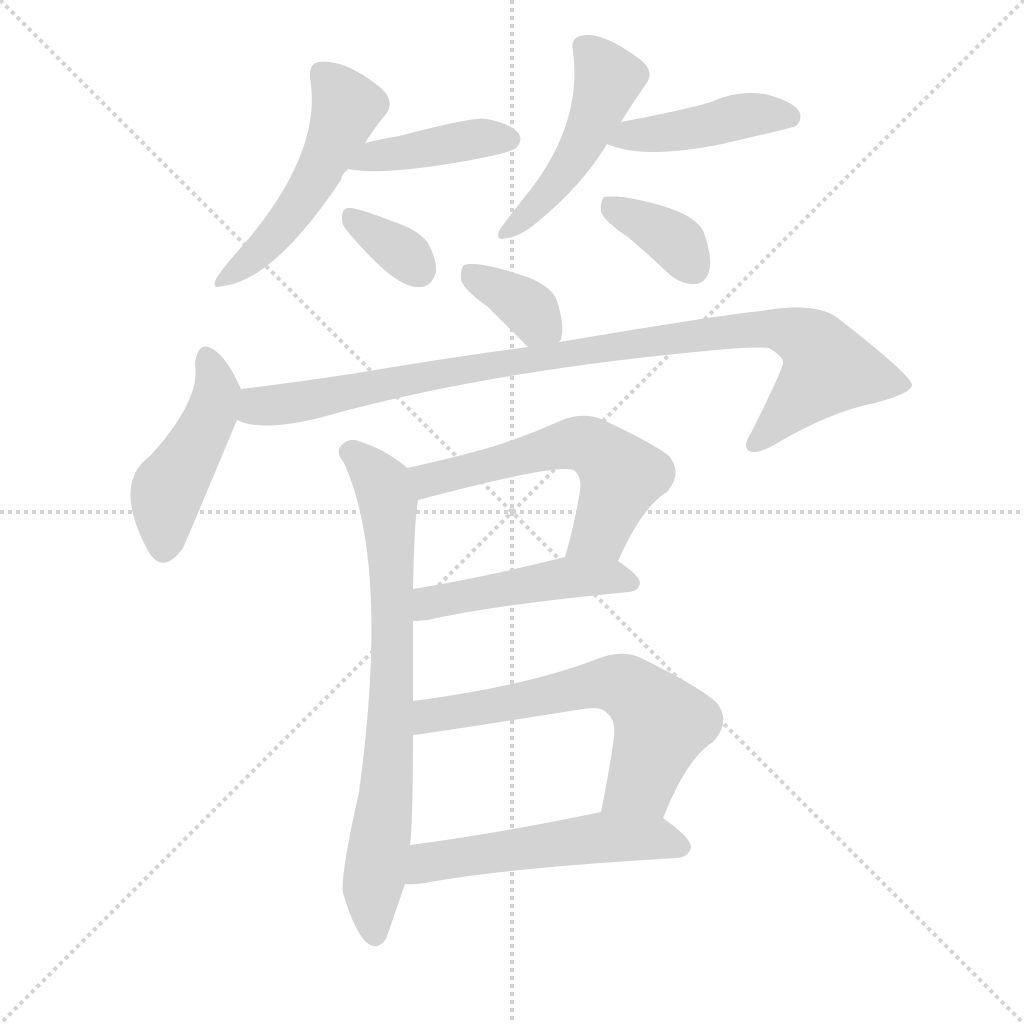
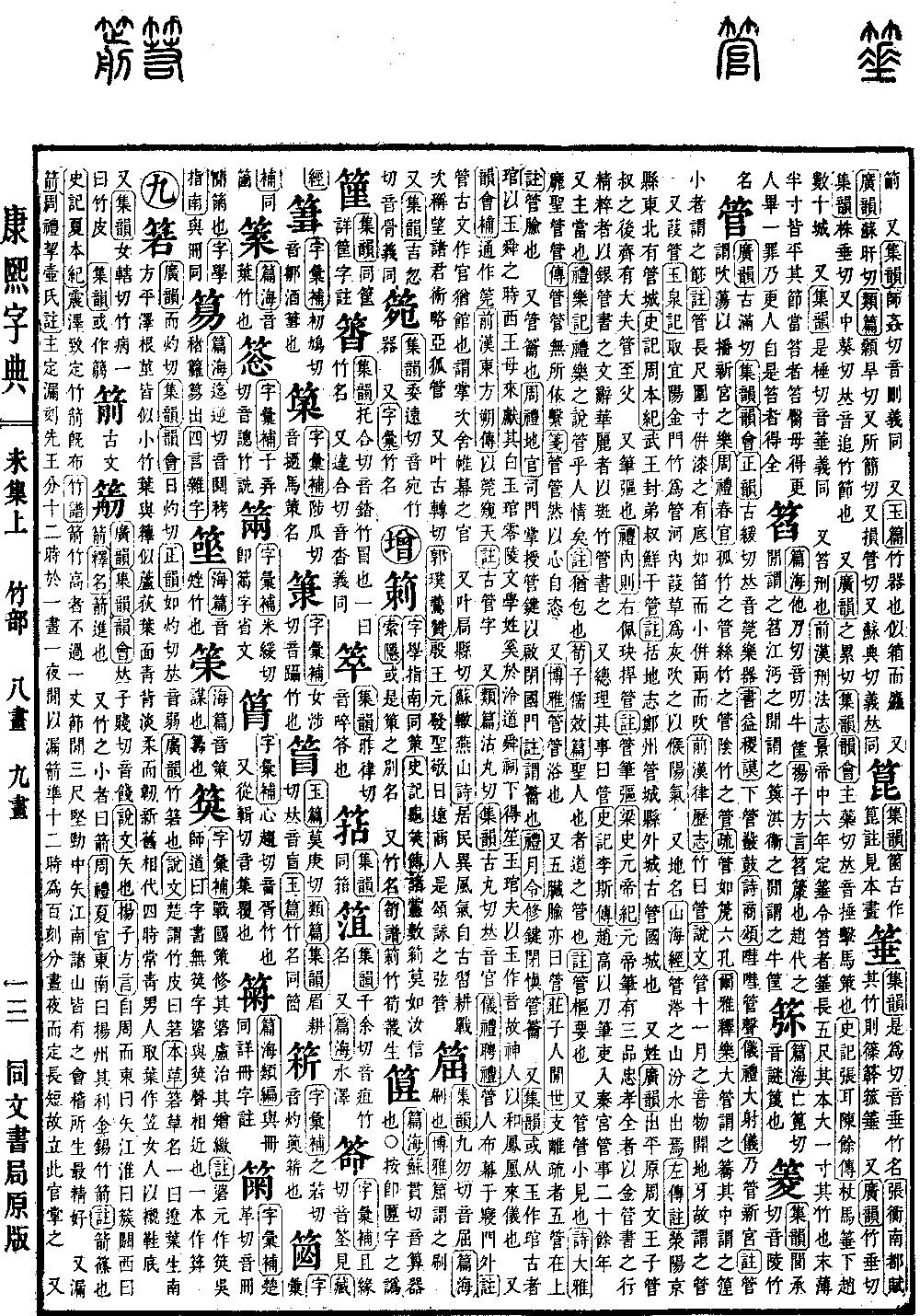
Wei Collection, Upper Volume. Radical: Bamboo (zhú). Kangxi strokes: 14. Page 889, Entry 06.
According to Broad Rhymes (Guangyun), pronounced guan (falling tone). According to Collected Rhymes (Jiyun), Rhyme Meetings (Yunhui), and Correct Rhymes (Zhengyun), pronounced guan (rising tone). It is a musical instrument.
Book of Documents (Shujing), Chapter on Benefits of Governance (Yiji): Perform on the pipes and drums.
Book of Odes (Shijing), Odes of Shang (Shangsong): The sound of the pipes is clear and crisp.
Book of Etiquette and Ceremonial (Yili), Great Archery Ceremony (Dasheyi): Then play the pipes for the new palace. Commentary: Pipes refer to blowing on bamboo reeds to broadcast the music of the new palace.
Rites of Zhou (Zhouli), Officers of Spring (Chunguan): Pipes of lone bamboo, pipes of grandson bamboo, pipes of shade bamboo. Commentary: The pipe is like a bamboo flute with six holes.
Erya (Erya), Explanation of Music (Shiley): The large pipe is called a jiao, the middle one is called a jian, and the small one is called a jia. Commentary: The pipe is one foot long, one inch in circumference, and is lacquered. It has a bottom, is like a flute but smaller, and is played in pairs.
History of the Former Han (Qianhan), Treatise on Music and Calendars (Lüli Zhi): Bamboo is called a pipe.
Explaining Graphs and Analyzing Characters (Shuowen): The pipe represents the sounds of the eleventh month; things open their sprouts from the earth, therefore it is called a pipe. Also, reed pipes.
Records of Jade Springs (Yuquanji): Take bamboo from the golden gate of Yiyang to make the pipe, use reed ash from Henei, and blow on it with positive energy.
Also, a place name. Mountain and Sea Classic (Shanhaijing): Pipe Mountain (Guan-cen), from which the Fen River flows.
Commentary to Zuo Tradition (Zuozhuan Zhu): Northeast of Jing County in Xingyang, there is the walled city of Guan.
Records of the Grand Historian (Shiji), Annals of Zhou (Zhou Benji): King Wu enfeoffed his younger brother Shu Xian in Guan. Commentary: According to the Comprehensive Geography (Kuodizhi), outside the walled city of Guan in Zheng Prefecture lies the ancient city of the State of Guan.
Also, a surname. Broad Rhymes (Guangyun): Originated from the descendants of Guan Shu, the son of King Wen of Zhou of the Pingyuan line; in the State of Qi, there was a grandee named Guan Zhufu.
Also, a brush holder. Book of Rites (Liji), Inner Teachings (Neize): On the right, one wears an archer's ring and a brush holder. Commentary: The brush holder is a tube for brushes.
History of the Liang (Liangshi), Annals of Emperor Yuan (Yuan Di Ji): Emperor Yuan had three grades of brushes: those who were perfectly loyal and filial used a gold tube; those whose conduct was refined used a silver tube; those whose literary compositions were ornate used a speckled bamboo tube.
Also, to manage matters is called guan. Records of the Grand Historian (Shiji), Biography of Li Si: Zhao Gao entered the Qin palace as a clerk, managing affairs for over twenty years.
Also, to be in charge. Book of Rites (Liji), Record of Music (Yueji): The theory of rites and music manages human sentiment. Commentary: It is like encompassing.
Xunzi (Xunzi), Discussion on Confucianism (Ruxiao Pian): As for the sage, he is the manager of the Way. Commentary: A manager is a pivot.
Also, guan-guan, small-mindedness. Book of Odes (Shijing), Greater Odes (Daya): Without a sage, one is narrow-minded. Commentary: Narrow-minded means having nothing to rely upon. Pronunciation: narrow-minded, relying on one's own impulses.
Also, according to the Bowya (Boya), guan-guan means to bathe.
Also, the points (shu) of the five viscera are also called guan. Zhuangzi (Zhuangzi), In the World of Men (Renjianshi): As for the disfigured one, his five conduits are above. Commentary: Conduits are the points.
Also, a key. Rites of Zhou (Zhouli), Officers of Earth (Diguan): The Gatekeeper manages the keys and bolts to open and close the national gates. Commentary: This refers to the key.
Book of Rites (Liji), Monthly Ordinances (Yueling): Repair the bolts and locks, and be cautious with the keys.
Also, according to Collected Rhymes (Jiyun), sometimes written as a character with the jade radical. In ancient times, the pipe was made of jade. During the time of Shun, the Queen Mother of the West came to offer white jade pipes. A scholar surnamed Xi in Lingdao, Lingling, found bamboo-like jade pipes beneath the Temple of Shun; since jade was used to make sound, the spirits were in harmony, and the phoenix appeared in ceremony.
Also, according to a supplement to Rhyme Meetings (Yunhui), commonly written as a variant form (guan). History of the Former Han (Qianhan), Biography of Dongfang Shuo: Looking at the sky through a pipe. Commentary: An ancient form of the character for pipe.
Also, according to the Categorized Dictionary (Leipian), pronounced guan (level tone). According to Collected Rhymes (Jiyun), pronounced guan (level tone).
Book of Etiquette and Ceremonial (Yili), Official Reception Ceremony (Pinli): The official in charge of lodging (guanren) arranges the curtains outside the sleeping gate. Commentary: The term for official in charge of lodging is also written in an ancient form (guan), which is the same as an inn; it refers to the official who manages the temporary quarters and curtains.
Also, rhymes with the sound of the character jiong (entering tone). Su Zhe (Su Zhe), Poem on Yanshan: The inhabitants have different customs, and from ancient times they have practiced farming and war. Next, they praise the Lord of Wangzhu, whose strategic arts are second only to the Fox Pipe.
Also, rhymes with the sound of the character zhuan (entering tone). Guo Pu (Guo Pu), Ode to Swallow: The King of Yin was of noble origin, his sagely respect grew distant. The merchants sing of this, chanting it to the strings and pipes.