Wei Collection, Upper Volume
Radical: Bamboo (zhú)
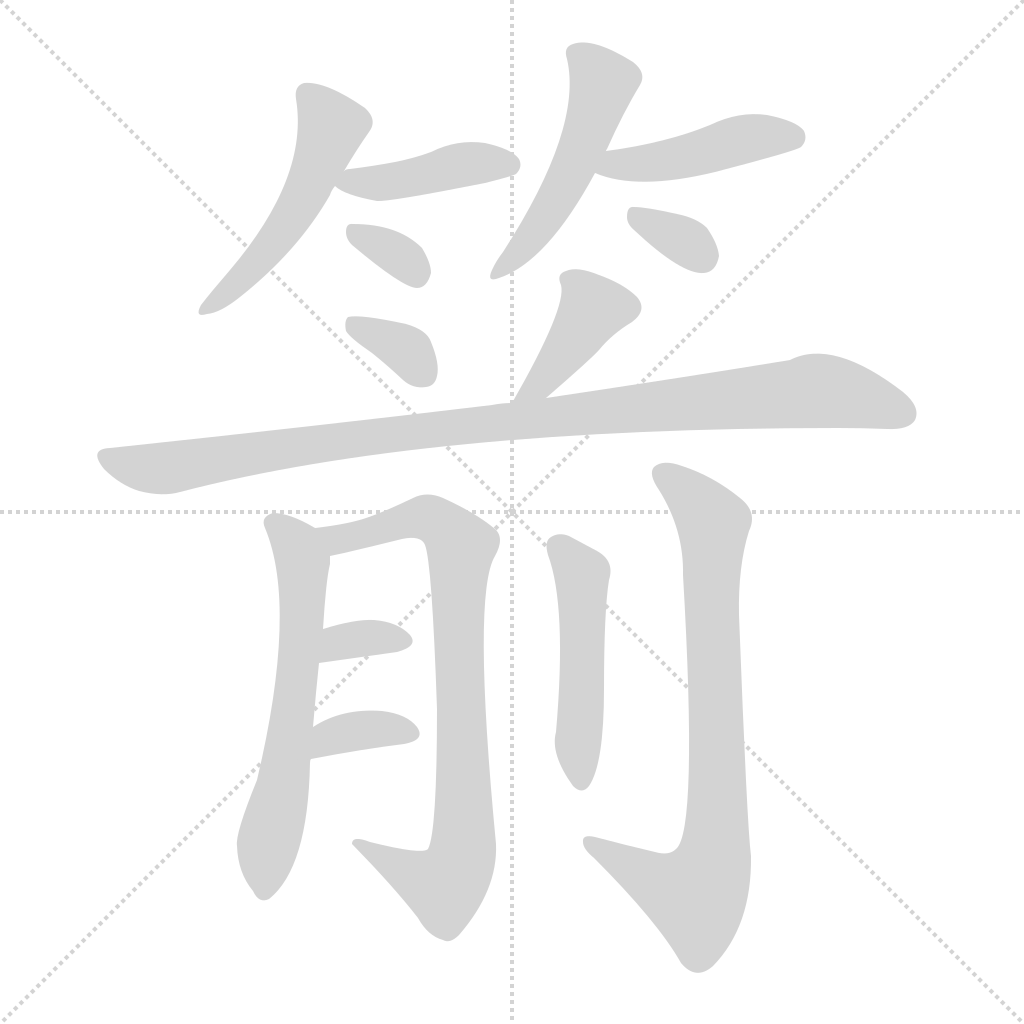
Arrow; Kangxi Strokes: 15; Page 889, Entry 34
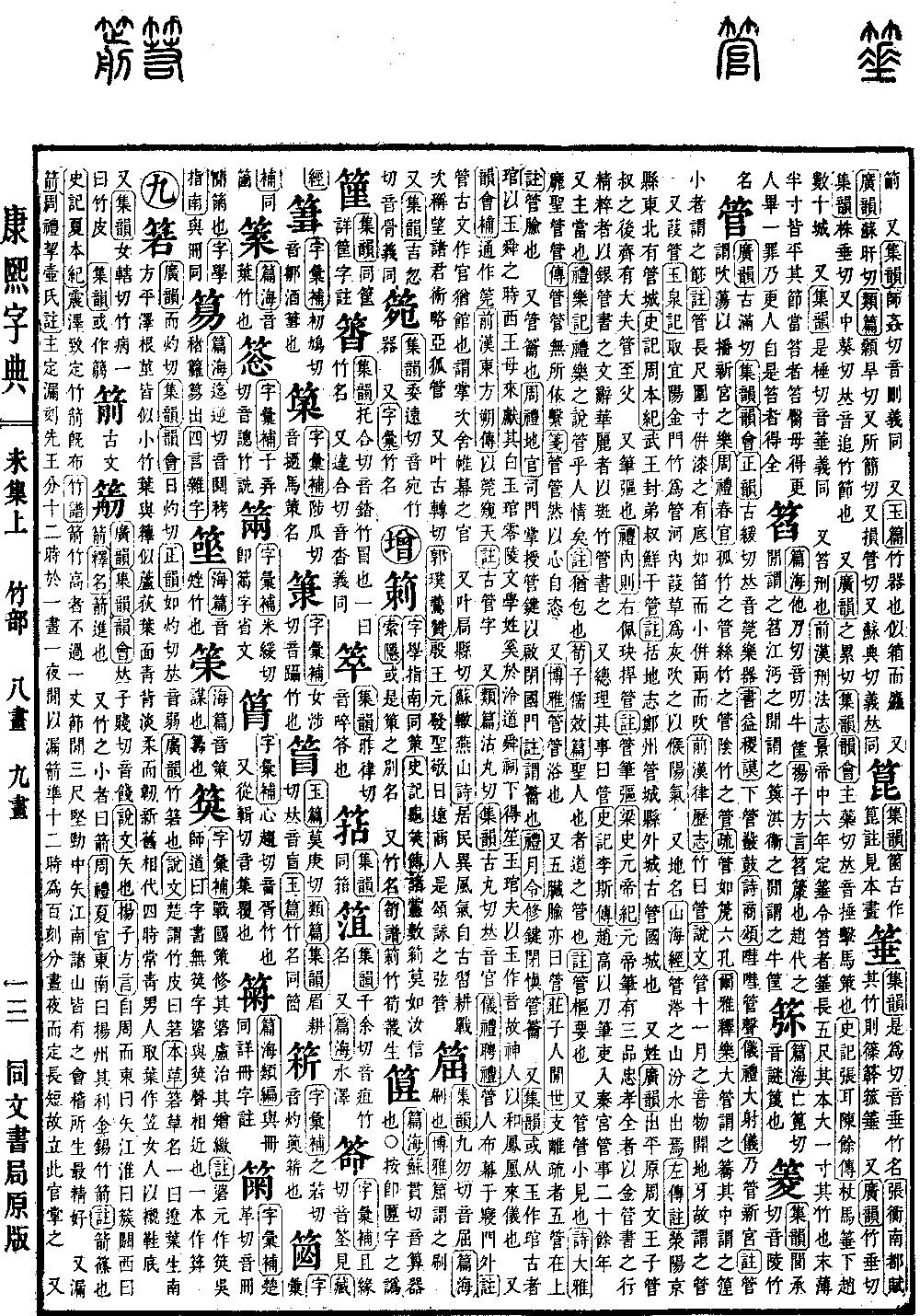
Ancient form. According to the Rhyme Dictionary of the Guang Yun (Guangyun), the Collection of Rhymes (Jiyun), and the Collection of Rhyme Annotations (Yunhui), pronounced jian (falling tone). According to the Explaining Graphs and Analyzing Characters (Shuowen), it is an arrow. According to the Regional Dialects (Fangyan) by Yang Xiong, those from the pass eastward call it an arrow shaft, in the Yangtze and Huai river regions it is called an arrow, and west of the pass it is called an arrow. According to the Explaining Names (Shiming), arrow signifies advancement. Also, a small species of bamboo is called arrow bamboo. According to the Rites of Zhou (Zhouli), Summer Official, the southeast is called Yangzhou, and its resources include gold, tin, and arrow bamboo. The commentary states that arrow refers to the dwarf bamboo. According to the Records of the Grand Historian (Shiji), Xia Annals, once the territory of Lake Zhenze was stabilized, arrow bamboo was spread throughout. According to the Bamboo Treatise (Zhupu), arrow bamboo grows no taller than one zhang, with three feet between joints; it is hard, strong, and suitable for making arrows. It is found in all the mountains of Jiangnan, with the finest quality produced in Kuaiji. Also, a clepsydra pointer. According to the Rites of Zhou, commentary on the Official of the Clepsydra, it is responsible for setting the water clock. The former kings divided the day and night into twelve periods, intervalled by clepsydra pointers, regulating the twelve periods into one hundred divisions to determine the length of day and night; therefore, this official was established to manage it. Also, gaming counters. According to the Politeness and Elegance (Boya), gaming counters are called arrows. Also, according to the Record of Mount Hua (Huashanji), there is a hole at the top of Arrow-Sheath Peak, just wide enough to see the sky; by climbing through the hole, one can reach the very summit. Also, red arrow, the name of a medicinal herb. According to Han Yu’s Exhortation to Learning (Jinxuejie), red arrow and green fungus. Also, according to the New Accounts of Guangdong (Guangdong Xinyu), the porcupine is known as the sealed swine; it originates from a bubble-fish which transforms into a pig, with bristles on its neck and back about a foot long like chopsticks, white at the base and black at the tip; when pursued by people, it shoots its bristles. According to the Collection of Rhymes (Jiyun), also written as jian.
Textual verification: According to the Regional Dialects (Fangyan) by Yang Xiong, from the Zhou region eastward it is called an arrow shaft, in the Yangtze and Huai river regions it is called a cluster, and west of the pass it is called an arrow. Following the original text, from the Zhou region eastward has been corrected to from the pass eastward. Furthermore, based on the citations in the commentaries to the Book of Odes (Shijing) and the text of the Juzhen edition, cluster has been corrected.