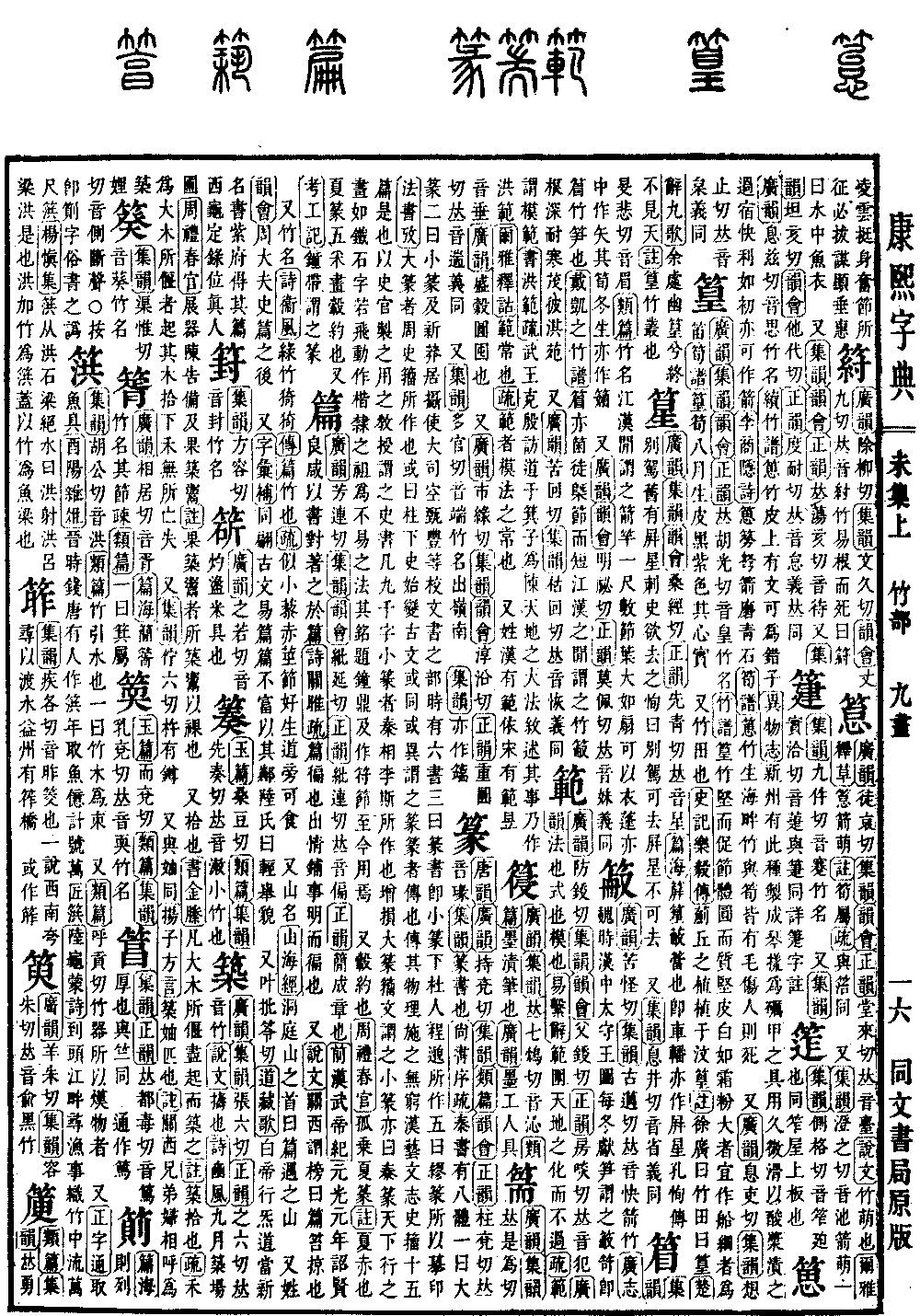
Wei Collection, Upper Volume
Radical: Bamboo (zhú)
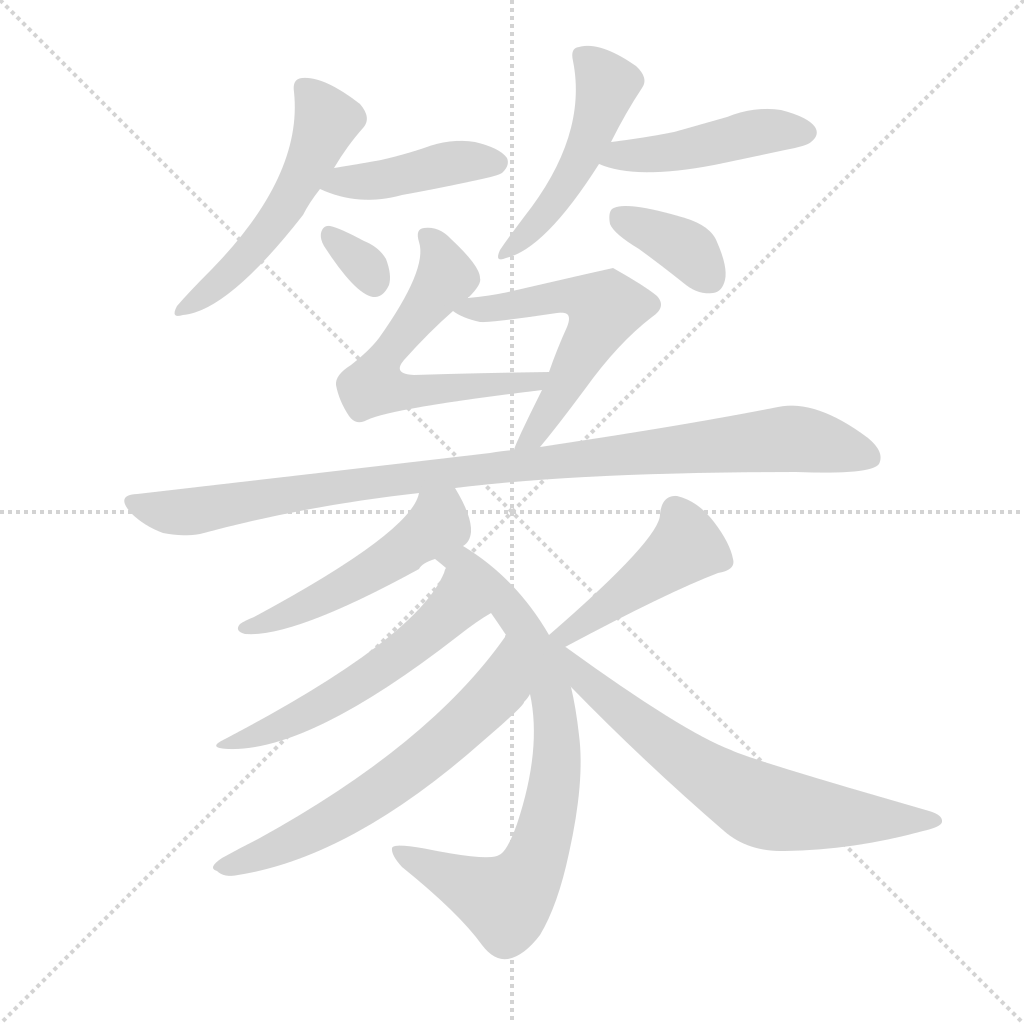
Zhuan
Kangxi strokes: 15
Page 892, Entry 13
Pronounced zhuan (rising tone).
In the Collected Rhymes (Jiyun), it refers to seal script. In the Preface to the Book of Documents (Shangshu Xushu), it is stated that during the Qin dynasty, there were eight styles of writing. The first was called large seal script, and the second was called small seal script. During the Xin dynasty, when Wang Mang was regent, he sent the Grand Minister of Works, Zhen Feng, and others to revise the classification of literary documents. At that time, there were six styles of writing. The third was called seal script, which is small seal script, created by Cheng Miao of Xiadu. The fifth was called profound seal script, which was used for carving official seals. According to the Examination of Calligraphy (Fashukao), large seal script was created by the Zhou dynasty historian Shi Zhou. Some say the historian of the archives (a historical official) began to change the ancient script, with some parts remaining the same and others different, calling it seal script. Seal implies to transmit; it transmits the principles of things and can be applied infinitely. The fifteen chapters of the Shi Zhou recorded in the Treatise on Literature of the Book of Han (Hanshu Yiwenzhi) refer to this. Because it was created by a historian for the purpose of instruction, it was called historian script, totaling nine thousand characters. Small seal script was created by Li Si, the prime minister of the Qin dynasty. He made additions and subtractions to the large seal script and the writings of Zhou, calling it small seal script, also known as Qin seal script, and promoted it throughout the nation. Its strokes are as firm as iron and stone, and its characters are as lively as if in motion; it became the source of standard script and clerical script, serving as an immutable rule. Those used for carving inscriptions on bells and tripods, as well as for making tallies and credentials, are still in use today. It also refers to the colorful patterns painted on the hubs of carriages. According to the Rites of Zhou (Zhouli), Spring Office, a lone official rides a summer-patterned carriage. The commentary states that summer means red. Summer-patterned refers to decorations painted on the carriage hub in five colors. According to the Record of Trades (Kaogongji), the raised, belt-like patterns on the body of a bell are also called seal script.