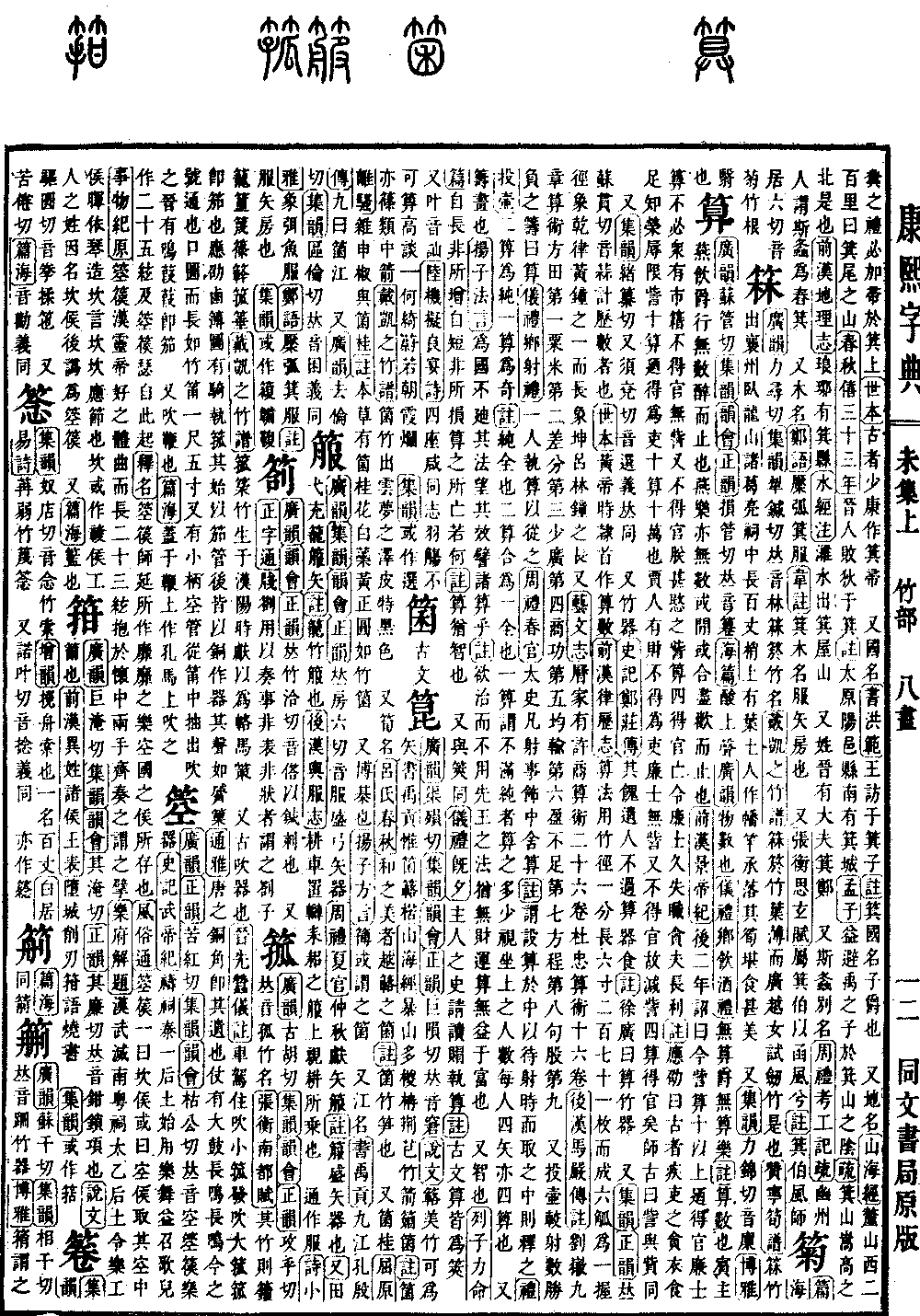
Wei Collection, Upper Volume
Radical: Bamboo (zhú)
Kangxi Strokes: 14
Page 888, Entry 09
Pronounced kong.
Konghou is a type of musical instrument.
Records of the Grand Historian (Shiji): When offering sacrifices to the Taiyi Deity and the Earth Goddess, ritual dances were first performed, singers were recruited, and twenty-five stringed zithers, as well as the konghou and se zithers, were constructed; from this time, they became popular.
Explanation of Names (Shiming): The konghou was created by the musician Shi Yan. It is a type of soft, lingering music preserved by feudal lords who had lost their states.
Comprehensive Account of Customs (Fengsutong): The konghou is also called kanhou. Some also refer to it as konghou, deriving the name from the fact that it is hollow inside.
Origin of Things and Affairs (Shiwu Jiyuan): Emperor Ling of Han was fond of the konghou. The instrument body is curved and long, possesses twenty-three strings, and is held in the arms; both hands are used together to pluck it, which is called bo.
Music Bureau Commentary (Yuefu Jieti): After Emperor Wu of Han pacified Nanyue, he offered sacrifices to the Taiyi Deity and the Earth Goddess and ordered the musician Hou Hui to construct a kanhou based on the design of the zither, saying the kan-kan sound echoes the rhythm. Kan is sometimes written as a variant form (gan). Hou is the surname of the musician. Therefore, it was named kanhou, which was later mistakenly transmitted as konghou.
Also, in the Sea of Characters (Pianhai), it refers to a bamboo basket.