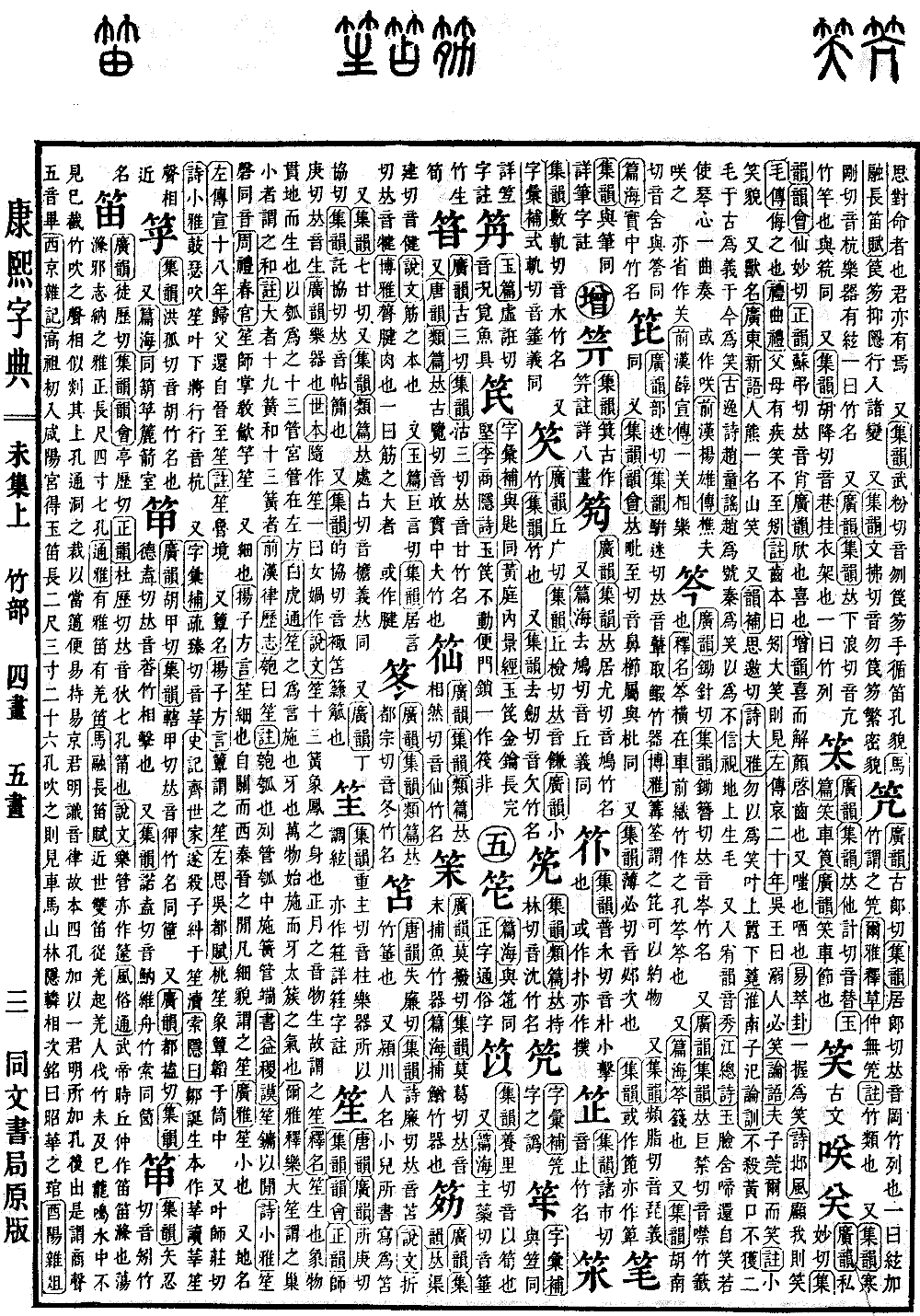
Wei Collection, Upper Volume
Radical: Bamboo (zhú)
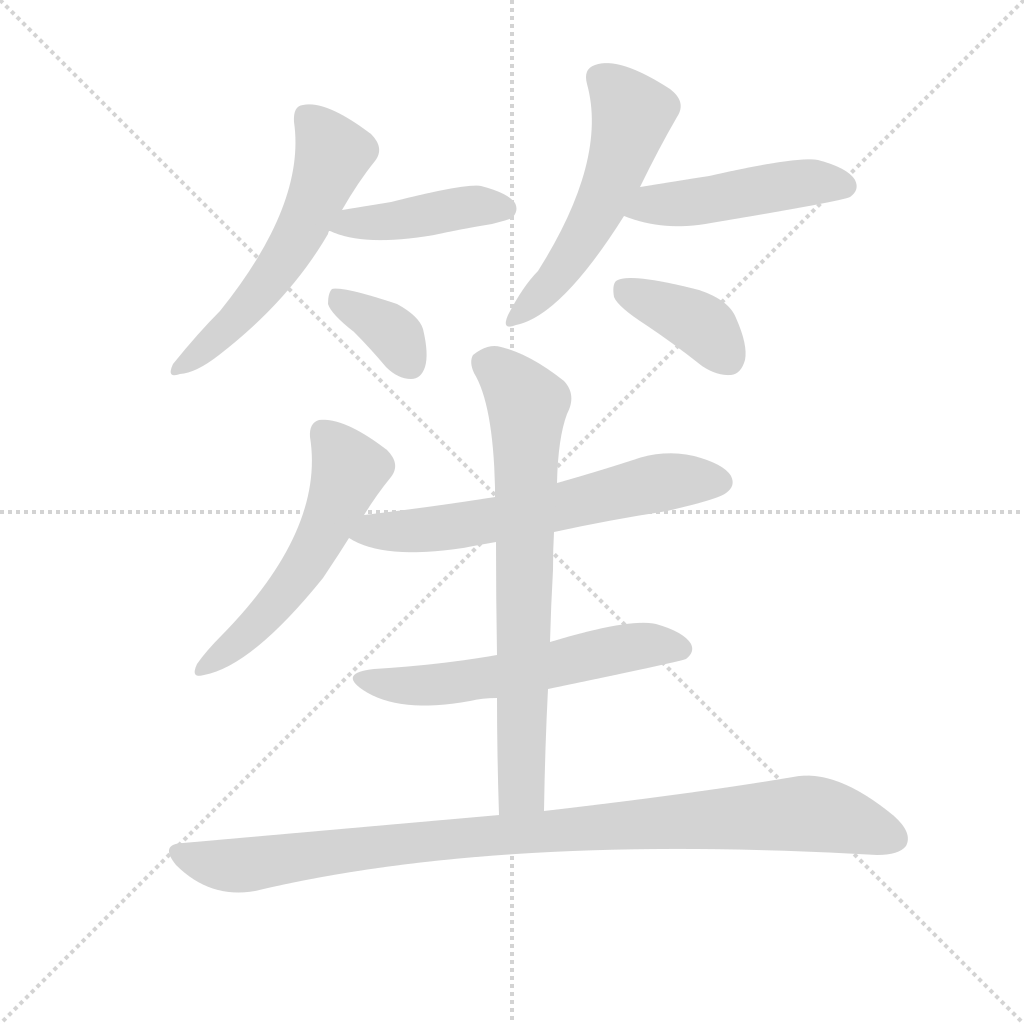
Sheng
Kangxi strokes: 11
Page 879, Entry 29
Pronounced sheng.
According to the Guangyun (Broad Rhymes), it is a type of musical instrument.
The Shiben (Genealogical Records) records that Sui made the sheng. There is also a claim that Nüwa made it.
The Shuowen Jiezi (Explaining Graphs and Analyzing Characters) states: The sheng has thirteen reed pipes, and its shape mimics the body of a phoenix. It represents the musical sound of the first lunar month, symbolizing the sprouting of all things. Because all things are growing, it is called sheng.
The Shiming (Explanations of Names) states: Sheng means to be born. It symbolizes the appearance of things breaking through the soil.
The Boya Shiyue (Broad Gleanings: Explanations of Music) states it is made from a gourd (pao) and has thirteen pipes, with the gong-note pipe on the left.
The Baihu Tong (Comprehensive Discussions in the White Tiger Hall) states: The sheng represents the yang energy of taicou (one of the twelve ancient pitch standards, corresponding to the first lunar month), symbolizing the sprouting of all things; hence it is called sheng.
The Erya Shiyue (Approaching Refinement: Explanations of Music) states: A large sheng is called chao, and a small one is called he.
Annotation: The large one has nineteen reeds, and the small one, the he, has thirteen reeds.
The Qianhan Lüli Zhi (Treatise on Harmonics and Calendrical Astronomy from the Former Han History) states: Gourd-type instruments are called sheng.
Annotation: Pao refers to a gourd. Bamboo pipes are arranged within the gourd, and reeds are installed at the ends of the pipes.
The Book of Documents (Shujing), Yi Ji chapter: The sheng and yong (large bell) were played in alternation.
The Book of Odes (Shijing), Xiao Ya: The sounds of the sheng and the qing (stone chime) harmonized with each other.
The Rites of Zhou (Zhouli), Chun Guan: The official position of Shengshi (Sheng Master) was responsible for teaching the playing of the yu and sheng.
It also carries the meaning of small or fine.
The Yangzi Fangyan (Regional Speech): Sheng means small. From the west of Hangu Pass, throughout the states of Qin and Jin, anything described as small is called sheng.
The Guangya states: Sheng means small.
It is also a place name.
The Zuo Zhuan (Commentary of Zuo), 18th Year of Duke Xuan: Guifu returned from the state of Jin and arrived at the place called Sheng.
Annotation: Sheng was a border territory of the state of Lu.
It also refers to the name of a bamboo mat.
The Yangzi Fangyan: A bamboo mat is called sheng.
The Zuo Si Wudu Fu (Rhapsody on the Capital of Wu): Tao-sheng (mats woven from peach-branch bamboo) and mats decorated with ivory are stored in bamboo tubes.
Also, pronounced as shuang (level tone).
The Book of Odes (Shijing), Xiao Ya: Plucking the se and blowing the sheng. It rhymes with the following line containing the character jiang, where the character xing is read as hang.
Also, according to the Zibu Bu (Supplement to the Character Collection), pronounced as shen (level tone).
The Records of the Grand Historian (Shiji), Qi Shijia: Consequently, Zi Jiu was killed at the place of Shengdu.
Suoyin says: The version by Zou Dansheng (a person's name) writes it as Shendu to be read, because shen and sheng have similar pronunciations.
Textual Corrections:
The statement "Made of gourd, thirteen pipes, the gong pipe is on the left" is sourced from the Boya, but was erroneously listed under the Shiming. Now, the words Boya Shiyue have been added before the sentence "Made of gourd."
The Baihu Tong: "The meaning of sheng is to spread, to bud. It is the energy of taicou, as all things begin to spread and bud." Note that the original text used the character pao; the two sentences above are explanations of "pao" and have no relation to the character "sheng." Now, based on the original book, it has been changed to: "Sheng represents the energy of taicou, symbolizing the growth of all things, hence it is called sheng."
The Book of Documents (Shujing), Yi Ji Mo: "The sheng and yong are used in alternation." Note that the Yi Ji is not referred to as a Mo; the character Mo has been changed to the chapter title.