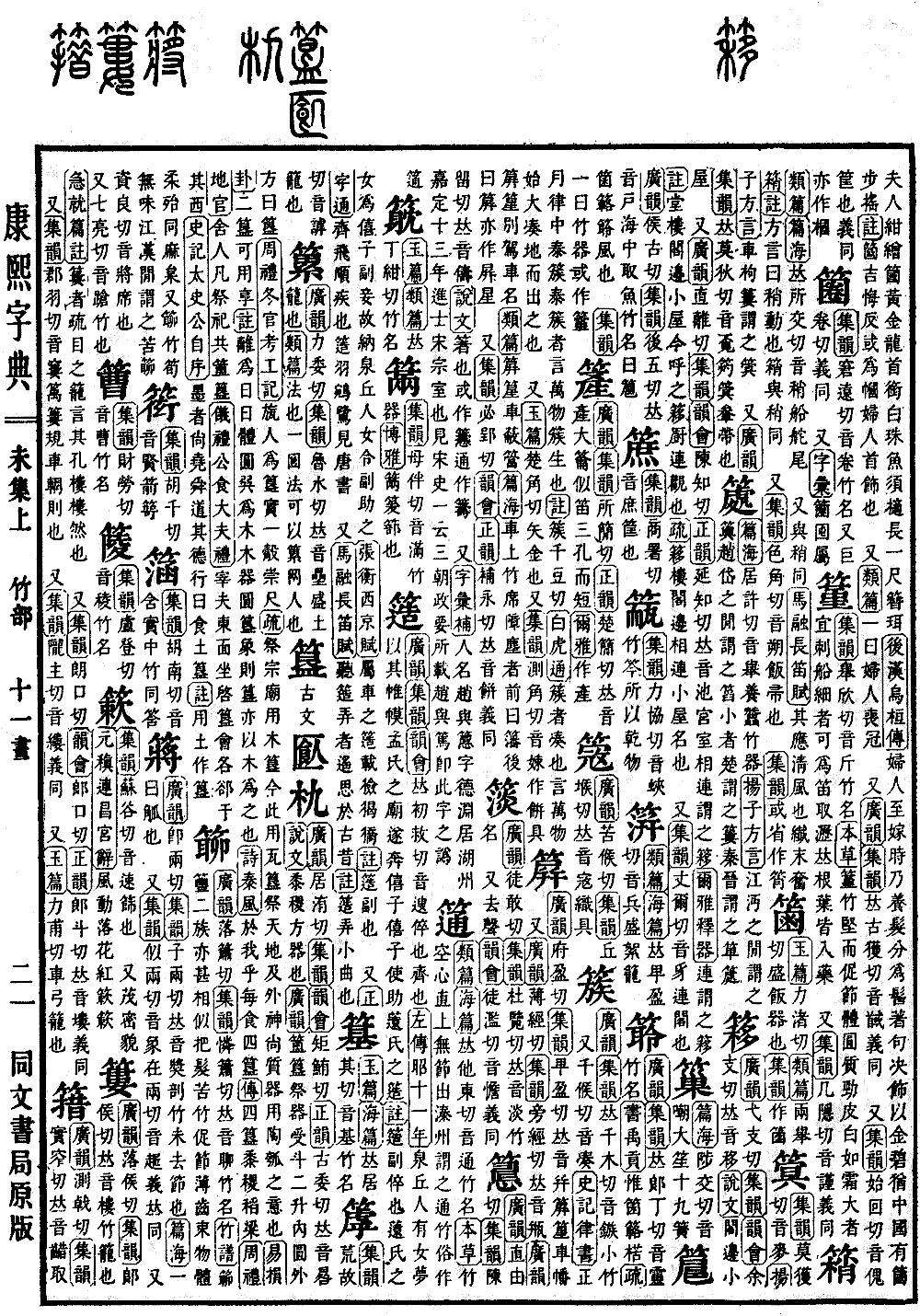
Wei Collection, Upper Volume
Radical: Bamboo (zhú)
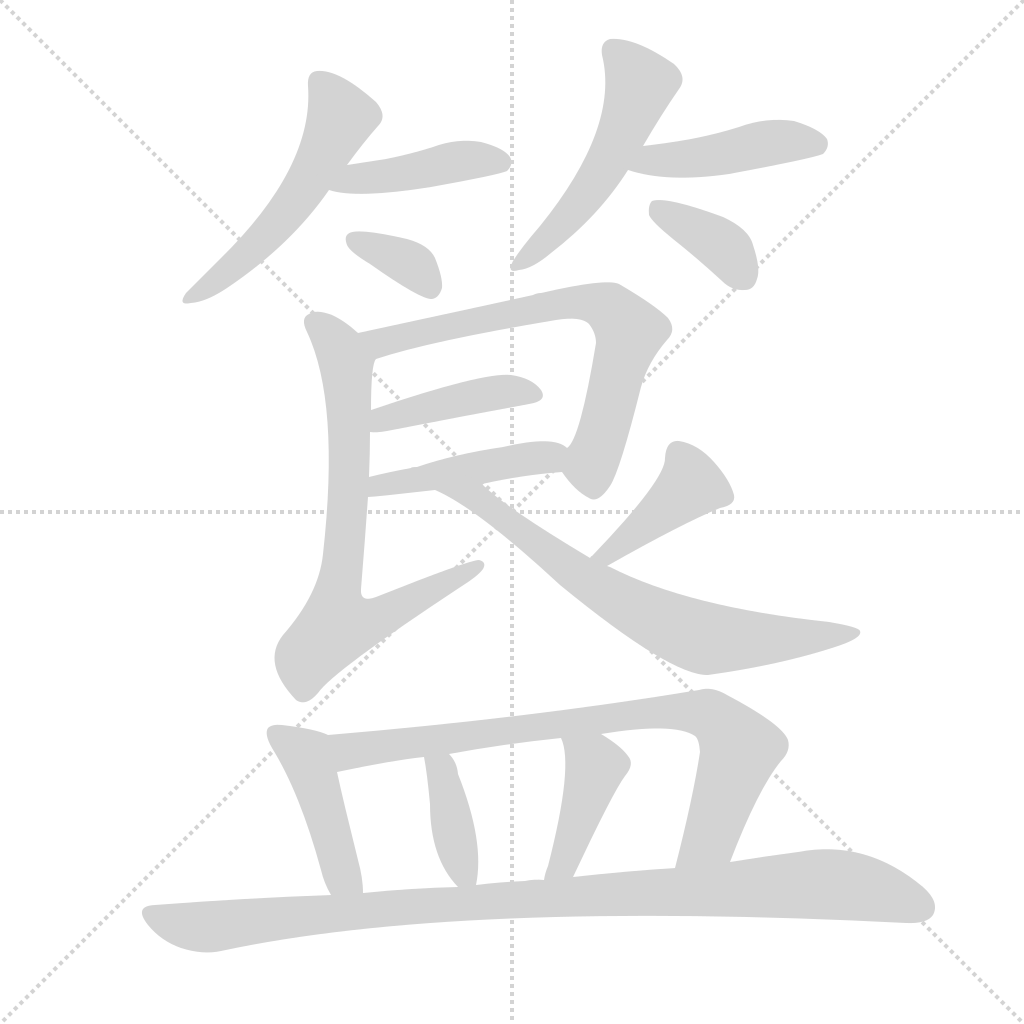
簋
Kangxi strokes: 17
Page 897, Entry 27
Ancient form: 朹
Pronounced gui (rising tone).
Shuowen Jiezi (Shuowen): A square vessel for millet.
Guangyun: Fu gui are sacrificial vessels. They hold one dou and two sheng. A vessel that is round inside and square outside is called a gui.
Book of Rites (Zhouli), Winter Officers, Artificers Record: The potter makes the gui. It holds one hu and is one foot tall.
Commentary: Wooden gui are used for ancestral temple sacrifices. The gui mentioned here are earthen, used for sacrifices to Heaven, Earth, and external spirits. This reflects the value of simplicity and the use of pottery and gourds.
Book of Changes (Yijing), Sun hexagram: Two gui may be used for the offering.
Note: The trigram Li represents the sun, and the sun is round. It also represents wood, and wooden vessels are round. Since the gui resembles this, it is also made of wood.
Book of Odes (Shijing), Odes of Qin: For our every meal, four gui.
Commentary: Four gui: millet, sorghum, rice, and beans.
Book of Rites (Zhouli), Office of Earth: The chamberlain provides the fu and gui for all sacrifices.
Book of Etiquette and Ceremonial (Yili), Official Meal for Grandees: The steward, facing east, sits and opens the gui cover, placing them to the west.
Records of the Grand Historian (Shiji), Preface of the Grand Historian: The Mohists honored Yao and Shun, spoke of their virtuous conduct, and said they ate from earthen gui.
Note: Using earth to make gui.
Textual research: In the commentary, four gui, millet, sorghum, rice, and beans. The original text listed rice and beans, which has been corrected accordingly. In the Records of the Grand Historian, Preface of the Grand Historian, the Mohists honored Yao and Shun, spoke of their virtuous conduct. The original text read honored Yao and Shun as one phrase and spoke of their virtuous conduct as another; the character said cannot be omitted, so it has been added.