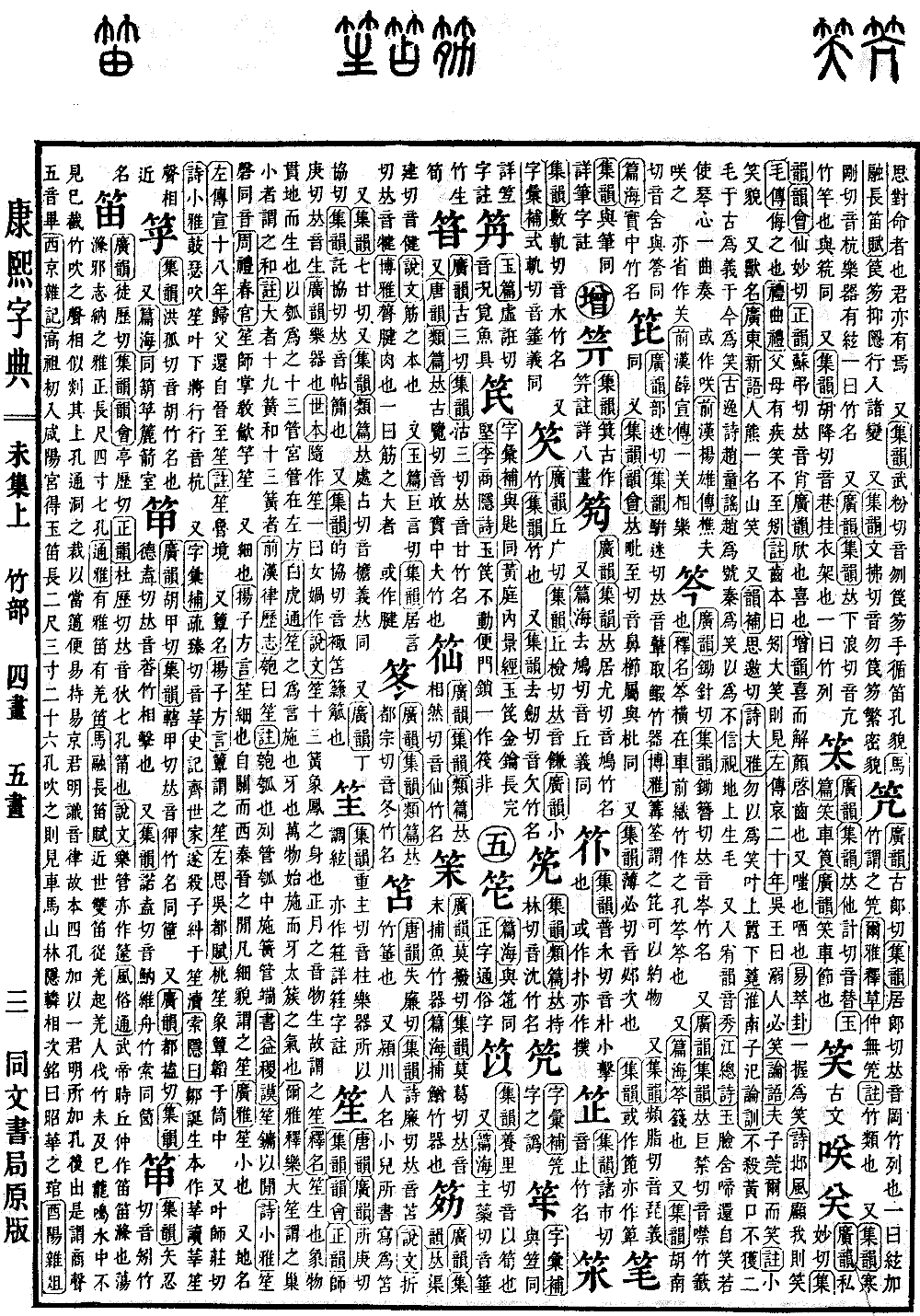
Wei Collection, Upper Volume
Radical: Bamboo (zhú)
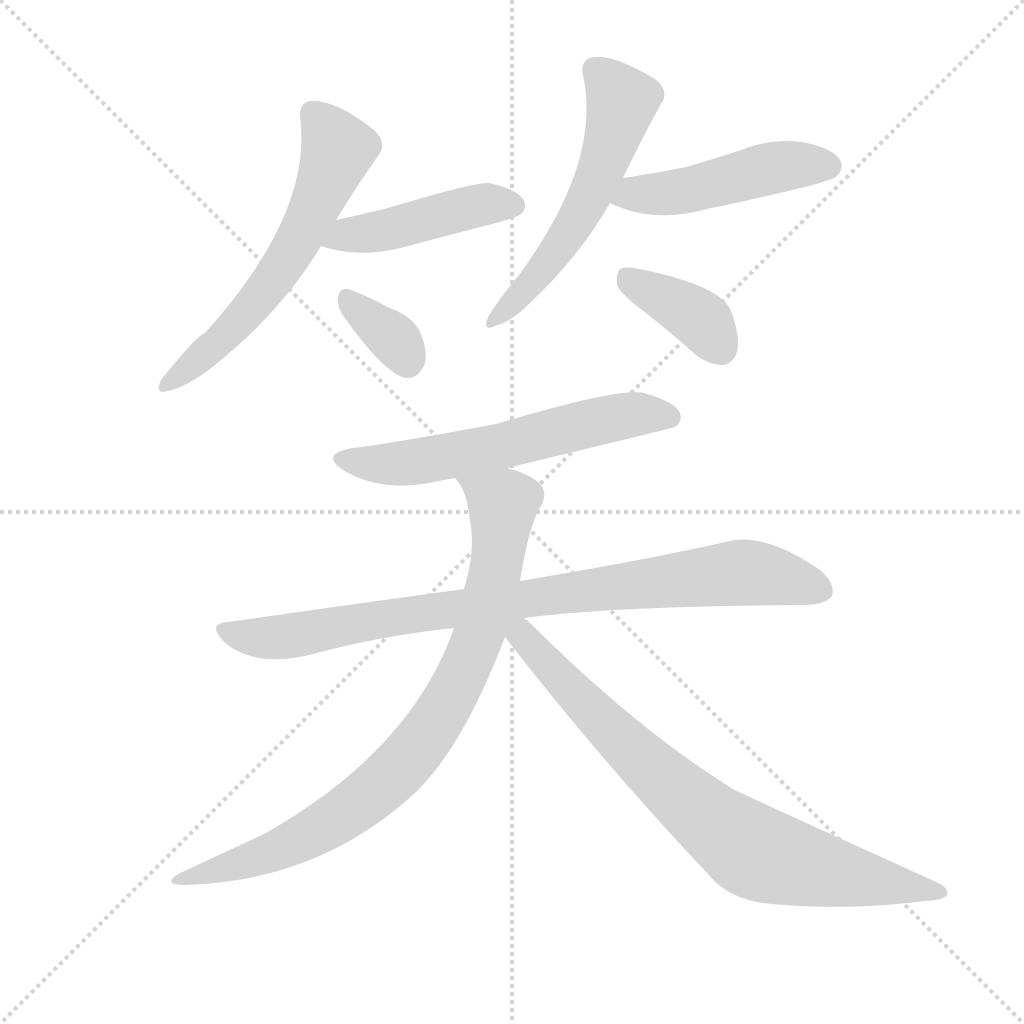
笑
Kangxi strokes: 10
Page 879, Entry 03
Ancient form: 咲
Pronounced xiao
Wide Dictionary (Guangyun): Pleasure; joy.
Increased Dictionary (Zengyun): To show joy by relaxing the facial muscles and opening the mouth. Also, to sneer or mock.
Book of Changes (Yijing), Hexagram 45 (Cui): To grasp with a hand is to laugh.
Book of Odes (Shijing): When he looks at me, he smiles.
Mao Commentary (Maozhuan): To treat with contempt.
Book of Rites (Liji): When parents are ill, do not laugh to the point of exposing the gums.
Annotation: The root of the teeth is called shen; laughing loudly exposes them.
Zuo Commentary (Zuozhuan), Twentieth Year of Duke Ai: The King of Wu said: A drowning man will surely laugh.
Analects (Lunyu): The Master smiled softly.
Annotation: The appearance of a small laugh.
Also, the name of a beast.
New Account of Guangdong (Guangdong Xinyu): The human bear, also called mountain laughter.
Also pronounced yao.
Book of Odes (Shijing): Do not treat it as a laugh, rhyming with xiao and rao.
Huainanzi: Not killing the fledgling, not capturing the grey-haired, was righteous in ancient times, but a laughingstock in the present.
Ancient Lost Odes, Zhao Ballad: Zhao is the cry, Qin is the laugh. If you do not believe it, look at the hair growing on the ground.
Also pronounced xiu, in the you rhyme category.
Poetry of Jiang Zong: The jade face holds tears while still laughing, as if playing a tune on the zither.
Sometimes written as 咲.
History of the Former Han (Qianhan Shu), Biography of Yang Xiong: The woodcutter laughed at him.
Also abbreviated as guan.
History of the Former Han (Qianhan Shu), Biography of Xue Xuan: To find joy together.