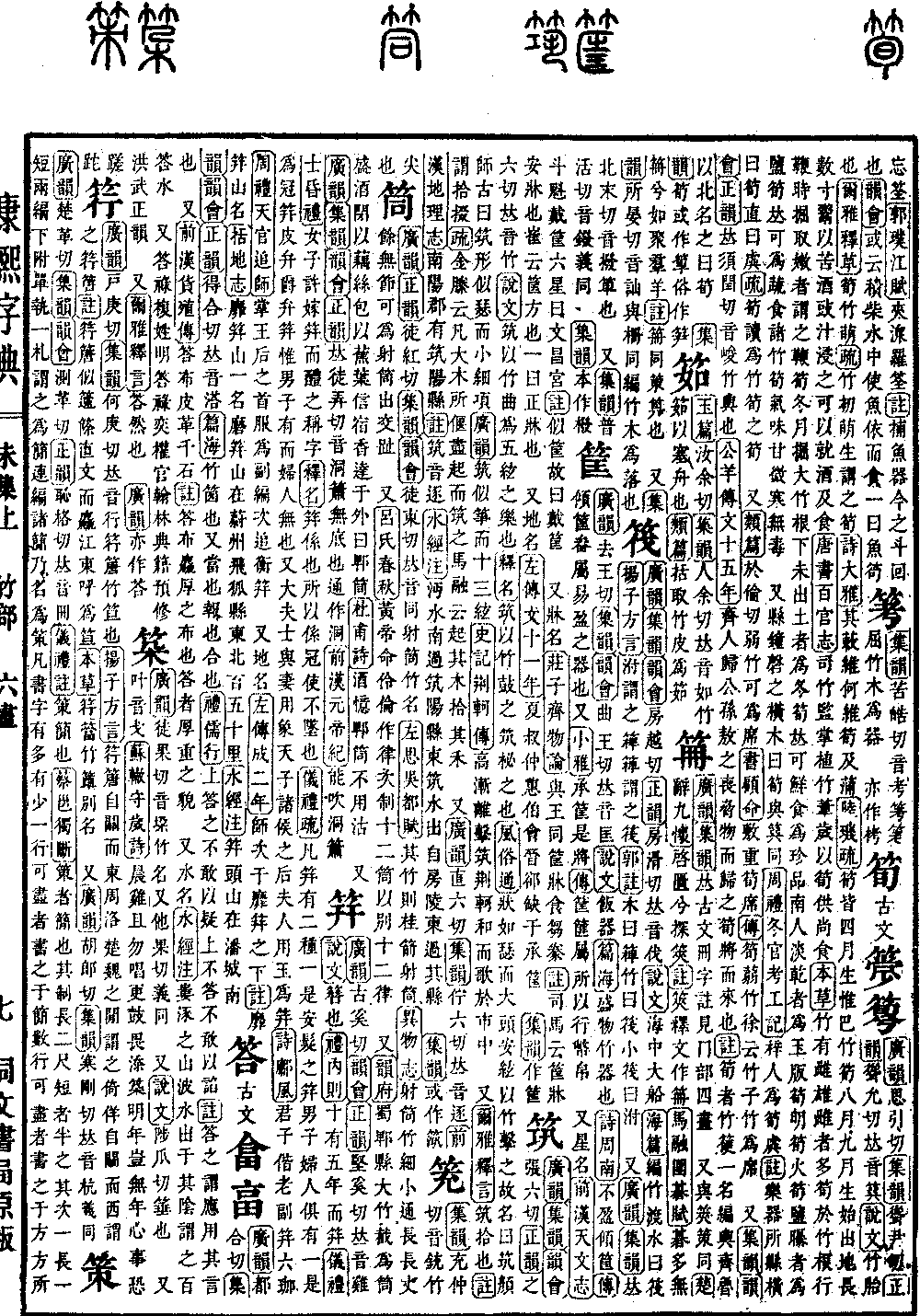
Wei Collection, Upper Volume
Radical: Bamboo (zhú)
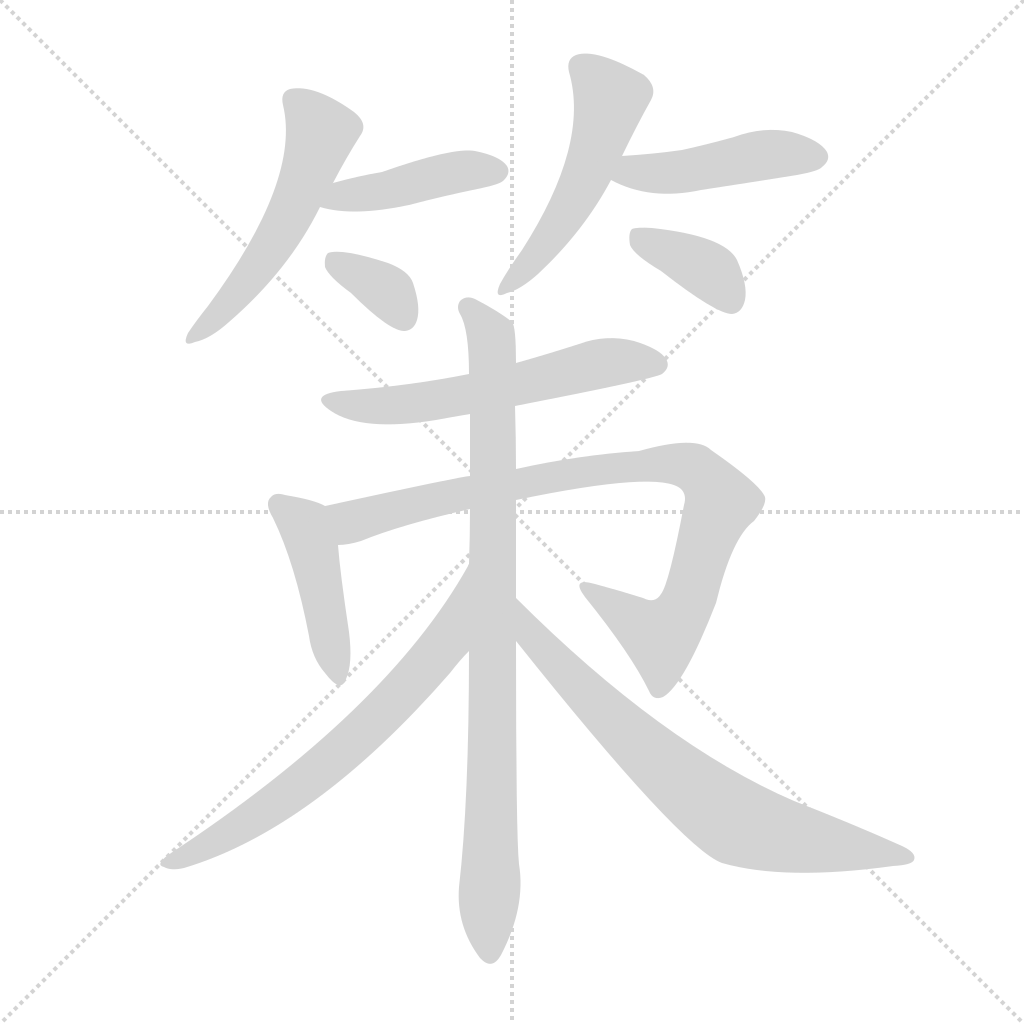
策
Kangxi Stroke Count: 12
Page 883, Entry 18
Pronounced ce
Pronounced ce
Pronounced che
Book of Etiquette and Ceremonial (Yili) Commentary: A ce is a bamboo slip.
Cai Yong, Sole Decision (Duduan): A ce is a bamboo slip. Its form is two feet long, with short ones being half that length; others alternate between long and short. Two cords are used to bind the slips together, with an extra slip attached at the bottom called a jian. Binding many slips together is called a ce. In writing, depending on the number of characters, those fitting on one line are written on a slip, those fitting in a few lines are written on a square board, and those that cannot fit on a square board are written on a ce.
Book of Rites (Liji), Songs of Propriety (Quli): When a teacher's books or zithers are placed in front, the student must kneel and move them, and may not step over them.
Comprehensive Examination (Tongkao): According to the regulations of the Han dynasty, when selecting scholars, difficult questions were posed; the examinees would draw a question to answer, which was called shece (archery-style drawing of a question). Questions clearly addressing the gains and losses of political education were called duice (answering questions).
Also refers to official documents.
Explanation of Names (Shiming): A ce-shu is a document issued by the monarch to drive or urge his subjects to action.
Zuo Commentary (Zuozhuan), 28th Year of Duke Xi: King Xiang of Zhou ordered the Yin clan, Prince Hu, and the Inner Scribe Shu Xingfu to use a ce-shu to appoint Duke Wen of Jin as the leader of the feudal lords.
Also refers to strategies or plans.
Records of the Grand Historian (Shiji), Biography of Yuan Ang: Although Yuan Ang lived in retirement, Emperor Jing of Han often sent men to ask for his strategies.
Also refers to yarrow stalks.
Records of the Grand Historian (Shiji), Treatise on the Feng and Shan Sacrifices: When the Yellow Emperor obtained the precious tripod and the divine yarrow, he calculated the calendar to predict the solar terms and dates. Commentary: Ce refers to divine yarrow stalks. The Yellow Emperor obtained the yarrow to calculate the calendar and predict future solar terms and dates.
Also the name of a type of bamboo.
Zuo Si, Rhapsody on the Capital of Wu (Wu Du Fu): There are clusters of ce bamboo and lao bamboo.
Wu Yun, Rhapsody on Bamboo (Zhu Fu): Bamboo species are not limited to one type; among them are ce bamboo, lao bamboo, jin bamboo, and man bamboo.
Also refers to a horse whip.
Book of Rites (Liji), Songs of Propriety (Quli): When the ruler's carriage is about to be driven out, the servant must stand in front of the horses holding the whip.
Zuo Commentary (Zuozhuan), 13th Year of Duke Wen: Shi Hui of Jin was about to leave (Qin), and Rao Chao gave him a whip. Commentary: Ce refers to a whip.
Also, using a whip to drive a horse is called ce.
Zuo Commentary (Zuozhuan), 11th Year of Duke Ai: At the Battle of Qing, Meng Zhice was the last to enter (the city gate) to serve as the rearguard, drawing his bow and whipping his horse.
Also Tiance (Heavenly Whip), the name of a star.
Zuo Commentary (Zuozhuan), 5th Year of Duke Xi: A nursery rhyme said: The quail's feathers spread, and the Tiance star is dim and without light. Commentary: Tiance refers to the Fushuo star.
Also Jin Ce, referring to a monk's staff, found in the Collection of Rhymes from the Book of Odes (Shiyun Jilue).
Also refers to something small.
Yangzi, Dialect (Fangyan): Wood that is small is called miao; in the northern border of Yan, Korea, and between the Lie River, it is called ce.
Also ce-ce, the sound of falling leaves.
Poetry of Han Yu: When the autumn wind blows, it makes a ceaseless ce-ce sound.
Also refers to a cautionary or key phrase.
Lu Ji, Rhapsody on Literature (Wen Fu): Using a few words placed in a critical spot to become the key phrase of an essay. Commentary: A horse runs fast because of the whip, which is a metaphor for an essay gaining clarity from a few words. Placing one sentence among many phrases is like whipping a horse to startle it into motion.
Also refers to a thorn.
Yangzi, Dialect (Fangyan): Anything in plants or trees that pricks people is called ce in the region between Northern Yan and Korea.
Also a surname. In the Ming dynasty, there were Cemin and Ce.
Also, according to the Collection of Rhymes (Jiyun), it refers to a small winnowing basket.
Sea of Phrases (Pianhai): Also written in a variant form (ce). The common form (ce) is incorrect.