Wei Collection, Upper Volume
Radical: Bamboo (zhú)
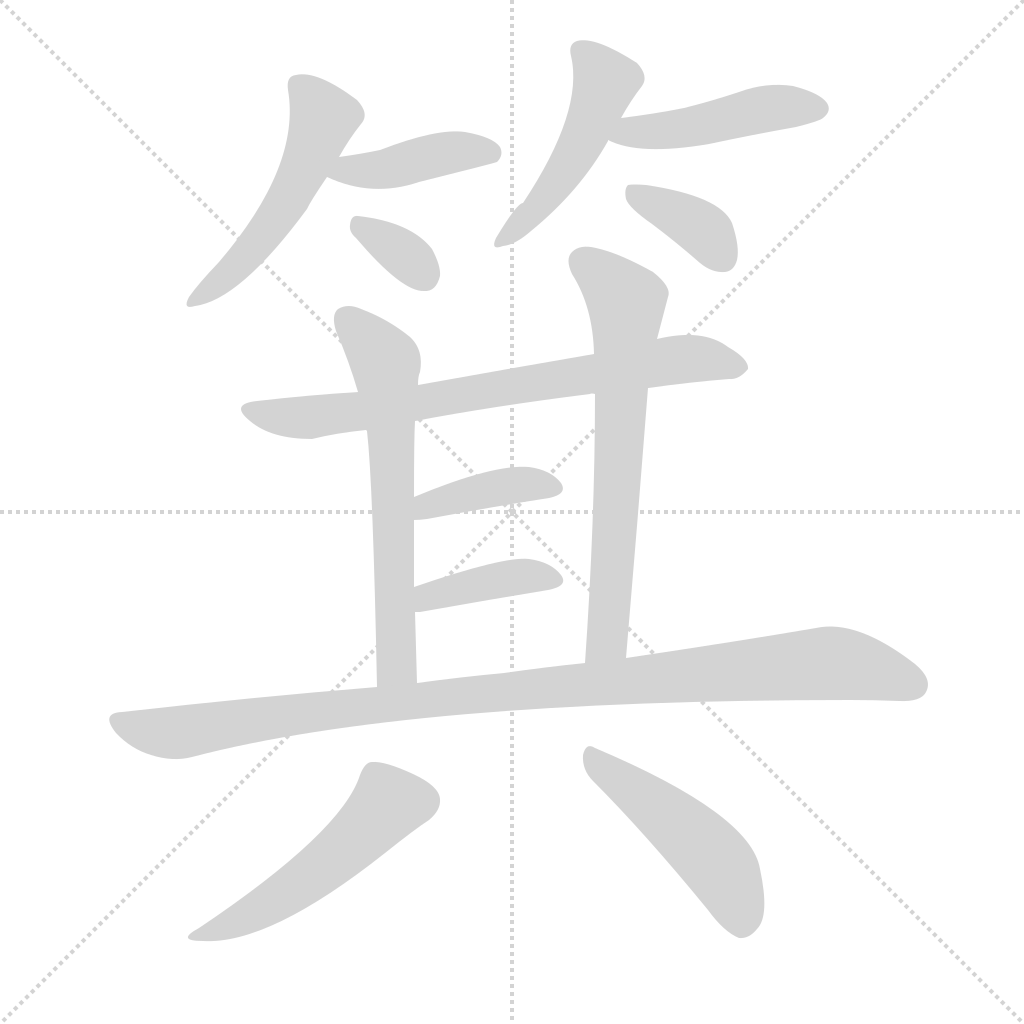
箕
Kangxi stroke count: 14
Page 887, Entry 25
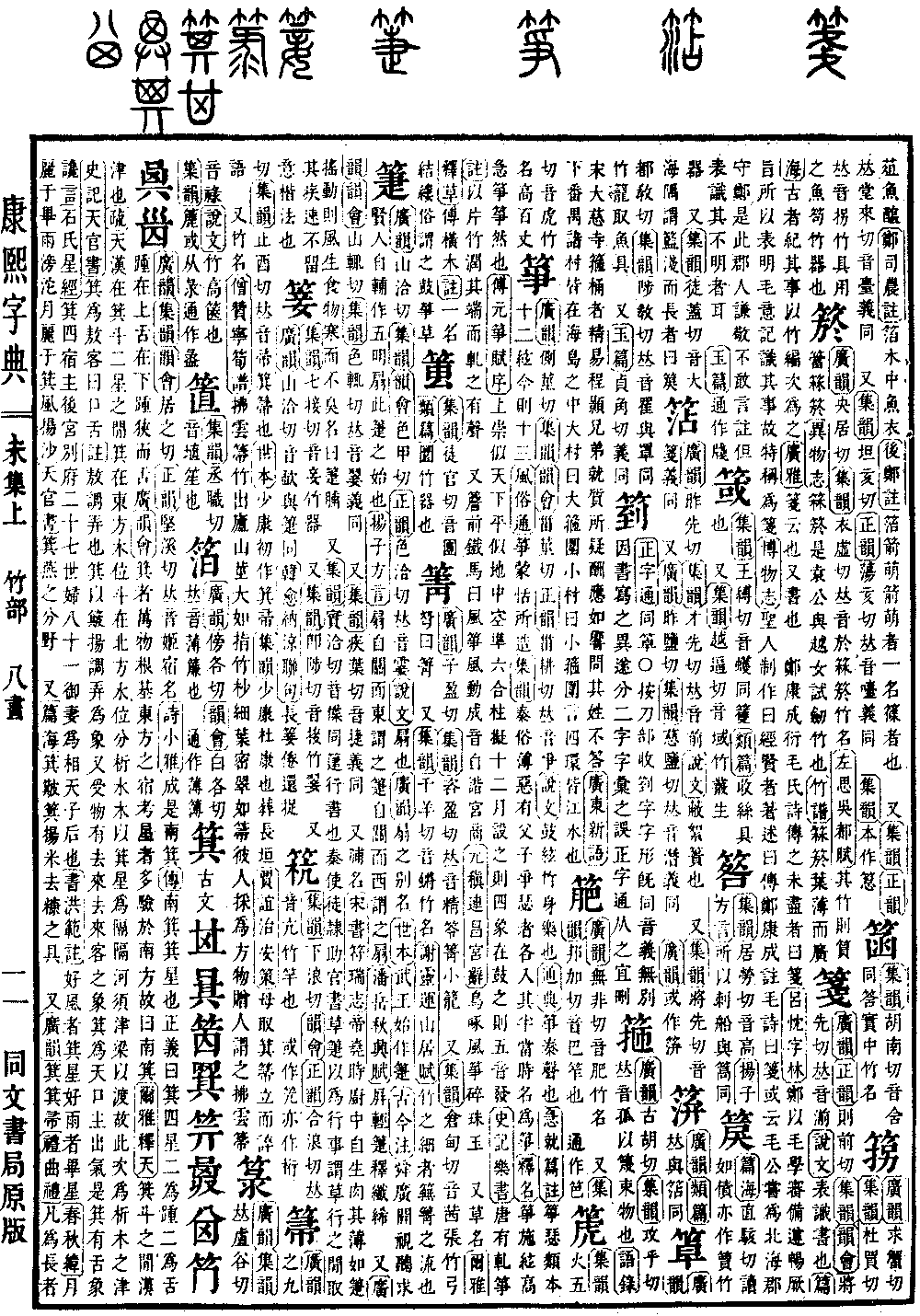
In ancient texts: Guangyun (Guangyun), Jiyun (Jiyun), and Yunhui (Yunhui) define the pronunciation as ji. Zhengyun (Zhengyun) defines the pronunciation as ji. Both match the pronunciation of the character for noble lady (ji).
It is the name of a lunar mansion. The Book of Odes (Shijing) in the Lesser Odes (Xiao Ya) contains the line: "Formed this southern Winnowing Basket." The Commentary (Zhuan) explains: The Southern Winnowing Basket is the Winnowing Basket lunar mansion. The Correct Meaning (Zhengyi) further clarifies: The Winnowing Basket mansion is composed of four stars, two as the heels and two as the tongue; the heels are at the top and the tongue is at the bottom, with the heel section being narrow and the tongue section being broad. Yunhui (Yunhui) states: The Winnowing Basket mansion is the foundation of all things and belongs to the eastern constellations. Those who observe celestial phenomena often verify them in the south, hence it is called the Southern Winnowing Basket. Erya (Erya), section Explaining Heaven (Shitian), records: The Ford of the Divided Wood (Ximu zhi jin) is located between the Winnowing Basket mansion and the Dipper mansion; it is the ferry point of the Celestial River (the Milky Way). The Sub-commentary (Shu) explains: The Milky Way flows between the Winnowing Basket and Dipper stars. The Winnowing Basket is in the east, which corresponds to the element of wood, and the Dipper is in the north, which corresponds to the element of water. Dividing water and wood, the Winnowing Basket star serves as the separator. Separating rivers requires ferries or bridges to cross, hence this sequence is called the Ford of the Divided Wood. Records of the Grand Historian (Shiji), section Treatise on Celestial Offices (Tianguan shu), states: The Winnowing Basket mansion symbolizes talkative guests and governs verbal disputes and right from wrong. The Note (Zhu) explains: To provoke means to tease or jest. The image of the Winnowing Basket mansion is like using a winnowing shovel to toss rice and tease. It can also contain objects that come and go. Coming and going is a symbol of guests. The Winnowing Basket mansion is the mouth of heaven, governing the emission of breath; therefore, the Winnowing Basket mansion has the image of a tongue, symbolizing slander. The Classic of Stars by Master Shi (Shi shi xing jing) states: The four stars of the Winnowing Basket mansion govern the rear palaces and separate offices, the twenty-seven ladies of the court, and the eighty-one concubines, acting as aides to the Emperor’s consort. The Note to the Book of Documents (Shangshu), chapter Great Plan (Hongfan), states: That which loves the wind is the Winnowing Basket star; that which loves the rain is the Net star. The Apocryphal Texts of the Spring and Autumn Annals (Chunqiu wei) state: When the moon approaches the Net mansion, there will be heavy rain. When the moon approaches the Winnowing Basket mansion, there will be fierce winds and blowing sand. The Treatise on Celestial Offices (Tianguan shu) states: The Winnowing Basket mansion corresponds to the celestial field of the Yan state.
Also, Pianhai (Pianhai) records: A winnowing basket (ji) is a tool used for winnowing husks from rice.
Also, Guangyun (Guangyun) records: A winnowing basket (ji) refers to a broom and a dustpan. The Book of Rites (Liji), section Tradition of Etiquette (Quli), states: For all etiquette involving cleaning for elders, one must place the broom on top of the dustpan. The Genealogies (Shiben) states: In ancient times, Shaokang invented the winnowing basket and the broom.
It is also the name of a state. The Book of Documents (Shangshu), chapter Great Plan (Hongfan), records: King Wu of Zhou visited the Viscount of the Winnowing Basket (Jizi). The Note (Zhu) states: The Winnowing Basket is the name of a state. The ruler held the rank of viscount.
It is also the name of a place. The Classic of Mountains and Seas (Shanhaijing) records: Two hundred li to the west of Li Mountain is called Winnowing Basket Tail Mountain. The Spring and Autumn Annals (Chunqiu), in the thirty-third year of Duke Xi, records: The people of the Jin state defeated the Di people at the Winnowing Basket (Ji) location. The Note (Zhu) states: South of Yangyi County in Taiyuan, there is a Winnowing Basket City. Mencius (Mengzi) records: To avoid the son of Yu, Yi went to the north of Winnowing Basket Mountain. The Sub-commentary (Shu) explains: Winnowing Basket Mountain is the north side of Mount Songgao. The History of the Former Han (Qian Hanshu), section Geography Treatise (Dilizhi), records: Langya Commandery has a Winnowing Basket County. The Commentary on the Water Classic (Shuijing zhu) records: The Wei River originates from Winnowing Basket House Mountain.
It is also a surname; the Jin state had a senior official named Ji Zheng.
It is also another name for the grasshopper (si zhong), a type of insect. The Sub-commentary to the Book of Rites of Zhou (Zhouli), section Records of Trades (Kaogong ji), states: The people of Youzhou call the grasshopper a mortar winnowing basket.
It is also the name of a tree. The Discourses of the States (Guoyu), section Discourses of Zheng (Zhengyu), records: Mulberry-wood bow and winnowing basket quiver. The commentary by Wei Zhao states: The winnowing basket is a type of tree. The quiver is a bag for arrows.
Also, Zhang Heng’s Rhapsody on Contemplating the Mystery (Si xuan fu) writes: Entrust the Winnowing Basket Earl (Jibo) to contain the wind. The Note (Zhu) states: The Winnowing Basket Earl is the god of wind.
Critical verification: The Erya (Erya), section Explaining Heaven (Shitian), states: Between the Winnowing Basket and the Dipper is the River Ford. According to the original text, the four characters for Ford of the Divided Wood have been added between the Winnowing Basket and the Dipper.