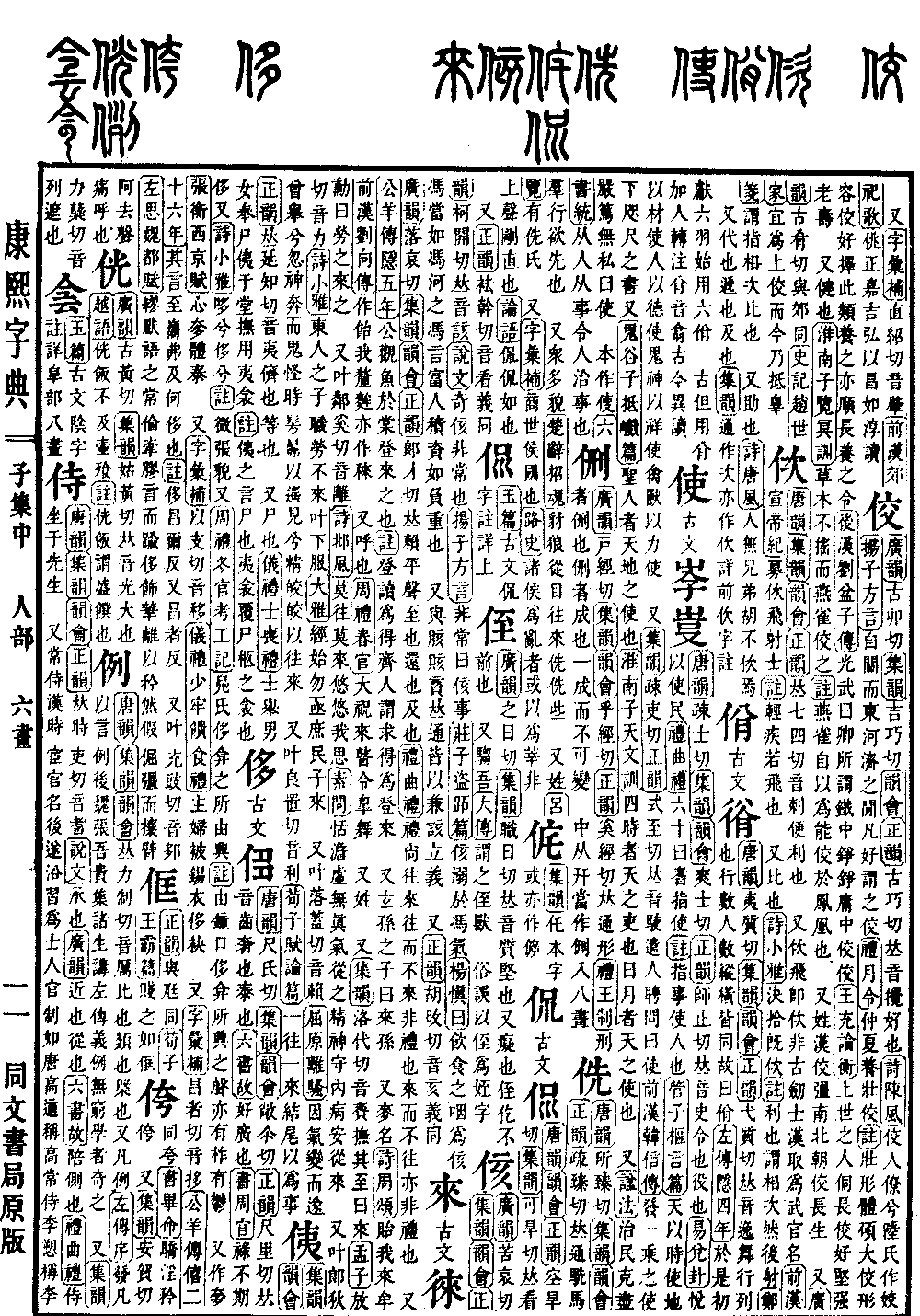
Zi Collection, Middle Volume, Radical: Person (rén), lai, Kangxi Strokes: 8, Page 101, Number 16
In ancient script, this is written as lai.
The Expanded Rhymes (Guangyun) provides the fanqie pronunciation of luo and ai. The Collected Rhymes (Jiyun), the Rhyme Assembly (Yunhui), and the Correct Rhymes (Zhengyun) provide the fanqie of lang and cai, read in the level tone like the character lai.
The meanings are: to arrive, to return, or to involve.
The Book of Rites (Liji) in the Summary of Ceremonies states: Propriety values reciprocity. To go and not come back is contrary to propriety; to come and not go back is also contrary to propriety.
The Gongyang Commentary (Gongyang Zhuan) for the fifth year of Duke Yin records: Duke Yin viewed the fishing at Tang, which was for the purpose of "deng lai." A note explains that "deng" is read as "de" (to obtain), as the dialect of the Qi region refers to seeking and obtaining something as "deng lai."
Furthermore, the son of a great-great-grandson is called a lai-grandson.
It also refers to a name for wheat. The Book of Odes (Shijing) in the Sacrificial Odes of Zhou says: Grant us wheat (lai) and barley (mou). The History of the Han Dynasty (Hanshu) in the Biography of Liu Xiang writes this as "feeding me li and mou." It is also written as a variant character pronounced lai.
It also refers to calling or summoning. The Rites of Zhou (Zhouli) records that the Great Invoker summons the blind musicians and commands them to dance.
It is also a surname.
According to the Collected Rhymes, it can also have the fanqie pronunciation of luo and dai, read as lai. Providing comfort to those who have arrived is called "lai." The Mencius (Mengzi) records that Fang Xun (Emperor Yao) said: Console them, encourage them to come (lai).
It also has a rhyming sound (ye) with the fanqie of lin and xi, read as li. The Book of Odes in the Odes of Bei says: Do not go and do not come (lai), for my heart is sorrowful and longing. The Basic Questions (Suwen) states: When the mind is tranquil and void, the true qi will follow (lai). If the spirit is guarded within, from where could illness come (lai)?
It also has a rhyming sound with the fanqie of lang and di, read as li. The Book of Odes in the Minor Odes says: The people of the eastern states are dedicated to hard labor yet receive no comfort (lai). This rhymes with the word "fu" (service) in the following line. The Major Odes section says: When the planning began, there was no urgency; the people came (lai) like children.
It also has a rhyming sound with the fanqie of luo and gai, read as lai. Qu Yuan's The Lament (Lisao) says: Taking advantage of the changing clouds, I soared upward; suddenly swift like a spirit or ghost. Appearing and disappearing as if seen from afar, the soul moved brilliantly to and fro (lai).
It also has a rhyming sound with the fanqie of liang and zhi, read as li. The Works of Xunzi (Xunzi) in the Section on Rhymed Expositions says: Coming and going (lai), tying the threads to complete the task.
Textual Research: Regarding the entry in the Section on Rhymed Expositions of the Works of Xunzi, "coming and going, ending to complete the task," the word "lun" (discourse) has been omitted in accordance with the original book.