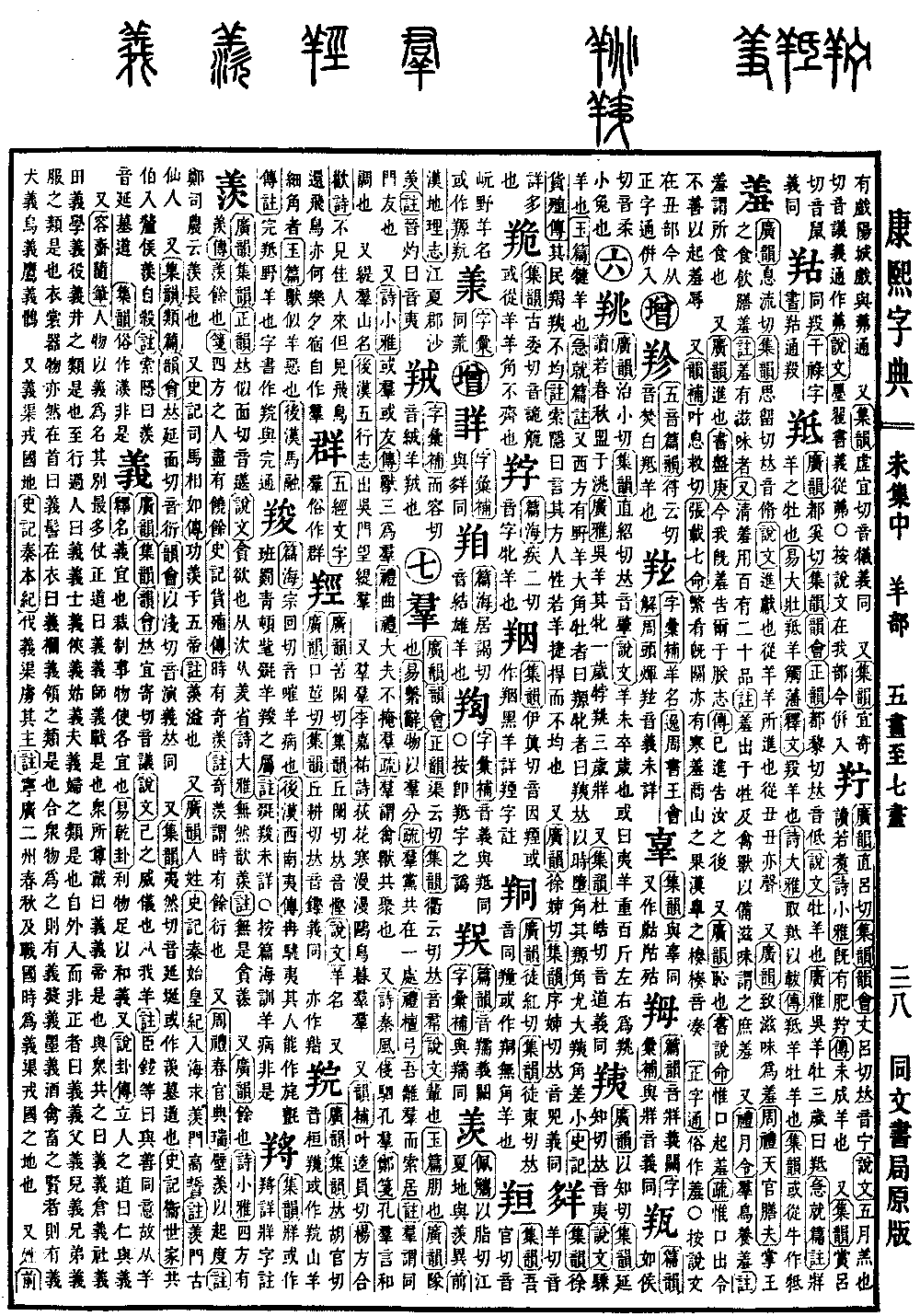
Wei Collection, Middle Volume. Radical: Sheep (yáng). Yi. Kangxi Stroke Count: 13. Page 952.
Broad Rimes (Guangyun), Collected Rimes (Jiyun), and Collected Rhymes (Yunhui) all indicate the pronunciation is derived from the fanqie yí-jì, sounding like yì.
Explaining Graphs (Shuowen) states: It refers to one's own dignified demeanor. It is composed of the components for self and sheep. A note by Minister Xuan and others says: It shares the same meaning as goodness (shàn), therefore it incorporates the sheep radical.
Explaining Names (Shiming) states: Yi means appropriateness (yí). It refers to judging and managing matters so that each is appropriate.
The Book of Changes (Yijing) in the Hexagram Qian section states: Benefiting things is sufficient to harmonize righteousness. Also, the Treatise on the Hexagrams (Shuoguazhuan) states: The way of establishing humanity is called benevolence and righteousness.
Also, the Miscellaneous Notes from Rongzhai (Rongzhai Suibi) notes: There are a great many categories where people or things are named with the term yi. Upholding the correct path is called yi, as seen in righteous armies or righteous wars. That which is respected and supported by the masses is called yi, as in a righteous emperor. That which is shared with the public is called yi, such as public granaries, public societies, public fields, public schools, public service, or public wells. Conduct that surpasses that of ordinary people is called yi, such as righteous men, chivalrous heroes, righteous aunts, righteous husbands, or righteous wives. That which enters from the outside and is not the primary or original form is called yi, such as adoptive fathers, adopted sons, sworn brothers, or non-primary mourning garments. This also applies to clothing and utensils; on the head there are false hairpieces, and on clothing there are detachable borders or detachable collars. When made by combining various materials, terms like mixed syrups, mixed inks, or mixed wines are used. Among virtuous animals, there are righteous dogs, righteous crows, righteous hawks, or righteous falcons.
Furthermore, Yiqu was a territory of the Rong state. The Records of the Grand Historian (Shiji) in the Annals of Qin states: They attacked Yiqu and captured its ruler. A note explains that the two prefectures of Ning and Guang were the territory of the Rong state of Yiqu during the Spring and Autumn and Warring States periods.
It is also a surname. The Book of Han (Hanshu) in the Biographies of Harsh Officials mentions Yi Zong, a person from Hedong.
It is also synonymous with the character yì meaning friendship. The Book of Han in the Biography of Dong Zhongshu states: Imbue the people with benevolence and guide them with righteousness.
It is also interchangeable with the character yí meaning ceremony or demeanor. The Book of Han in the Biography of Zou Yang states: Sent the lords of Dongmu and Zhuxu eastward to honor the descendants of Yifu. Ying Shao notes: This refers to Yifu of the state of Zhu. Yan Shigu notes: The character yi here should be read as yí.
It is also interchangeable with the character yí meaning appropriate. The Supplemental Rimes (Yunbu) notes its use in the Rites of Zhou (Zhouguan) regarding those killed appropriately, and in the Records of the Grand Historian regarding a ruler's appropriate successor; in these cases, it is pronounced as the fanqie yú-jī.
Also, the Supplemental Rimes notes it rhymes as the fanqie niú-hé. A note on the Rites of Zhou states: The character for demeanor (yí) is written as righteousness (yì), and both were anciently pronounced as é. The Old Text Book of Documents (Shangshu) states: Without partiality or bias, follow the King's righteousness. Here, the word for bias (bēi) rhymes with the word for slope (pō).
According to Explaining Graphs, this character was originally placed under the Radical: Self (wǒ). It is now merged into this section following the Correct Character Mastery (Zhengzitong).