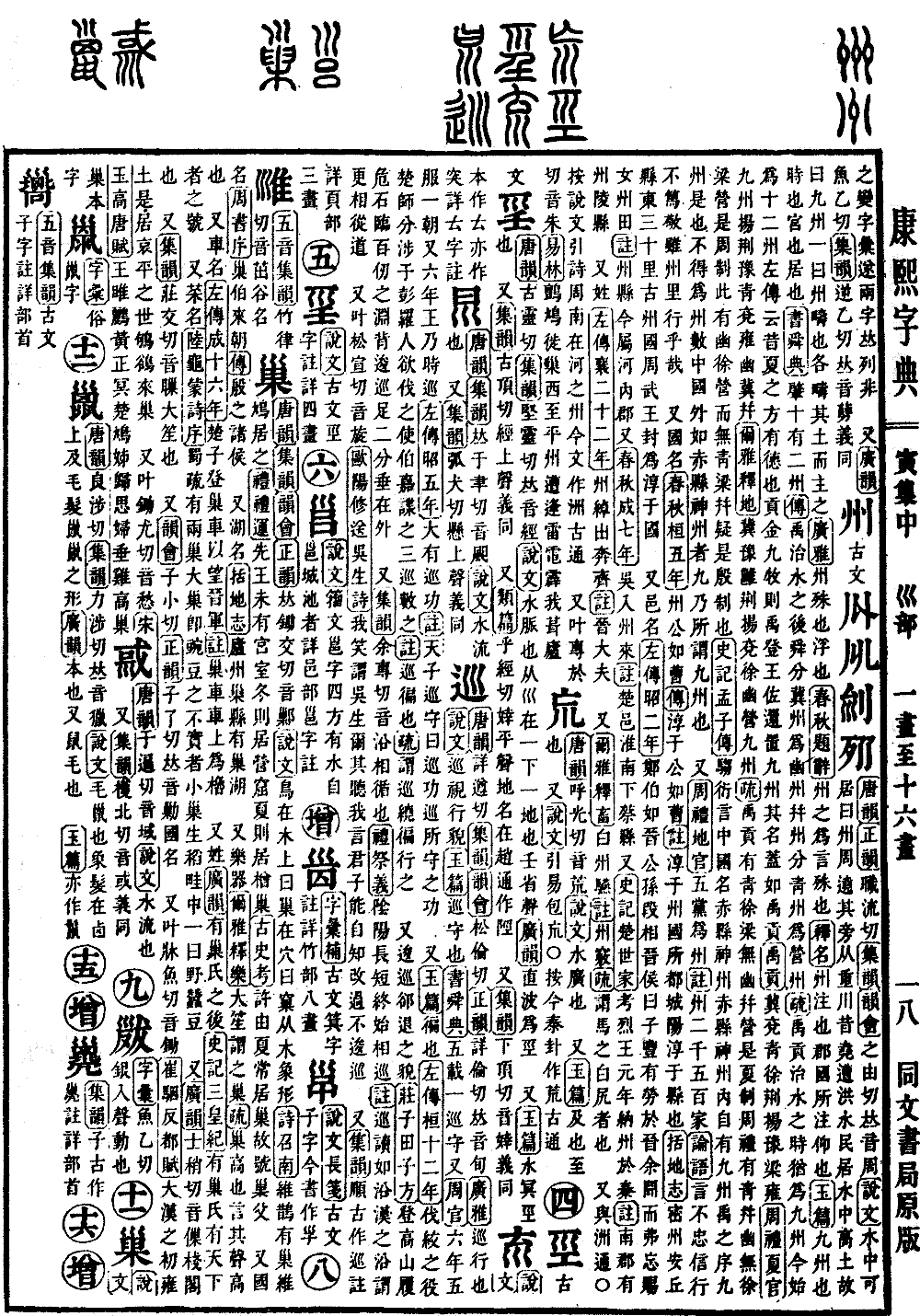
Yin Collection, Middle Volume
Radical: River (chuān)
Page 324, Entry 01
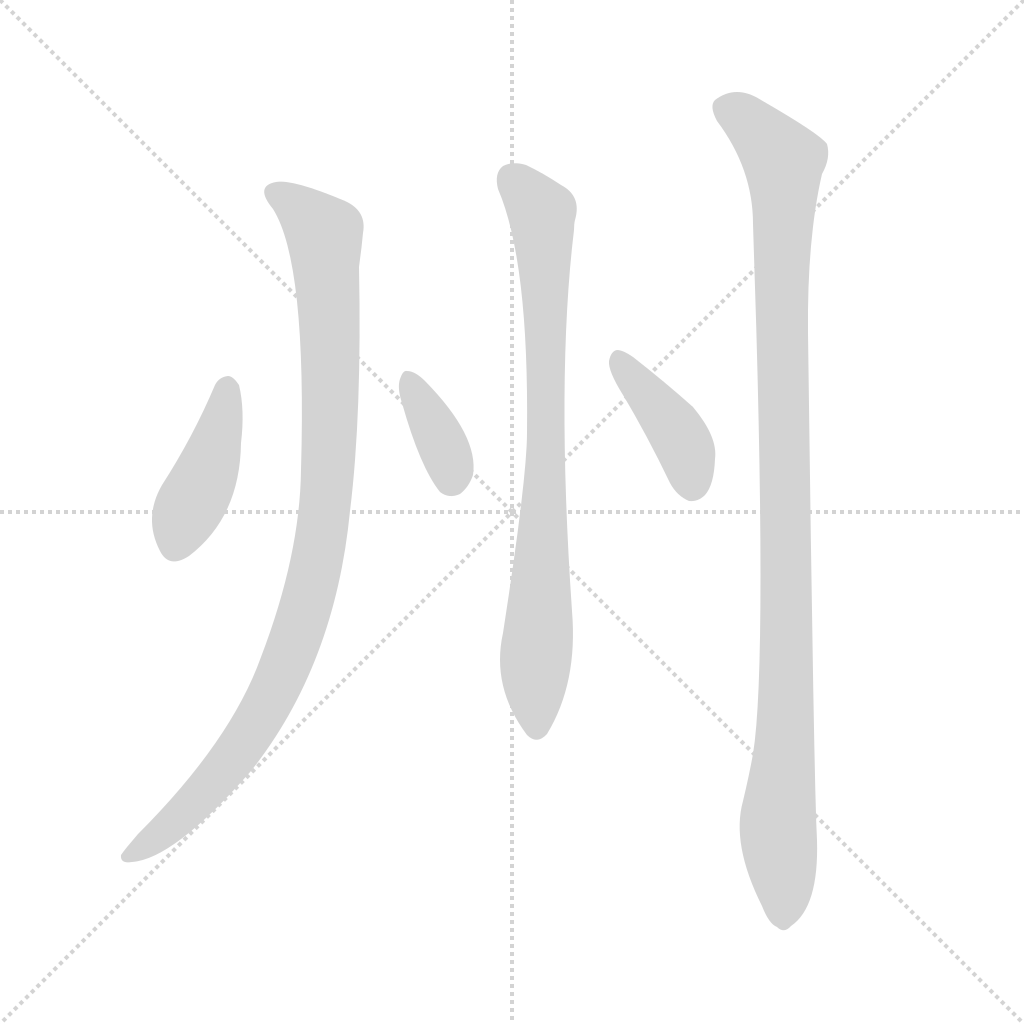
Pronounced zhou.
According to the Explaining Graphs and Analyzing Characters (Shuowen Jiezi), a place in the water where one can reside is called a zhou. Water flows around its sides; the character shape consists of two rivers stacked. In ancient times, Emperor Yao encountered a great flood, and the people lived on high ground amidst the water, hence it is called the Nine Provinces (Jiuzhou). Another explanation: a zhou represents categories, meaning each manages its own land. The Broad Elegance (Guangya) states: a zhou is a distinction, and also means to float or carry. The Spring and Autumn Annals: Exegetical Commentary (Chunqiu Tici) says: the character zhou expresses the meaning of distinction. The Explanation of Names (Shiming) states: a zhou is a gathering place where districts and states look for guidance. The Jade Chapters (Yupian) explains: it refers to the Nine Provinces, and also to seasonal orders, palaces, and dwellings. The Book of Documents (Shangshu), Chapter of Shun states: they began to be divided into twelve provinces. The Commentary explains: after the Great Yu controlled the floods, Emperor Shun divided Ji Province into You Province and Bing Province, and divided Qing Province into Ying Province. The Sub-commentary explains: the Tribute of Yu (Yu Gong) record of flood control still lists nine provinces, and only now does the division into twelve begin. The Commentary on the Spring and Autumn Annals (Zuo Zhuan) says: in the past, when the Xia dynasty had virtue, the leaders of the nine provinces offered tribute of metal. After the Great Yu ascended to the assisting throne, he re-established the nine provinces, with names likely as recorded in the Tribute of Yu. The Nine Provinces recorded in the Tribute of Yu are: Ji, Yan, Qing, Xu, Jing, Yang, Yu, Liang, and Yong. The Rites of Zhou (Zhou Li), Office of Summer, records the nine provinces as: Yang, Jing, Yu, Qing, Yan, Yong, You, Ji, and Bing. The Approaches to Language (Erya), Chapter on Terrestrial Geography, records the nine provinces as: Ji, Yu, Yong, Jing, Yang, Yan, Xu, You, and Ying. The Sub-commentary explains: the Tribute of Yu includes Qing, Xu, and Liang, but lacks You, Bing, and Ying; this was the system of the Xia dynasty. The Rites of Zhou includes Qing, Bing, and You, but lacks Xu, Liang, and Ying; this was the system of the Zhou dynasty. This text (Erya) includes You, Xu, and Ying, but lacks Qing, Liang, and Bing; it is suspected to be the system of the Shang dynasty. The Records of the Grand Historian (Shiji), Biography of Mencius records: Zou Yan said China is named the Red Region Divine Province. Within the Red Region Divine Province there are naturally nine provinces, which are the nine provinces arranged by the Great Yu. These cannot be counted as the total number of provinces. Outside of China, there are nine such places like the Red Region Divine Province; these are the so-called Nine Provinces.
Also, the Rites of Zhou, Office of Earth, records: five neighborhoods constitute one zhou. The Commentary explains: one zhou consists of two thousand five hundred households. The Analects (Lunyu) says: If one's words are not loyal and sincere, and one's conduct is not generous and respectful, can one succeed even within one's own village or district?
Also refers to the name of a feudal state. The Spring and Autumn Annals, Fifth Year of Duke Huan, records: the Duke of Zhou went to the State of Cao. The Commentary explains: the Duke of Chunyu went to the State of Cao. The Commentary adds: Chunyu is where the State of Zhou established its capital, which is the Chunyu County of Chengyang Commandery. The Records of Localities (Kuodizhi) records: the ancient State of Zhou was thirty li east of Anqiu County in Mi Province; King Wu of Zhou enfeoffed it as the State of Chunyu.
Also refers to a city name. The Commentary on the Spring and Autumn Annals, Third Year of Duke Zhao, records: the Duke of Zheng Jian went to the State of Jin, and Gongsun Duan assisted Duke Ping of Jin, saying: Zi Feng has merits for the State of Jin; I heard about this and did not forget it, and have granted you land in the zhou territory. The Commentary explains: this county of Zhou now belongs to Henei Commandery.
Also, the Spring and Autumn Annals, Seventh Year of Duke Cheng, records: the State of Wu attacked Zhoulai. The Commentary explains: it was a city of the State of Chu, located in Xiaca County, south of the Huai River.
Also, the Records of the Grand Historian, Annals of Chu, records: in the first year of King Kaolie of Chu, the territory of Zhou was ceded to the State of Qin. The Commentary explains: there is a Zhouling County in Nanjun.
Also, it is a surname. The Commentary on the Spring and Autumn Annals, Twenty-first Year of Duke Xiang, records: Zhou Chuo fled to the State of Qi. The Commentary explains: he was a high official of the State of Jin.
Also, the Approaches to Language, Chapter on Animals, records: a white zhou is a bin horse. The Commentary explains: zhou refers to the anus. The Sub-commentary explains: this describes a horse with a white rump.
Also, it is interchangeable with the character zhou (islet). According to the Explaining Graphs and Analyzing Characters quoting the Book of Odes (Shijing), Zhou Nan: "on the islet (zhou) of the river," modern versions write it as zhou, which were interchangeable in ancient times.
Also, rhyming variant pronounced zhu. The Forest of Changes (Yilin) records: the hawk and the dove moved their nests, traveling west to Pingzhou. Encountering thunder and lightning, it split my thatched hut.
Verification: In the Commentary on the Spring and Autumn Annals, Second Year of Duke Zhao, it says Duke Zheng went to Jin and Gongsun Duan accompanied him. According to the original text, "Second Year" has been corrected to "Third Year." In the Twenty-second Year of Duke Xiang, it says Zhou Chuo fled to Qi. According to the original text, "Twenty-second Year" has been corrected to "Twenty-first Year."