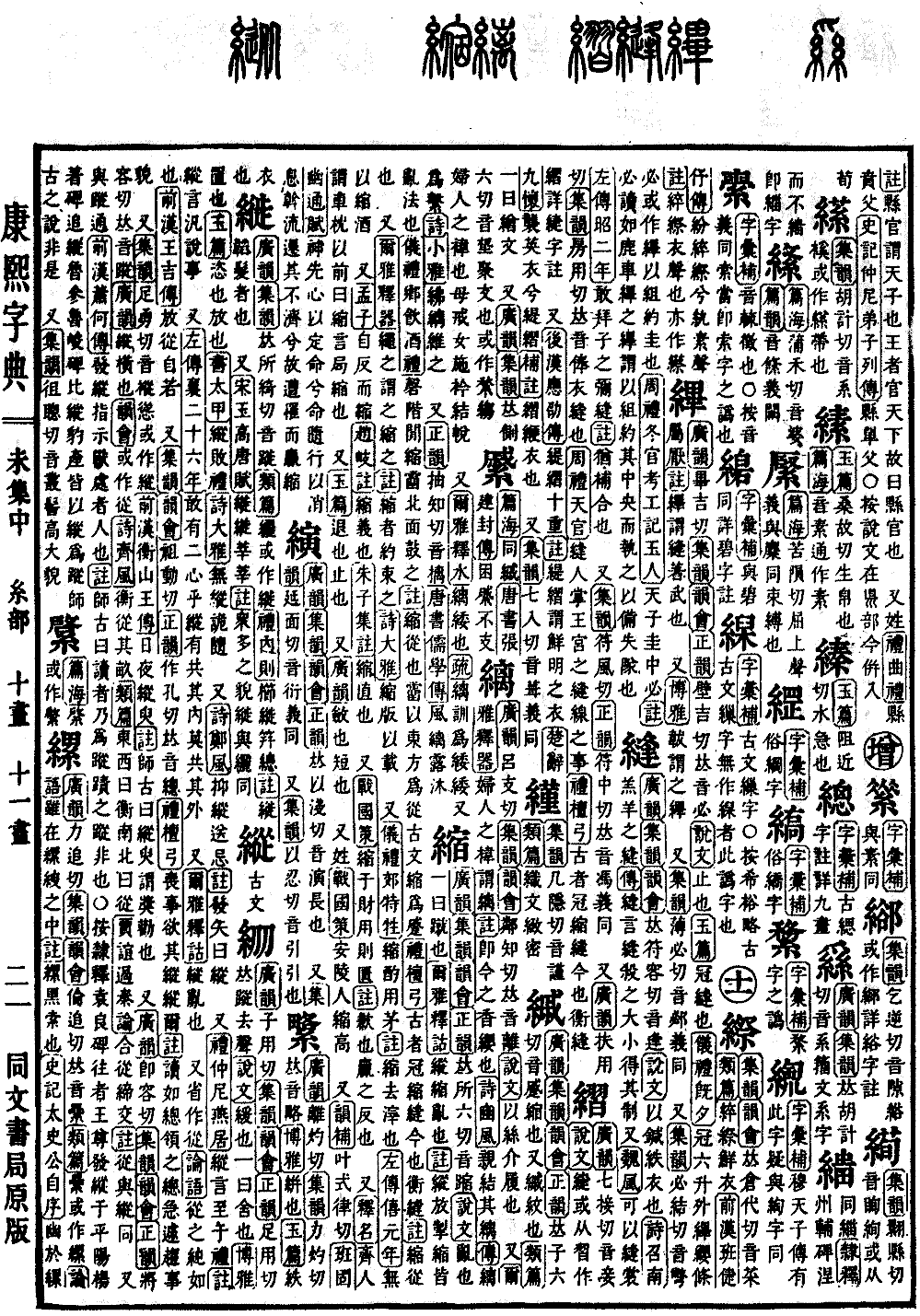
Wei Collection, Middle Volume
Radical: Silk (mì)
纵
Kangxi Stroke Count: 17
Page 935, Entry 01
Ancient form.
Pronounced zòng (falling tone).
Pronounced zòng (falling tone).
Pronounced zōng (falling tone).
Shuowen Jiezi (Shuowen): To loosen. Also means to release.
Guangya: To place.
Yupian: To indulge; to release.
Book of Documents (Shangshu), Chapter Taijia: To indulge in ruining ritual.
Book of Odes (Shijing), Lesser Odes: Do not indulge the treacherous and flattering.
Book of Odes (Shijing), Zheng Feng: To hold back and release. Commentary: To shoot an arrow is called zòng.
Book of Rites (Liji), Zhongni Yanju: To speak freely about ritual. Commentary: Free speech means to discuss matters broadly.
Zuo Tradition (Zuozhuan), 26th Year of Duke Xiang: How could I have divided loyalties? Even if I had them, I would provide for the interior and not for the exterior.
Erya, Shigu: To be in disorder.
Also written in a simplified variant form (cóng).
Analects of Confucius (Lunyu): To follow them purely.
History of the Former Han Dynasty (Hanshu), Biography of Wang Ji: To act indulgent and carefree.
Pronounced zǒng (rising tone).
Book of Rites (Liji), Tangong: In mourning affairs, one wishes to be hasty and urgent. Commentary: Read as the zǒng in zǒnglǐng (to lead or manage). It describes the appearance of rushing to attend to affairs.
Pronounced sǒng (rising tone).
Sometimes written as a variant form (sǒng).
History of the Former Han Dynasty (Hanshu), Biography of the Prince of Hengshan: Encouraging day and night. Commentary: Shigu says that zòngyú means to encourage or incite.
Pronounced zōng (flat tone).
Meaning: Vertical and horizontal.
Sometimes written as a variant form (cóng).
Book of Odes (Shijing), Qi Feng: Plowing fields east-west and north-south.
Leipian: East-west is called héng; north-south is called zòng.
Jia Yi, The Faults of Qin (Guo Qin Lun): To form alliances and establish pacts. Commentary: Cóng is the same as zòng.
Also interchangeable with zōng (footprint).
History of the Former Han Dynasty (Hanshu), Biography of Xiao He: The person who reveals the tracks and indicates where the beasts are is the hunter. Commentary: Shigu says that readers use the zōng of zōngjì (tracks/traces), but that is incorrect. According to the Lishi by Yuan Liang: Wang Zun revealed the tracks at Pingyang. Yang Zhu: Tracking Lu Can. Lu Jun: Comparing the tracks of Leopard's offspring. All these use zòng to mean zōng. Shigu's assertion is incorrect.
Pronounced cóng (flat tone).
The appearance of a high and large hair bun.