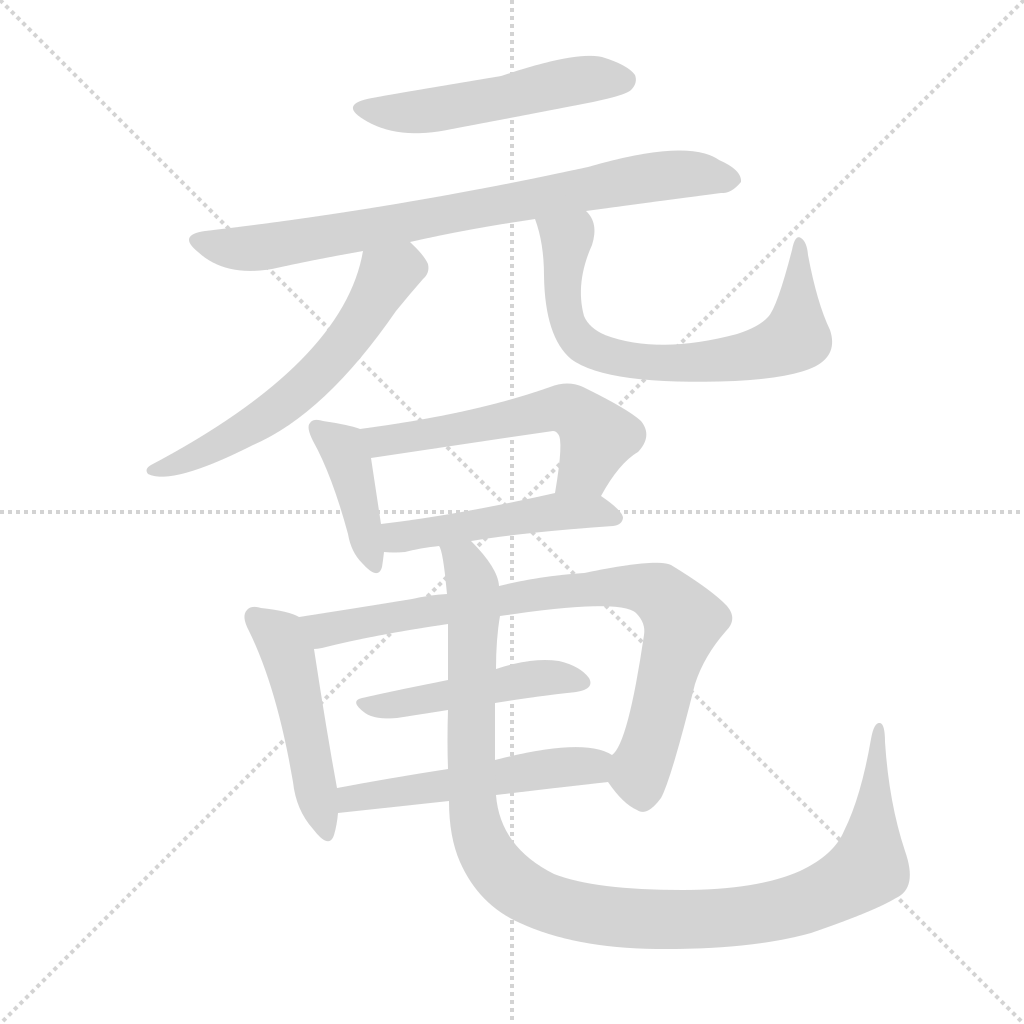
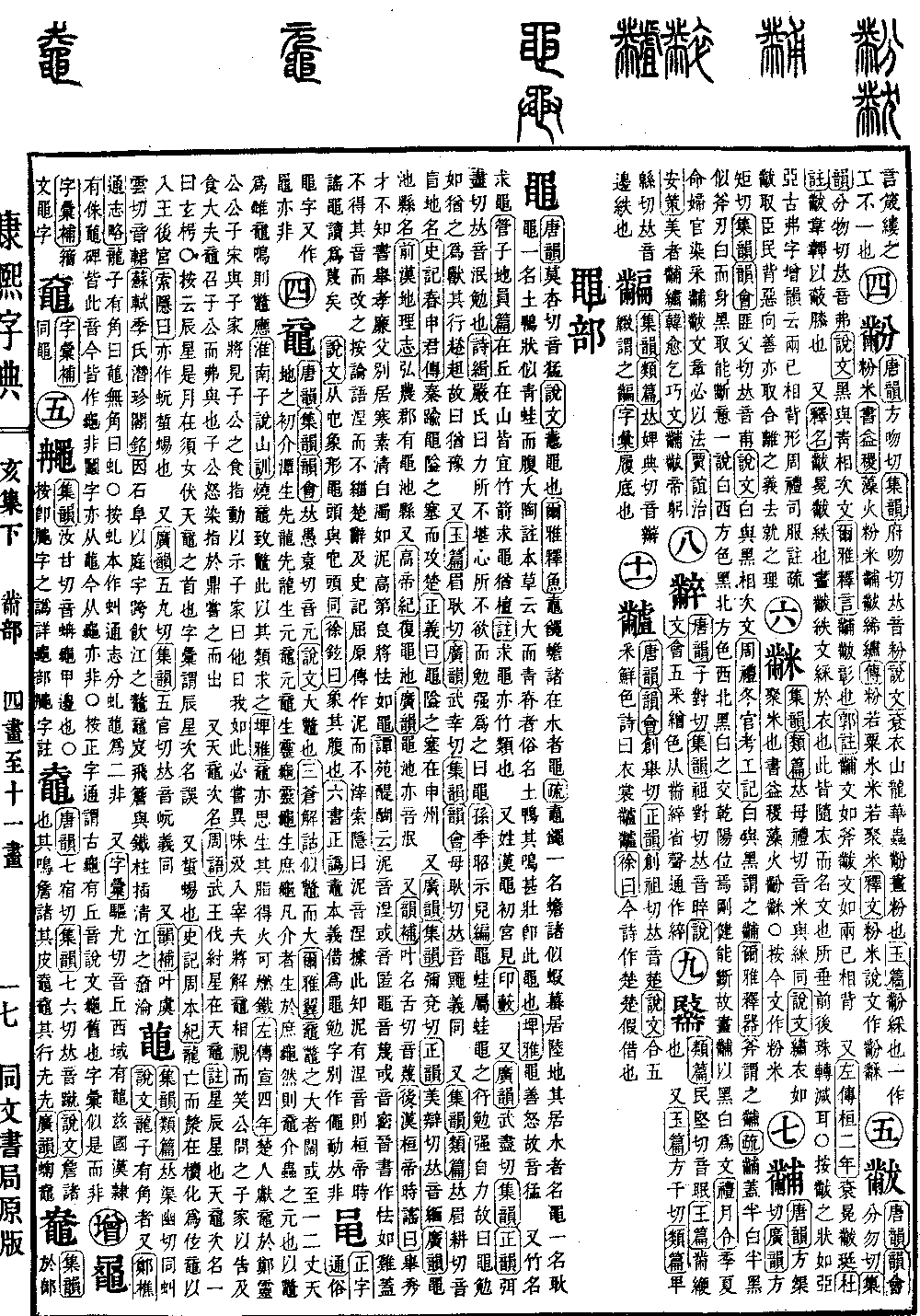
Hai Collection, Lower Volume
Radical: Toad (mǐn)
Kangxi Strokes: 17
Page 1523, Entry 01
Tang Rhymes (Tangyun), Collected Rhymes (Jiyun), and Dictionary of Rhymes (Yunhui) cite the pronunciation as yuan.
Shuowen Jiezi states it means large.
Sancang Jiegu states it is like a soft-shelled turtle but larger.
Erya Yi states: The yuan is the largest of the shelled creatures; some are ten to twenty feet wide. At the beginning of heaven and earth, the aquatic spirits produced the ancestral dragon, the ancestral dragon produced the ancestral yuan, and the ancestral yuan produced the spiritual tortoise, from which all other shelled creatures descended. Thus, the yuan is the progenitor of all shelled insects. It takes the soft-shelled turtle as its mate; when the yuan calls, the turtle responds.
Huainanzi, Discourse on the Mountains (Shuoshun): Burning the fat of a yuan draws them in; this is using its own kind to seek it out.
Piya states: The yuan also desires life; its fat, when ignited, can melt iron.
Zuo Tradition (Zuozhuan), Fourth Year of Duke Xuan: The people of Chu presented a yuan to Duke Ling of Zheng. Prince Song and Ziji were about to see the Duke. The prince's index finger moved, and he showed Ziji, saying, Whenever this happens, I am sure to taste an exotic delicacy. When they entered, the head chef was about to carve the yuan, and they looked at each other and laughed. The Duke asked why, and Ziji told him. When the Duke fed the officials the yuan, he summoned the prince but did not give him any. The prince was enraged, dipped his finger into the pot, tasted it, and left.
Also, Heavenly Yuan is the name of a lunar mansion.
Discourses of the States (Zhouyu): When King Wu attacked the Shang, the stars were in the Heavenly Yuan.
Commentary: The star refers to the planet Mercury. Heavenly Yuan is the name of a lunar mansion. Another name is Xiao. The Lexicon (Zihui) claims it is the secondary name of Mercury, which is incorrect.
Also refers to a lizard.
Records of the Grand Historian (Shiji), Annals of Zhou: The dragon disappeared, but its saliva remained in a cabinet; it transformed into a black lizard and entered the King's inner palace.
Commentary (Suoyin): Also written as a variant form (yuan), meaning lizard.
Guangyun and Jiyun cite the pronunciation as wan. The meaning is the same.
Rhyme Supplement (Yunbu) records an alternate reading as qun.
Su Shi, Inscription for the Hidden Treasure Pavilion of the Ji Family: Resting against the rocky mound to form a courtyard, spanning the tortoises and yuan that drink from the river, the flying eaves and iron pillars are precipitous, piercing the deep, clear river.