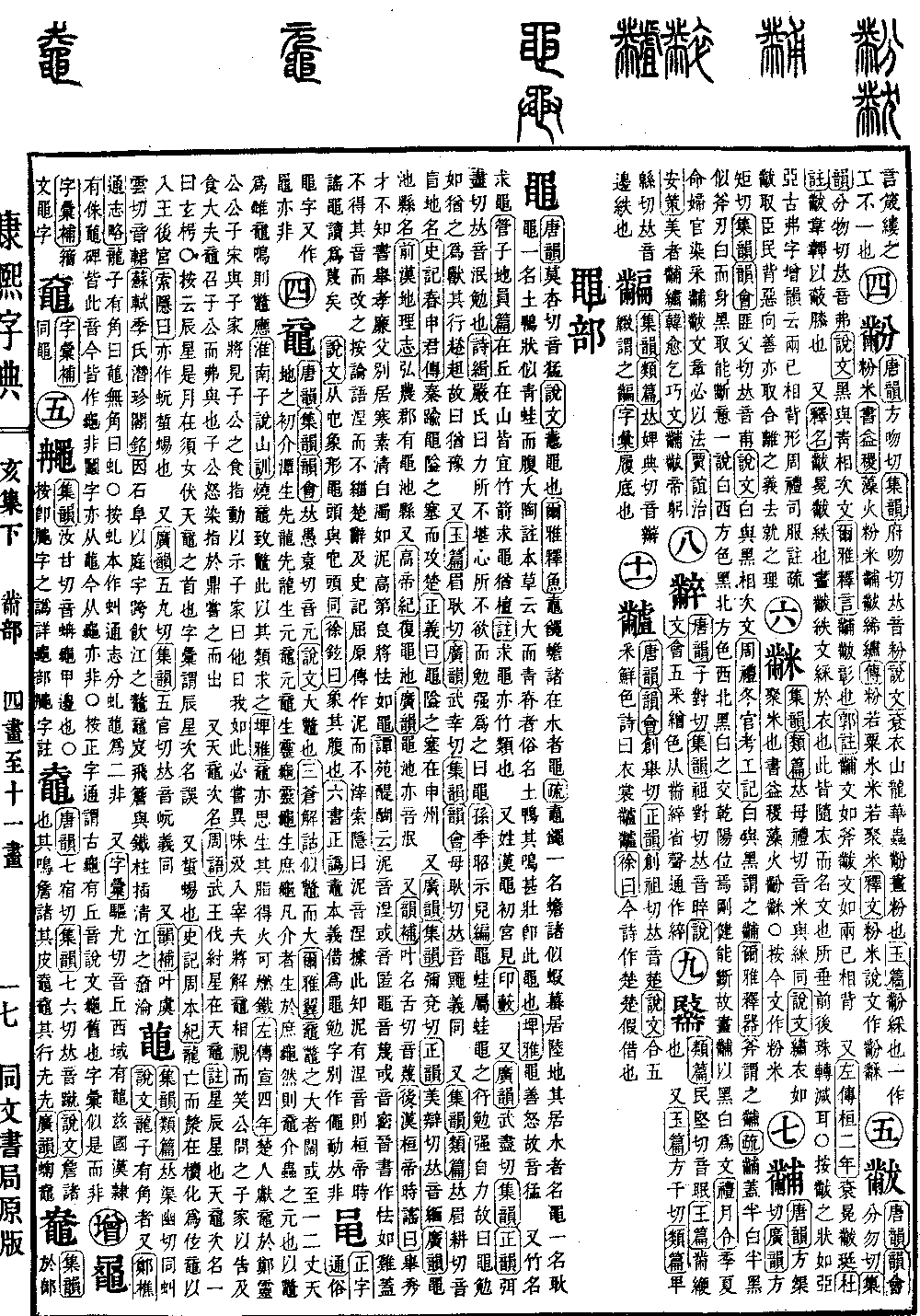
Hai Collection, Lower Volume
Radical: Frog (mǐn)
Kangxi Strokes: 17
Page 1523, Entry 11
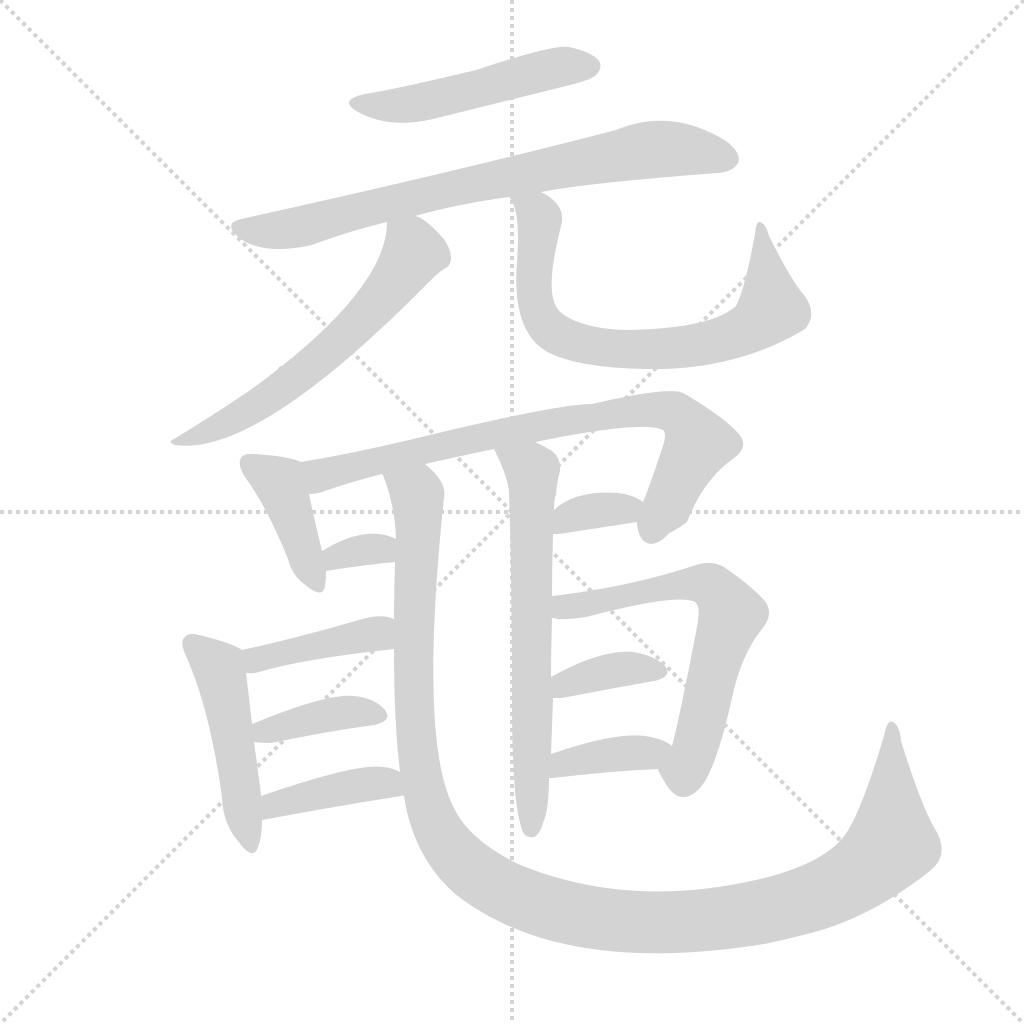
Pronounced yuan. In the Analytical Dictionary of Characters (Shuowen Jiezi), it is defined as a large soft-shelled turtle. In the Exegesis of the Three Cang (Sancang Jiegu), it is described as resembling a soft-shelled turtle but larger. In the Expanded Wings of the Erya (Erya Yi), it is stated that the yuan is the largest among soft-shelled turtles, reaching one or two zhang in width. When heaven and earth first opened, the Jietan spawned the primordial dragon, which spawned the primordial yuan, which spawned the spirit turtle, from which all shelled aquatic creatures descended. Thus, the yuan is considered the ancestor of all shelled aquatic creatures; it mates with the soft-shelled turtle, and when the yuan calls, the soft-shelled turtle responds. In the Book of the Master of Huainan (Huainanzi), specifically the Discourse on Mountains (Shuoshun), it is noted that burning a yuan to attract a soft-shelled turtle demonstrates the principle of attracting one's own kind. In the Augmented Exegesis (Piya), it is said that the yuan desires to multiply, and its fat can melt iron when exposed to fire. According to the Zuo Commentary (Zuo Zhuan), under the fourth year of Duke Xuan, the people of Chu presented a yuan to Duke Ling of Zheng. Prince Song and Zija were about to have an audience. Prince Song's index finger began to twitch, and he showed it to Zija, remarking that whenever this happened, he was destined to taste a rare delicacy. Upon entering, they saw the chef dismembering the yuan and exchanged knowing smiles. The Duke asked the reason, and Zija told him. When the Duke later distributed the yuan meat to the grandees, he summoned Prince Song but denied him a portion. Enraged, Prince Song dipped his finger into the cauldron, tasted the soup, and left. Also refers to Tianyuan, a name for a celestial station. In the Discourses of the States (Zhouyu), it is recorded that when King Wu of Zhou campaigned against the Shang king Zhou, the Year Star (Jupiter) was positioned in the Tianyuan station. The commentary notes that the Year Star is Jupiter, and Tianyuan is a station name, also known as Xuanxiao. The note clarifies that the claim in the Dictionary of Characters (Zihui) that the Year Star is a station name is incorrect. Also refers to a lizard. In the Records of the Grand Historian (Shiji), specifically the Basic Annals of Zhou, it is mentioned that the dragon disappeared, but its saliva remained in a box, transforming into a black yuan that entered the harem of King Li of Zhou. The commentary (Suoyin) states it is also written with the character yuan (lizard), meaning a lizard. Pronounced wan. The meaning is the same. Also rhyming with yun, pronounced qun. In the Inscription for the Qianzhen Pavilion of the Ji Family (Ji shi qianzhen ge ming) by Su Shi: Relying on the stone mountain to build courtyards and pavilions, spanning the giant sea turtles and yuan in the river, the towering eaves and iron pillars pierce the deep, clear waves of the river.