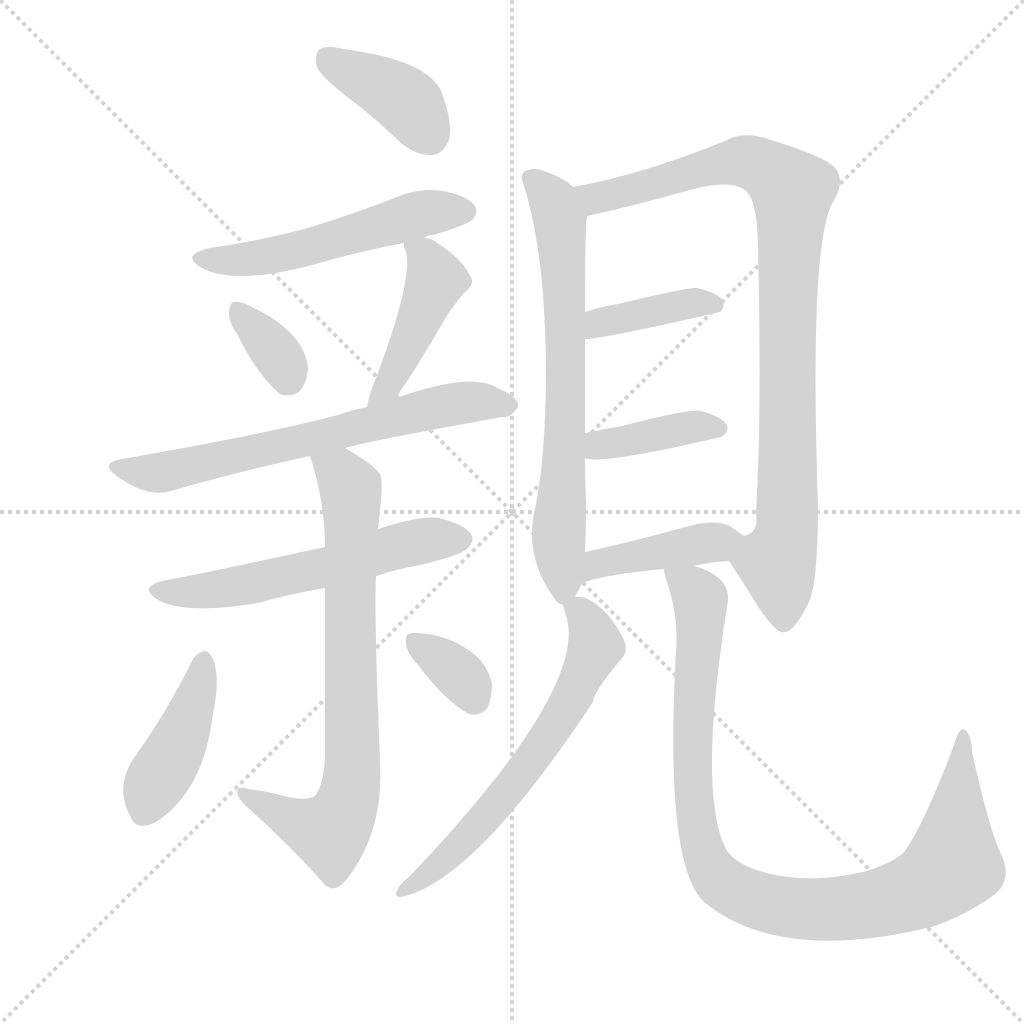
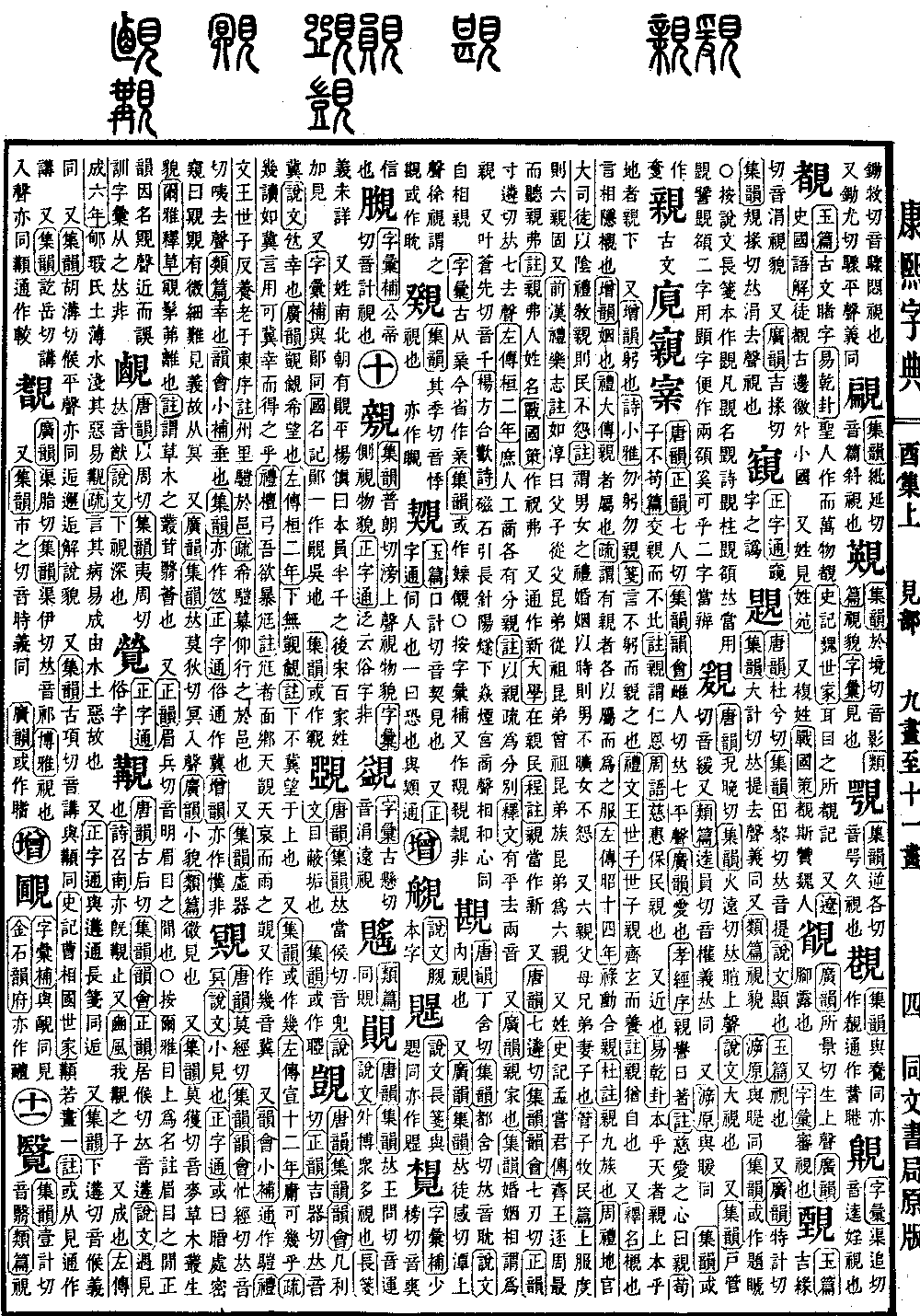
You Collection, Upper Volume
Radical: See (jiàn)
Kangxi Strokes: 16
Page 1136, Entry 12
Ancient form: Qin.
Pronounced qin (level tone).
Tang Rhymes (Tangyun) and Correct Rhymes (Zhengyun) read it as qin, and Collected Rhymes (Jiyun) and Rhyme Collection (Yunhui) read it as qin.
In the Broad Rhymes (Guangyun), it means to love.
In the Preface to the Classic of Filial Piety (Xiaojing Xu), it says: Praise for those we love becomes known daily.
The commentary states: A heart of compassionate love is called qin.
In the Xunzi, Non-Rigidity chapter, it says: Associate with those you love but do not be partial.
The commentary states: Qin refers to benevolent grace.
In the Discourses of Zhou (Zhouyu), it says: Compassionate and kind, protecting the people, this is qin.
Also, it means near.
In the Book of Changes (Yijing), Qian hexagram: That which is rooted in heaven is near to what is above, that which is rooted in earth is near to what is below.
Also, as stated in the Supplemented Rhymes (Zengyun), it means oneself.
In the Book of Odes (Shijing), Lesser Odes (Xiaoya): Do not do it in person, do not do it yourself.
The commentary says: This means not doing it in person, but rather doing it oneself.
In the Book of Rites (Liji), Hereditary Princes of King Wen: The heir apparent personally fasts and provides nourishment.
The commentary states: Qin here means self.
Also, in the Explanations of Names (Shiming), it means to undergarment. It means to cover or shield one another.
As stated in the Supplemented Rhymes (Zengyun), it means marriage.
In the Book of Rites (Liji), Great Record: Those who are close are relatives.
The commentary states: This means those who have kin, each with their associated rank for whom one wears mourning attire.
In the Zuo Commentary (Zuozhuan), 14th year of Duke Zhao: Confer merit to unite the kin.
Du Yu’s commentary states: Qin refers to the nine degrees of kin.
In the Rites of Zhou (Zhouli), Earth Officer, Grand Minister of Instruction: Using the rites of yin to teach the kin, the people will not hold grievances.
The commentary states: This refers to the rites between men and women; if marriage occurs at the proper time, then men are not without partners and women are not resentful.
Also, the six degrees of kin are father, mother, elder brother, younger brother, wife, and children.
In the Guanzi, Shepherd of the People chapter: When superiors follow the standards, the six degrees of kin remain stable.
Also, in the commentary to the History of the Former Han (Qianhan Shu), Treatises on Rites and Music, Ru Chun states: Father and son, brothers from the same father, brothers from the same grandfather, brothers from the same great-grandfather, and brothers from the same clan are the six degrees of kin.
Also, a surname.
In the Records of the Grand Historian (Shiji), Biography of Lord Mengchang: The King of Qi banished Zhou Zui and listened to Qin Fu.
The commentary states: Qin Fu is a person’s name.
In the Strategies of the Warring States (Zhanguo Ce), it is written as Zhu Fu.
Also, often used interchangeably with the character meaning to renew.
In the Great Learning (Daxue): To renew the people.
The Cheng commentary states: Qin should be written as renew.
Also, pronounced qin (departing tone).
In the Zuo Commentary (Zuozhuan), 2nd year of Duke Huan: Commoners, laborers, and merchants each have their own degrees of kin.
The commentary states: This distinguishes between those who are close and those who are distant.
The Explanation of Characters (Shiewen) notes there are both level and departing tone pronunciations.
Also, in the Broad Rhymes (Guangyun), it refers to a spouse’s family.
In the Collected Rhymes (Jiyun), marriage partners calling each other is called qin.
Also, rhyming with the character for qian, pronounced qian.
In Yang Fang’s Poem on Joyous Union: The lodestone attracts the long needle, the sun-mirror brings down the scorching smoke; the sounds of the palace and commercial scales harmonize with each other, and when hearts are the same, they naturally feel close to one another.
The Compendium of Characters (Zihui) states that anciently it was written with the component for clan. Now it is simplified to the current form.
The Collected Rhymes (Jiyun) says it is also written as variant forms.
Note: The Compendium of Characters (Zihui) supplement also writes it differently, which is incorrect.
Textual research: In the Book of Odes (Shijing), Lesser Odes (Xiaoya), it was written as do not do it in person, do not do it yourself. It has been corrected to follow the original text as: Do not do it in person, do not do it yourself.